Alicia Davis: The Underdog Candidate for Texas House District 21 Ready to Bring Real Change
In a bid to unseat the incumbent representative Dade Phelan for Texas House District 21, Alicia Davis, a 7th generation Texan and lifelong resident of Jasper County has announced her bid for the Republican primary.

House Speaker Dade Phelan has a challenger with real potential to take his seat.
JASPER COUNTY, TEXAS — In a bid to unseat the incumbent representative Dade Phelan, a fresh face is emerging in the race for Texas House District 21, and her name is Alicia Davis. A 7th generation Texan and lifelong resident of Jasper County, Davis declared her candidacy on June 7th, setting the stage for an underdog’s journey to give voice to the “real people” of her district.
Davis, a self-proclaimed “regular blue-collar hardworking taxpayer,” is on a mission to challenge the status quo and represent the everyday citizens who feel ignored by their elected representatives. Her campaign is founded on core conservative values that she believes are under attack.
“Texans who do not reside in our district or those simply seeking vengeance or to climb a political ladder don’t quite understand that this is not just about ‘getting rid’ of Dade Phelan or a speakership,” Davis explains. “Our Conservative values are under attack, and the real people of our district have had no voice, no representation, or anyone standing up for us—except for me.”

Davis’s background is far from the typical political resume. She is not a career politician and did not come from a wealthy or influential family. Instead, she has spent her life working as a postal worker, a small business owner, and even raising Basset Hounds. Her commitment to advocacy blossomed during her retirement, fueled by the frustrations of being “taxed into poverty” by what she calls an “overreaching government.”
Her husband, Hubert Jr. (Hubie), has been an electrician at the local paper mill for three decades, and together, they have raised two sons. Her life experiences have shaped her perspective, motivating her to stand up for the rights and freedoms of everyday people.
“I’m just like most of y’all,” she says. “I am fed up with being ignored, discredited, and disrespected by my elected representatives.”
Davis’s campaign stands out for its refusal to rely on big campaign donations or political endorsements. Instead, she relies on the support and blessings of the very people she aims to represent. “I am one of the rare ones who cannot be bought and who has to actually earn their votes,” she states proudly.
One of the central issues Davis is known for is her relentless advocacy to eliminate property taxes and challenge what she calls the “TX CAD Mafia” (County Appraisal Districts). Her extensive research and investigation into this matter have exposed significant fraud, corruption, and discrimination within the system. Her efforts have not only yielded media attention but have also helped thousands of people protest their property tax appraisals for free.
Davis acknowledges that her campaign is not the typical political run, but she draws inspiration from historical figures who were also “outsiders and underdogs,” such as Roosevelt, Reagan, and Trump. She emphasizes that her campaign is about the people she serves and their rights.
As the race for Texas House District 21 heats up, Alicia Davis continues to rally support from everyday Texans who share her vision for change. Her campaign is not about politics as usual but about representing the “real people” who have long felt forgotten. As the March 5th election date approaches, her message is clear: “I have been the ONLY one that has actually gone to war for us when I wasn’t being paid to or didn’t even have to.”
With the spirit of a true Texan, Alicia Davis seeks to follow in the footsteps of her ancestor, the legendary David Crockett, by standing up for what’s right, speaking up for the little man, and fighting for the people she serves.
For more information about Alicia Davis you can download her Press Release, visit her Facebook page, or donate to her campaign on her website at: www.aliciafortexas.com







Fate, TX – The race to fill the vacant Fate City Council Place 1 seat vacated by the recall of Codi Chinn, will consist of four candidates. Randy Long, Stephanie Delaine Adams, Joshua Martin and Donovan Heinrich.
Randy Long is a serves as the Rockwall County director for True Texas Project, a conservative grassroots organization.
Stephanie Delaine Adams served 12 years on the Rockwall ISD Board of Trustees, including two years as board president from 2017 to 2019. She is now a Realtor.
Joshua Martin has lived in Fate for approximately six years and is a recruiting manager with QXO. He previously served as president of the Old Shepard Place neighborhood association in Plano.
Donovan Heinrich previously ran for Fate City Council, Place 5, in 2021, receiving 288 votes, or 30.48%, against eventual winner Jim DeLand.
More to follow on each candidate in the upcoming days.
Election
Texas Senate Hopeful James Talarico Shared Pride Event Stage With 11-Year-Old Child Drag Performer

Federal Court Upholds State Limits on Minors at Adult Drag Shows
Taylor, TX – A federal appeals court has just upheld a Florida law restricting minors from attending certain adult live performances, including some drag shows. Within hours of that ruling, renewed attention was focused on Texas Democratic U.S. Senate candidate James Talarico after reports resurfaced showing he headlined a 2021 Pride fundraiser featuring an 11-year-old child drag performer promoted as one of the event’s main attractions.
On Tuesday, the U.S. Court of Appeals for the 11th Circuit ruled in HM Florida-ORL, LLC v. Secretary of the Florida Department of Business and Professional Regulation, allowing Florida to enforce its law restricting minors from attending certain adult live performances. Florida Attorney General James Uthmeier announced the decision, calling it a victory for protecting children. The ruling does not prohibit drag performances for adults, but it recognizes that states may impose limits when minors are involved.
The timing has drawn renewed scrutiny to Talarico’s record as he campaigns for the U.S. Senate against Texas Attorney General Ken Paxton.

According to promotional materials first highlighted by the Washington Free Beacon, Talarico was a featured speaker during Taylor PRIDE’s June 26, 2021 fundraiser in Taylor, Texas. The event was organized to raise money for “rural LGBTQ communities” and included live music, Drag Story Hour, adult drag performers, and an 11-year-old performer using the stage name “Kween Kee Kee.”
Taylor PRIDE advertised the child as “the absolute cutest & youngest of our drag performers.” Promotional posts stated the child would perform a drag routine and host “Kee Kee Storytime,” where children would participate in Pride-themed craft activities. The event was held at Texas Beer Company.
Photographs published from the event show Talarico addressing attendees from the stage and posing with participants. Additional photographs and video posted publicly show Kween Kee Kee, a local preteen named Keegan, performing in a shimmering blue dress, platinum blonde wig, and theatrical makeup during what organizers described as a Youth Drag Show. One attendee shared video of the child performing the splits before the audience.
The fundraiser also featured several adult drag performers, including Brianna Brinxx, Belladonna Dior, Felecia Enspire, and a performer using the stage name Sedonya Face.
Following criticism from conservative activists who protested the event, Taylor PRIDE defended the festival on social media. The organization rejected claims that the event was sexually explicit or exploitative and encouraged the public to review photographs from the event and decide for themselves.
Talarico’s campaign did not respond to requests for comment from the Washington Free Beacon regarding his participation.
The resurfaced event adds to a broader record that Republicans have highlighted throughout Talarico’s political career. While serving in the Texas House, Talarico opposed legislation restricting drag performances in the presence of children and argued lawmakers should avoid harming what he described as Texas’ drag performers. He has also opposed Republican-backed legislation restricting certain transgender medical treatments for minors and has frequently spoken in support of LGBTQ causes.
More recently, however, Talarico has attempted to present himself as a more moderate statewide candidate. He has described previous remarks, including referring to God as “nonbinary,” as “cringey” and has removed some progressive messaging from campaign materials as he seeks to broaden his appeal beyond Democratic primary voters.
The renewed attention comes as cultural debates surrounding children and drag performances continue playing out both politically and legally. Florida’s appellate court victory represents one of the most significant recent rulings supporting a state’s authority to restrict minors from attending certain adult-oriented live performances, even as litigation over similar laws continues elsewhere.
Council
Fate Council Opens the Door on Executive Session Secrets, Revealing Why Greenberg Was Cleared

Fate, TX – Monday night’s Fate City Council meeting pulled back the curtain on something that had puzzled residents for weeks.
Why would four members of the council vote against finding an ethics violation or imposing sanctions against Mayor Andrew Greenberg after attorney Ross Fischer had concluded there was probable cause to believe Greenberg may have violated the city’s code of ethics?
The answer, it turns out, was hidden behind deliberative privilege that some members of the Fate City Council didn’t want you to know about.
City Council Meeting for June 15, 2026, Agenda items 6G and 6H called for the council to consider waiving attorney-client privilege concerning ethics complaints involving Mayor Andrew Greenberg, former Councilman Mark Harper, and former Councilwoman Codi Chinn… for the June 1st meeting. The council voted 4-2 to waive deliberative privilege and allow discussion of what had previously occurred behind closed doors.
The June 1 vote had left many residents, particularly those of Karen Keiser, who supported the recall effort against Greenberg, confused. Council members had voted 4-2 not to pursue sanctions or make findings of an ethics violation, with Councilman Allen Robbins and Councilwoman Ashley Rains voting in the minority.
What the public, and Mrs. Keiser, didn’t know was that in executive session, there was great disagreement about the Ross Fischer report.
According to a phone interview Pipkins Reports had with Mayor Greenberg on Tuesday, one of the central issues involved allegations that he had improperly disclosed confidential employee information concerning former City DPS Chief Lyle Lombard to this investigative journalist, by releasing audio of a phone conversation he had with Councilwoman Codi Chinn.
In a conversation with Greenberg on Tuesday, Greenberg said that attorneys within the Texas Attorney General’s Office had previously determined that only three minutes (approximately) of an audio recording between Greenberg and Chinn contained personal or confidential information, none of which formed the basis of these ethics allegations as stipulated by Fischer.
Greenberg further argued that Fischer’s conclusions relied on assumptions rather than evidence showing that any “deliberative” information had actually been provided. Even more, Mr. Fischer refused to seek guidance from the Attorney General to determine if any of his assertions about confidential information were actually “deliberative”.
For context, the words, “deliberative information” are in reference to any “confidential” information that city officials might discuss regarding a city employee. But not all information about an employee is to be considered “confidential”, and this is a very important point of the discussion.
Under the Texas Public Information Act (Government Code Chapter 552), information concerning public employees is presumed public unless a statute or recognized exception applies. Merely discussing an employee does not make the information “deliberative” or “confidential”, unless and until the city requests and receives an exemption from the Attorney General. In this case, none of the information alleged by Mr. Fischer was determined by the Attorney General to be “confidential” or permitted to be withheld.
Sidebar: How did Autumn Lobinsky know what was in those three minutes that were never released to the public?
Texas Government Code §552.111 protects certain interagency and intra-agency memoranda reflecting advice, recommendations, opinions, and policymaking discussions. This is often called the “deliberative process privilege.”
However, the exception generally applies only to communications involving policymaking, not routine personnel matters. The Texas Attorney General has repeatedly distinguished between:
- Policy deliberations → potentially protected.
- Routine administrative or personnel matters → generally not protected.
Thus, discussions about: performance evaluations, discipline, complaints, hiring decisions, salary matters, are not automatically considered to be “deliberative information.”
Therefore, the Council Members argued in executive session that Fischer failed to make the case that the information exchanged met those qualifications.
Furthermore, Fischer’s investigation provided no other corroborating evidence.
Emails between Michael Pipkins and Ross Fischer show that Fischer sought information from Pipkins concerning the investigation. In a May 27 email, Fischer volunteered to Pipkins that Greenberg had acknowledged allowing Pipkins access to the recording, and asked whether Greenberg had provided a copy or merely played portions of the audio.
(Would Fischer’s release of information to Pipkins about his conversation with Greenberg be a release of confidential information? )
Regardless, Pipkins declined to answer, citing journalistic policy and the protection of confidential sources absent a subpoena or court order. Fischer then acknowledged to Pipkins that Greenberg had admitted playing portions of the recording and indicated he was attempting to verify Greenberg’s account. Part of this exchange was cited in Fischer’s report. We are providing the full context of the email exchange below.
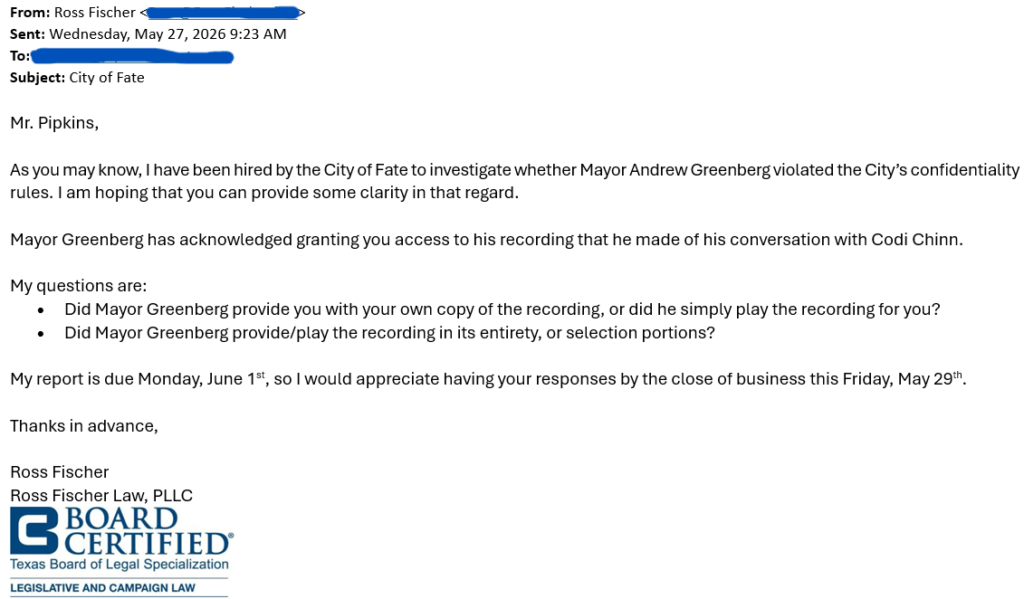
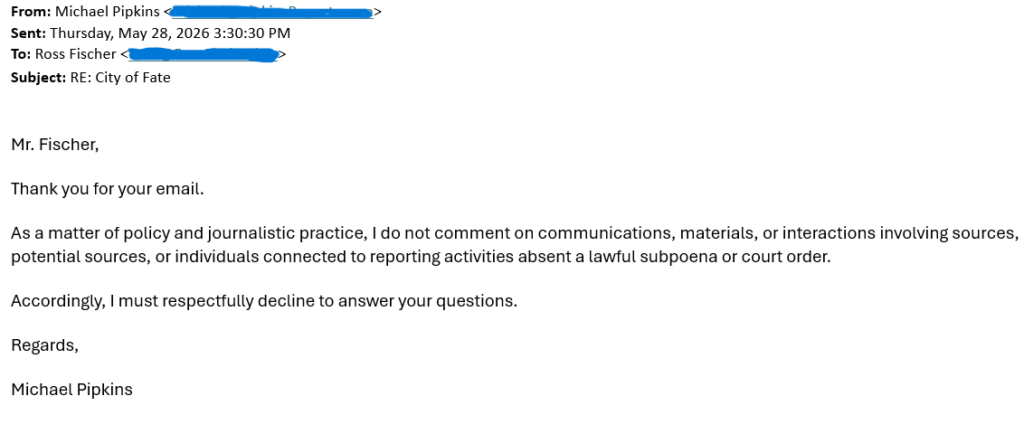
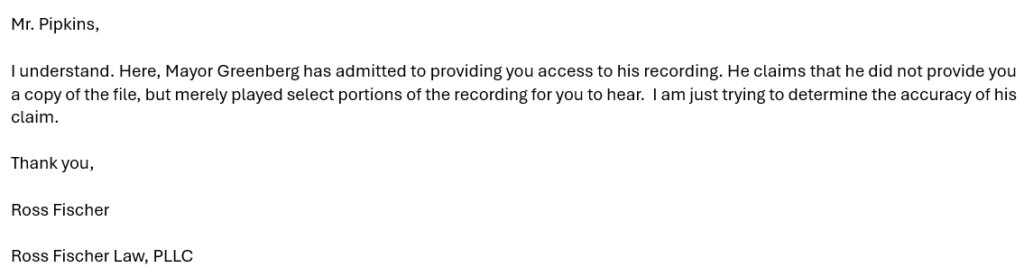
[Email Exchange Between Ross Fischer and Michael Pipkins]
According to Greenberg, no evidence was produced showing that any of the information disclosed by Greenberg was in fact, “deliberative information” (ie: confidential). Yet, Mr. Fisher’s report would go on to recommend that he violated the City’s Code of Ethics, regardless of the actual fact that none of the information had been, or would be, considered privileged.
“Conclusion. Assuming Mayor Greenberg’s response is accurate, he still released deliberative information about personnel decisions a month before Council waived that
privilege. Based on Mayor Greenberg’s admissions alone, there is credible evidence that he violated Section 2-309(6) of the City’s Code of Ethics.”
Ross Fischer Report
[Copy of the report by Ross Fischer. ]
Armed with information that the report was potentially faulty, four members of the council ultimately voted against finding a violation or imposing sanctions against Greenberg. Now we know why the council voted the way they did.
Meanwhile, another controversy emerged during public comments in the June 15th meeting.
Residents Lance and Lorne Megyesi addressed the council concerning the ongoing recall effort. While Lorne attempted to chastise and lecture the council, Lance cited Sections 3.06 and 3.10 of the City Charter and argued that government could continue functioning even if four council members are removed in November.
Section 3.06 clearly states that a quorum must consist of four council members. while Section 3.10 indicates that a majority of the council is considered a quorum.
“Governments cannot be allowed to collapse due to vacancies,” Megyesi told the council.
Megyesi argued that a group smaller than the normal quorum would possess limited authority to restore a quorum through appointments or by ordering an election. He further stated that a Texas Attorney General opinion supported that position, though he provided no opinion number or supporting document to substantiate his claim, and the evidence discovered by Pipkins Reports, indicates the exact opposite.
As a relevant sideline, former Mayor David Billings recently advanced a similar argument in a Rockwall Times opinion piece titled “The City Will Go On,” arguing that a successful recall would not halt Fate city government.
That assertion, however, has drawn criticism from residents who argue that elected offices are far more than ceremonial titles, as the former “retired” mayor would suggest.
Under Section 2.09 of the City Charter, the City Council possesses authority to compromise and settle claims and lawsuits involving the city. (ie: Wrongful Termination Lawsuits). Section 2.13 authorizes the council to require bonds from city officials and employees. (ie: New hires) The council also possesses authority over appointments and hiring decisions involving key city personnel.
Critics note that if a loss of quorum persisted and the city manager, city secretary, or city attorney departed unexpectedly, there would be no mechanism for replacing those positions without council action. And without a quorum, that simply can’t happen.
The mayor’s office also carries real statutory responsibilities beyond just presiding over meetings.
Under Section 32-45 of the city code, the mayor serves as floodplain administrator or appoints a designee. In addition, Section 10-20 establishes the mayor as the city’s emergency management director. What happens if the City suffers a natural disaster?
Billings argues that essential functions of government would continue and that legal mechanisms exist to preserve continuity. Opponents counter that continuity and normal governance are not the same thing.
Consider the precedent of the 2004 Haltom City recall, where the recall and loss of a quorum of five of seven council members effectively halted normal council operations for three months (Feb – May) until elections restored the vacancies. In that situation, Attorney General Opinion GA-0175, concluded that recalled officials did not hold over and that the city effectively was without a quorum until elections restored the vacancies.
Haltom City’s Charter is not that different to that of Fate.
Critics of the recall note that Fate could face an even longer period of uncertainty. If four members were removed in November and vacancies were not filled until the next uniform election date in May, the city could potentially spend roughly six months without a fully functioning council… unless a district judge were to step in and order an election.
While day-to-day city services would likely continue, critics argue that Billings characterizing the loss of a majority of the governing body as little more than an inconvenience understates the practical consequences. Settlements, appointments, policy decisions, and unforeseen emergencies do not operate on election calendars.
And while contingency plans can be devised for almost anything, critics contend that improvisation in the middle of a crisis is hardly the same thing as having a fully functioning government.
Government may survive without a quorum. Haltom City proved that. But survival and governance are not the same thing, and it is the citizens who will suffer by being caught in the middle.
Opinion
There is something remarkable about the coalition that has formed around the effort to remove Mayor Andrew Greenberg and three sitting council members, Mark Hatley, Martha Huffman and Rick Maneval.
Councilwoman Ashley Rains and Councilman Allan Robbins support the effort. Former Mayor David Billings supports the recall and uses his platform to assert that the city government would continue uninterrupted after a successful recall. Former Councilman Lance Megyesi and his brother, former Mayor Lorne Megyesi, support the recall and have publicly discussed their own legal theories concerning how a reduced council might restore a quorum through “appointments”. Former Councilman Mark Harper and former Councilwoman Codi Chinn have likewise remained active voices in the city’s political battles.
Residents can draw their own conclusions, but the cast of characters is familiar. These are all current and former officeholders; they are all political allies; they are all responsible for the current state of social unrest as well as the development disaster that grips Fate at this time. And they have all united in a common cause to oust the current council and restore their power. They appear to be, to a common observer, as bitter, angry individuals hell-bent on revenge. Their childish antics on social media and feigned outrage at the podium are proof of that.
Make no mistake, these are not strangers united by coincidence. They are experienced political figures with a common bias and a shared interest in their vision of the future direction of the city. A vision that does not match that of the current council majority. In my opinion, citizens are witnessing an orchestrated coup in real time. Many people don’t even know that they are being manipulated by a group of washed-up, failed politicians.
Supporters of the recall have been convinced that they are trying to save Fate from an unethical council. And supporters of the current council argue the exact opposite. They see the current recall effort and false ethics complaints as an attempt by a network of present and former officials to reverse political defeats that occurred at the ballot box.
Why is it that the new and former members of the Council consistently advocate for Less Open Government, instead of More Open Government? Why are their supporters so angry and hateful on social media?
One fact should concern every voter, regardless of whose sign sits in their front yard.
This group organizing the recall is already trying to steer the conversation away from whether four officials should be removed to what happens afterward, how a quorum could be restored, and what powers a reduced council might possess. That is not an academic debate. It is a debate about who governs. And they are positioning themselves to be “appointed” to fill that gap.
And that’s where citizens should become very skeptical.
Because in a republic, political power is supposed to flow from elections, not from creative interpretations, procedural maneuvers, or the hope that voters won’t notice the difference.
The people of Fate have every right to vote to remove elected officials, or to retain them, as they see fit when they go into the polling place.
But when people go into that voting booth, they should take stock of which side has been fighting for actual transparency, reporting facts, and working to do what is right for the citizens, and which side is for keeping things behind closed doors, acting like children … and trying to stir up anger among the citizens.
You must be logged in to post a comment Login