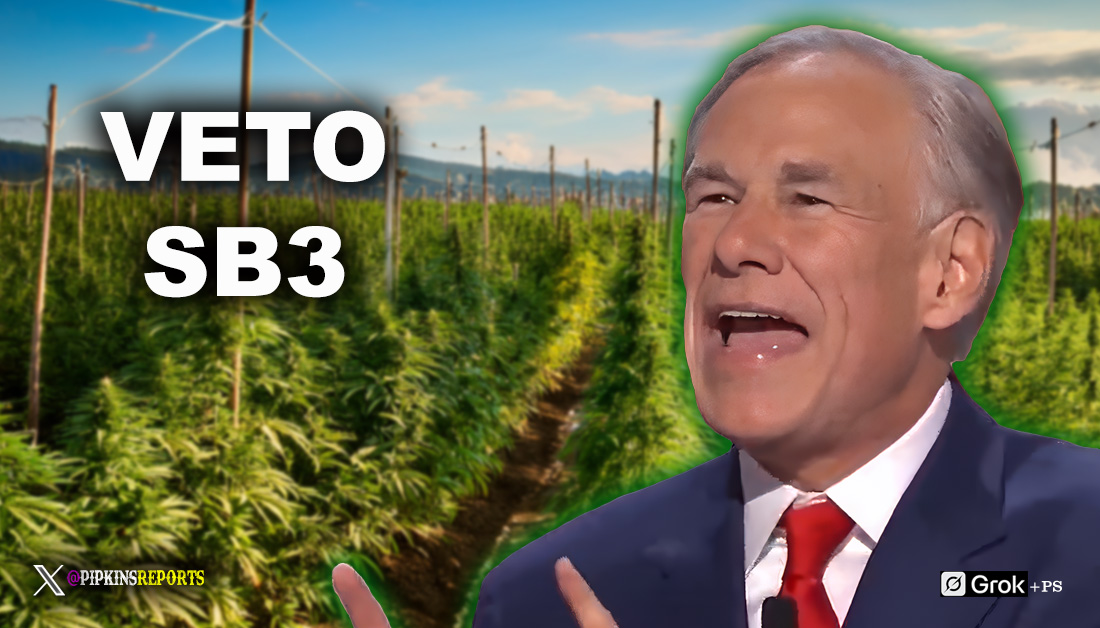
Abbott’s Veto of SB3 Saves Texas Hemp Industry, Sparks Battle Over Regulation
In a dramatic eleventh-hour move, Texas Governor Greg Abbott vetoed Senate Bill 3 (SB3) late Sunday night, June 22, 2025, sparing the state’s $8 billion hemp industry from obliteration and setting the stage for a contentious special legislative session to address the regulation of consumable hemp products. The decision, which defied the expectations of powerful allies like Lieutenant Governor Dan Patrick, has ignited a firestorm of debate, pitting free-market principles and constitutional fidelity against calls for stringent public safety measures. For Texas conservatives, Abbott’s veto represents a principled stand against heavy-handed government overreach, but it also exposes fault lines within the Republican coalition as the state grapples with the future of a burgeoning industry.
SB3, authored by Senator Charles Perry (R-Lubbock) and championed by Patrick, sought to ban all consumable hemp products containing any measurable amount of tetrahydrocannabinol (THC) or other intoxicating cannabinoids, including the popular delta-8 and delta-9 compounds. The bill’s draconian provisions—criminalizing possession as a misdemeanor and manufacturing as a felony—would have shuttered an industry that employs 53,000 Texans, generates $267 million in annual tax revenue, and supports thousands of small businesses and farmers. Its passage through the Senate (26–5) and House (87–54) reflected strong Republican support, driven by concerns over unregulated hemp products and their accessibility to minors. Yet, the bill’s blanket prohibition clashed with the federal 2018 Farm Bill, which legalizes hemp products with up to 0.3% delta-9 THC, setting the stage for Abbott’s veto.
In a four-page proclamation, Abbott delivered a constitutional rebuke to SB3, arguing that its outright ban would “not withstand valid constitutional challenges” and would create a “collision course” with federal law. Citing a 2023 federal court ruling that halted a similar ban in Arkansas, Abbott warned that SB3 would likely be enjoined, leaving Texas with no regulatory framework to protect public safety. “The result in Arkansas? Their law has sat dormant, meaningless, having no effect for nearly two years,” he wrote. Instead of prohibition, Abbott called for a regulatory approach modeled on alcohol laws, including age restrictions, mandatory testing, and local control over retail. His announcement of a special session starting July 21, 2025, to craft such a framework signals a commitment to balancing public safety with economic liberty—a hallmark of constitutional conservatism.
The veto was a triumph for the Texas Hemp Business Council, which mobilized 150,000 petition signatures and 5,000 handwritten letters to sway the governor. “Governor Abbott’s veto reinforces Texas’ reputation as a leader in business innovation and practical policymaking,” the council declared, praising his rejection of “overreach” that would have pushed consumers toward unregulated black markets. Veterans, a key constituency, also celebrated. Dave Walden, a combat veteran and Texas VFW senior vice commander, credited hemp-derived THC gummies with helping him avoid opioids since 2018. “This is about control, not public safety,” Walden said at a June press conference. “Veterans are caught in the crossfire.”
Farmers and small business owners echoed this sentiment. A sixth-generation Texan farmer warned that SB3 would “wipe out the entire hemp crop,” devastating rural economies. Candice Stinnett, a Texas Hemp Coalition board member, expressed relief, noting the industry’s willingness to embrace “tightened” regulations. On X, the hashtag #VetoSB3 trended as Texans from all walks—entrepreneurs, patients, and liberty-minded conservatives—hailed Abbott’s decision. “Texans aren’t buying it, and neither should @GregAbbott_TX,” posted the Hemp Business Council, reflecting widespread skepticism of prohibitionist rhetoric.
Yet, the veto has drawn sharp criticism from SB3’s supporters, exposing tensions within the GOP. Lieutenant Governor Patrick, visibly stung, accused Abbott of betraying the 105 Republicans who backed the bill, along with law enforcement and families affected by addiction. In a fiery X post, Patrick lamented Abbott’s “total silence” during the legislative session and announced a press conference for June 23 to rally opposition. Groups like Citizens for a Safe and Healthy Texas, backed by Houston-area mothers, argued that unregulated hemp products pose a dire threat to youth, citing cases of mental health crises linked to high-potency THC.
For constitutional conservatives, Abbott’s veto is a victory for limited government and federalism. SB3’s clash with the 2018 Farm Bill risked federal preemption, undermining Texas’ sovereignty to regulate its own markets. Moreover, its criminal penalties—jailing farmers and shop owners for federally legal products—smacked of the same overreach conservatives decry in other contexts. The Reason Foundation, a libertarian voice, had urged Abbott to reject SB3, arguing it would “dismantle” an industry while doing little to curb youth access. Regulation, not prohibition, they argued, is the answer.
Still, the veto is not the end of the story. Abbott’s call for a special session places the hemp issue squarely in the crosshairs of Texas’ political machine. The governor’s proposed regulatory framework—barring sales to minors, mandating testing, and empowering local governments—offers a path forward but faces hurdles. Patrick’s influence in the Senate and the bill’s prior legislative support suggest a fierce fight ahead. The hemp industry, while relieved, remains on edge, with stakeholders like Hayden Meek of Delta 8 Denton preparing for potential legal battles if regulation veers too restrictive.
Abbott’s decision underscores a broader truth: in Texas, the battle for liberty often hinges on resisting the temptation to over-regulate in the name of safety. As the special session looms, conservatives must hold the line, ensuring that any new framework respects the Constitution, protects economic freedom, and avoids the pitfalls of prohibition. For now, the hemp industry breathes a sigh of relief—but the fight for its future is just beginning.
Featured
Kristi Noem Commemorates Border Crossing Decline with National Leaders
WASHINGTON, D.C. – Secretary of Homeland Security Kristi Noem joined national security leaders in a dual-state event to commemorate a historic decline in border crossings, according to an official release from the Department of Homeland Security. The event spanned two locations, Arizona and North Dakota, in a single day, highlighting coordinated efforts to strengthen border security. Noem, alongside other officials, marked the achievement as a significant milestone in national security policy.
The Department of Homeland Security reported a measurable drop in unauthorized border crossings, attributing the success to enhanced enforcement measures and inter-agency collaboration. Specific data on the decline was not detailed in the initial announcement, though officials emphasized the impact of recent policy implementations. The two-state commemoration underscored the geographic breadth of the issue, addressing both southern and northern border concerns.
In Arizona, Noem and security leaders reviewed operations along the southern border, a longstanding focal point for immigration enforcement. Later in the day, the group traveled to North Dakota to assess northern border security, an area often overlooked in national discussions but critical to comprehensive policy. The dual focus aimed to demonstrate a unified approach to protecting all U.S. borders, per the department’s statement.
The official release from Homeland Security included remarks from Noem, who praised the dedication of personnel involved in the effort. “This decline in crossings is a testament to the hard work of our agents and the effectiveness of our strategies,” she said. Her comments were echoed by other leaders present, though no additional direct quotations were provided in the initial report.
Background on the border security initiatives reveals a multi-year push to address vulnerabilities at both entry points. Southern border challenges, particularly in Arizona, have long dominated policy debates due to high volumes of crossings and complex terrain. Meanwhile, northern border issues in states like North Dakota often involve different dynamics, including trade security and seasonal migration patterns. The Department of Homeland Security has prioritized resources for both regions, though specific funding allocations remain undisclosed in the latest update.
The cause of the reported decline ties directly to recent enforcement actions, though exact mechanisms were not specified in the announcement. Officials pointed to improved technology, increased staffing, and stronger partnerships with local and state authorities as contributing factors. Further details on these efforts are expected in forthcoming reports from the department, which has committed to transparency on border metrics.
Opinion
The recognition of a decline in border crossings signals a potential turning point in how the nation secures its frontiers. Celebrating this achievement in two distinct regions reinforces the importance of a comprehensive strategy that does not neglect less-discussed areas like the northern border.
Events like these also serve as a reminder that security is not a partisan issue but a fundamental duty of government. Prioritizing resources and personnel to protect sovereignty while maintaining lawful entry processes should remain a core focus, ensuring that progress is sustained through consistent policy and accountability.
Featured
Trump Says U.S. Used Classified “Discombobulator” to Paralyze Venezuelan Defenses
CARACAS, VENEZUELA — When President Donald J. Trump dropped the phrase “Discombobulator” in a recent interview, the world sat up and took notice. According to the president, the United States deployed a secret weapon to render Venezuelan military systems useless as U.S. forces executed a daring raid that resulted in the capture of Nicolás Maduro.
In an interview with the New York Post, Trump stated the device “made the equipment not work,” and that Venezuelan radar, missiles, and defensive systems “never got their rockets off” during the operation. “I’m not allowed to talk about it,” he said, referring to the classified nature of the technology.
The remarks have sparked curiosity, skepticism, and intense speculation about what the “Discombobulator” might actually be — and what its use means for U.S. military capability and foreign policy.
What Happened: The Maduro Raid and the Discombobulator Claim
On January 3, 2026, U.S. special operations forces carried out a rapid, highly coordinated mission in Caracas that culminated in the capture of Venezuela’s president, Nicolás Maduro, and his wife, Cilia Flores. The operation, code-named Operation Absolute Resolve, involved aircraft, helicopters, unmanned drones, and elite troops.
Speaking about the raid, Trump took credit for the success, telling the New York Post and others that a classified weapon, the so-called Discombobulator, as he called it, played a decisive role. He claimed that the device disabled Venezuelan military equipment, including systems supplied by Russia and China, before U.S. forces landed.
According to Trump’s account, Venezuelan troops tried to activate their defenses, “pressed buttons,” and found nothing worked. The president’s description suggests a form of electronic or directed-energy warfare — although he offered no detail on mechanism or development.
Context: Military Technology and Secrecy
The U.S. military has long invested in electronic warfare and directed-energy research. Systems that jam radar, disrupt communications, and interfere with electronic signals have been under development for decades. Yet no publicly acknowledged program has been confirmed to match Trump’s description of the Discombobulator.
Wartime secrecy and classification make it entirely plausible that capabilities not widely known could exist. Still, without independent verification or military documentation, journalists and analysts caution against jumping to definitive claims based on the president’s interview alone.
Conservative Commentary and Conclusion (Opinion)
The success of the Maduro raid reflects decisive leadership and a willingness to act where lesser administrations have hesitated. The Discombobulator claim — irrespective of its accuracy — underscores a broader theme: American ingenuity paired with bold strategy is unstoppable.
If such a capability exists and was responsibly employed to save lives and neutralize threats without explosive conflict, it represents a powerful demonstration of military superiority. Critics who mock the name risk missing the larger strategic point.
Whether the Discombobulator ends up in the annals of military history or remains a rhetorical flourish, the episode has already ignited fear in our adversaries about American power, innovation, and military might.
Sources:
- President Trump comments on “Discombobulator,” PBS NewsHour, Jan. 26, 2026.
- AP News reporting on Trump’s interview and weapon description.
- Gulf News analysis of unnamed weapon and its reported effects.
- Axios on use of U.S. drones and technology in operation.
- Wikipedia entry on 2026 United States intervention in Venezuela.
Council
Fate City Council Votes to Release Secret Recordings
Councilman Mark Harper walks out of meeting before adjournment.
FATE, TX – The Fate City Council voted late Monday night to waive deliberative privilege, opening the door to the public release of secret audio recordings that may have driven a recall election against Councilwoman Codi Chinn. The decision came after hours of public criticism, procedural friction, and a lengthy executive session with legal counsel.
The meeting, held Monday, February 2, was streamed live by the city and is available on YouTube at: https://www.youtube.com/live/zQVN0i-d8C0 (Embedded Below)
(Source: City of Fate, official meeting broadcast)
Timeline for Readers
- 00:33:52 – Public comments begin, largely focused on the recall election of Councilwoman Codi Chinn.
- 00:56:10 – Councilman Harper interrupts public Comment.
- 00:57:00 – Councilman Harper interrupts public Comment.
- 00:58:00 – Councilman Harper interrupts public Comment.
- 02:21:00 – Executive Session – Council enters closed session to consult with legal counsel.
- 03:22:52 – Council reconvenes in open session.
- Primary motion – Council votes to “waive deliberative privilege”, allowing release of disputed audio recordings.
Public Comment and Visible Strain
Public comments began just after the 33 minute mark and quickly centered on the recall election. Speaker after speaker questioned the conduct of city officials and demanded transparency regarding audio recordings that have circulated privately but remained unavailable to the public.
During one speaker’s remarks, critical of Councilwoman Chinn, procedural tension became visible. Three separate times, Councilman Mark Harper interrupted to remind Mayor Andrew Greenberg that the speaker had exceeded the three-minute time limit. Each time, Mayor Greenberg thanked Harper for the reminder, then directed the speaker to continue.
The exchange stood out. While council rules clearly limit speakers to three minutes, the mayor’s repeated decision to allow the speaker to proceed suggested an effort to avoid the appearance of silencing criticism during a highly charged meeting.
Clarifying the Recordings
Contrary to some early assumptions, the audio recordings at issue were not recordings of executive sessions. Instead, they are one-party consent recordings, the existence of which has been previously reported and alluded to on Pipkins Reports. Their precise origin has not been publicly detailed, but their contents have been referenced repeatedly by both supporters and critics of the recall effort.
Behind Closed Doors
Following the public meeting, the council entered executive session to consult with legal counsel. After about an hour, members returned to open session at approximately 3:22:52 .
The primary motion coming out of that session was to “waive deliberative privilege“. The effect of the vote was to remove a legal obstacle to releasing the secret audio recordings that have been at the center of the controversy.
No excerpts were played, and no conclusions were announced. The council did not rule on the legality of the recordings, nor did it weigh in on the merits of the recall election itself.
Why the Vote Matters
The decision does not resolve the recall of Councilwoman Chinn. It does not validate or refute claims made by either side. What it does is shift the debate away from rumor and secondhand accounts.
According to guidance from the Texas Municipal League, governing bodies may waive certain privileges when transparency is deemed to serve the public interest, particularly when litigation risk is balanced against public trust (Texas Municipal League, Open Meetings Act resources).
Opinion and Perspective
The council’s action was a necessary step. Secret recordings, selectively referenced and strategically leaked, undermine confidence in local government. So does a refusal to confront them directly.
Transparency is not about protecting officials from embarrassment. It is NOT the job of the council to assist the city in concealing information that may be used against it in legal proceedings when the City Manager, or Councilmen, may have done bad things. It is about protecting citizens from manipulation. If the recordings exonerate those involved, their release will restore credibility. If they raise concerns, voters deserve to hear them unfiltered before making decisions in a recall election.
Monday night in Fate did not end the controversy. It ended the excuse for keeping the public in the dark.
You must be logged in to post a comment Login