
A Recall Erupts in Fate: Petition Targets Councilwoman Codi Chinn

Fate, TX – The political temperature in Fate, Texas, spiked sharply yesterday after a recall petition targeting City Councilwoman Codi Chinn was formally filed, setting off a chain reaction that quickly moved from City Hall into the volatile arena of social media.
On January 5, 2026, Fate Mayor Andrew Greenberg submitted a recall petition seeking an election to remove Chinn from office. The filing designates ten individuals as a recall committee, a required procedural step under Texas law. Mayor Greenberg is listed as the committee’s contact person. Among the 10 members of the committee is Fate Councilman Rick Maneval, and two district leaders of the Rockwall County Republican Party, not including Mayor Greenberg, who is also a district leader. An unusual, but lawful development that underscores the severity of the internal rift now gripping the council.
The petition itself is notable for what it does not include. It does not state a formal reason for recall, a choice permitted under Texas municipal practice and one that places the focus squarely on the procedural rights of voters rather than litigating motives at the filing stage.
That restraint did not last long.
Public knowledge of the involvement by the Mayor, Maneval, and the others in the Committee comes by way of a post made by Chinn. According to multiple sources, Chinn was provided a copy of the petition through her official city email account within hours of the application being filed. Shortly thereafter, Chinn published images of the petition on social media. Using her personal Facebook profile, she exposed the names, signatures, and home addresses of all ten recall committee members.
The City of Fate has not disclosed the recall application as of the publication of this article. Chinn’s post, as of publication, remains visible.
What the Petition Does and Does Not Do
Under Texas law, home rule cities like Fate may allow for the recall of elected officials if their city charter provides a mechanism. The recall process begins not with accusations, but with voter participation. The petition merely initiates that process.
While the petition does not articulate grounds for recall, the filing comes amid ongoing controversy surrounding Chinn, including allegations that she played a central role in pressuring for the removal of Fate DPS Chief Lyle Lombard. No formal adjudication of that allegation has occurred, but it has remained a persistent flashpoint.
Chinn is also widely known in Fate for her combative and caustic online presence, frequently engaging residents in prolonged and hostile exchanges on social media. Supporters describe her posture as that of an “activist” challenging entrenched interests. Critics argue it reflects a disregard for the decorum and restraint expected of an elected official.
How the Recall Process Works in Fate
Because recall procedures are governed primarily by a city’s charter, the precise requirements vary from one municipality to another. In general terms, however, a recall petition must be supported by verified signatures from qualified voters, typically calculated as a percentage of voters from the most recent election for the office in question.
Based on charter standards common to Texas home rule cities and election data from the relevant council race, the number of verified signatures required in Fate is estimated to be approximately 351. Those signatures must be collected within a defined circulation period and submitted to the city secretary for validation.
Once submitted, city staff are responsible for verifying that each signer is a registered voter and that the petition complies with charter and state requirements. If the petition is deemed sufficient, the City Council is obligated to order a recall election, allowing voters to decide whether the officeholder should be removed before the end of the term.
What Comes Next
The immediate next step is groundwork. Organizers of the recall are urging Fate residents who are registered to vote to contact RecallCodi@yahoo.com. Committee members will have to collect the required signatures and submit them to the city for verification. City officials will review the petition for compliance and determine whether it qualifies to move forward. If it does, Fate voters—not Facebook commenters or council colleagues—will have the final say.
Regardless of the outcome, the episode has already delivered a stark lesson. Local government is not insulated from the corrosive effects of digital outrage culture. When elected officials treat political opposition as a target rather than a constituency, when they wield their power to oust beloved city employees, there will be consequences.









FATE, TX – Fate voters are heading into a May 2 election that could fundamentally rearrange the city’s governing body.
Two City Council seats are open, with no incumbents seeking reelection. At the same time, residents will weigh a recall question targeting sitting Council Member Codi Chinn. If the recall succeeds, the newly seated council, whatever its composition after the election, would appoint someone to fill the resulting vacancy.
Taken together, the ballot presents more than routine municipal housekeeping. It presents a potential structural reset.
Who Is On The Ballot
For Council Member, Place 2, voters will choose between Lorna Grove and Ashley Rains. The seat is currently held by Mark Harper, who opted not to run for another term.
For Council Member, Place 3, Melinda McCarthy faces Allen Robbins, a former Fate councilman. That seat is currently held by Scott Kelley, who also chose not to seek reelection.
In addition, the ballot includes a recall measure concerning Council Member Codi Chinn. Under Texas municipal law, recall elections allow voters to decide whether an elected official should remain in office before the end of a term. If a majority supports removal, the position becomes vacant.
What Happens If The Recall Succeeds
If voters approve the recall, the City Council would be responsible for appointing a replacement to serve out the remainder of the term, unless the city council calls a special election. In Fate’s case, the council has authority to fill a vacancy by appointment.
That means the composition of the council immediately after May 2 will matter significantly. The same body that voters help shape at the ballot box would select the individual who fills the recalled member’s seat.
In practical terms, voters are not only choosing two new council members. They may also be indirectly influencing who could become a third.
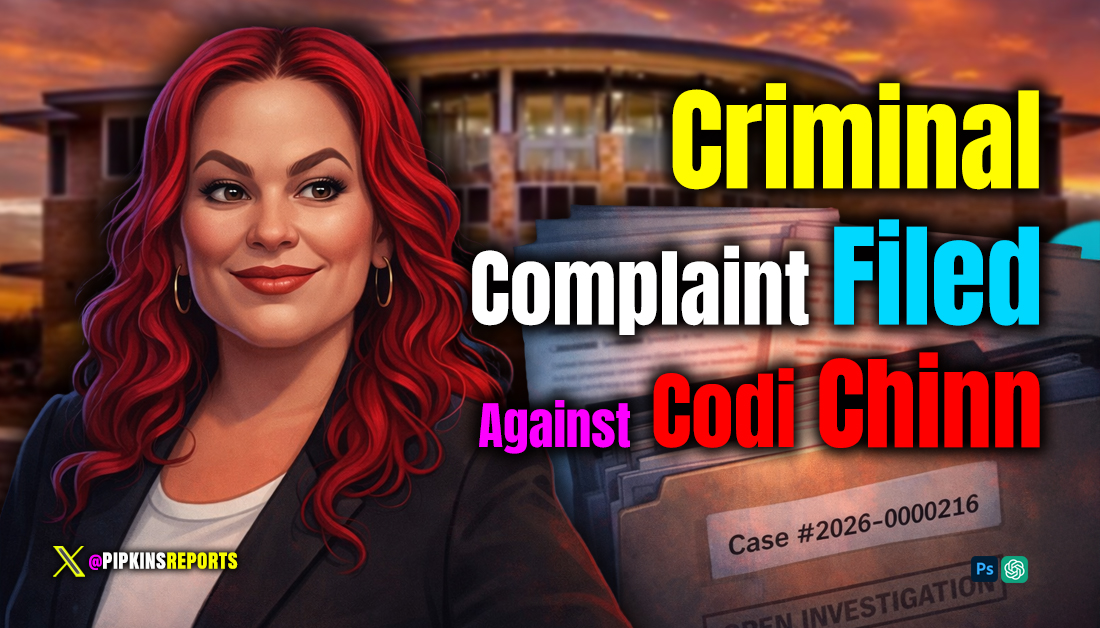
FATE, TX – In the weeks after a citizen-led recall petition was filed against Fate Councilwoman Codi Chinn, the political fight moved from City Hall into a police case file.
A criminal complaint obtained through an open records request shows the Fate Police Department opened Case #2026-00000216 listing Chinn as a suspect in an investigation under Texas Penal Code §42.074(b) — Unlawful Disclosure of Address or Telephone Number. The report classifies the alleged offense as having occurred in “Cyberspace” and notes the offender was suspected of using a computer. The case status is listed as Open / Ready for Review, and no charges have been filed as of publication.
The report identifies multiple Fate residents as victims — whose names we have redacted. The remaining redactions, which includes addresses of the victims as shown on the documents below, were made by the City of Fate.
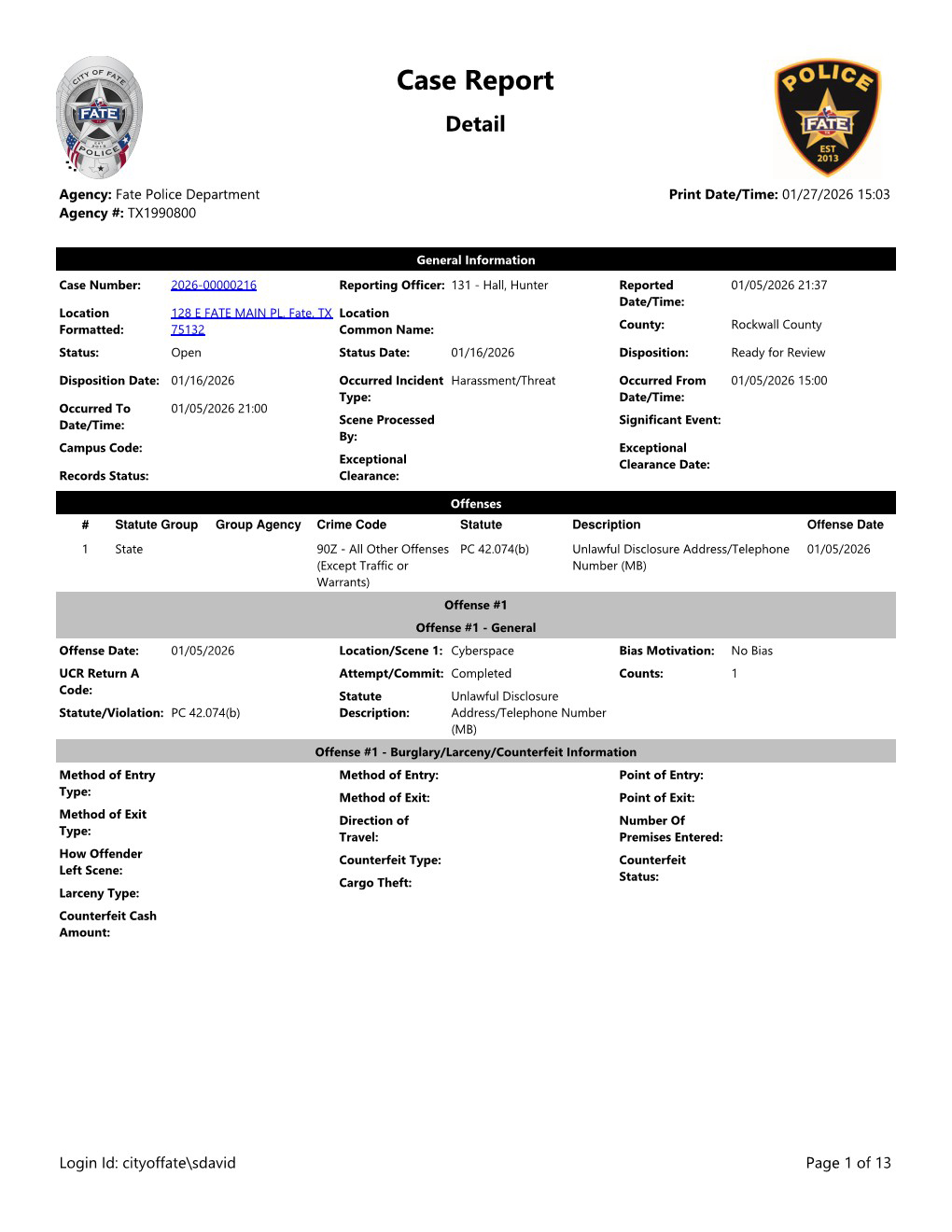
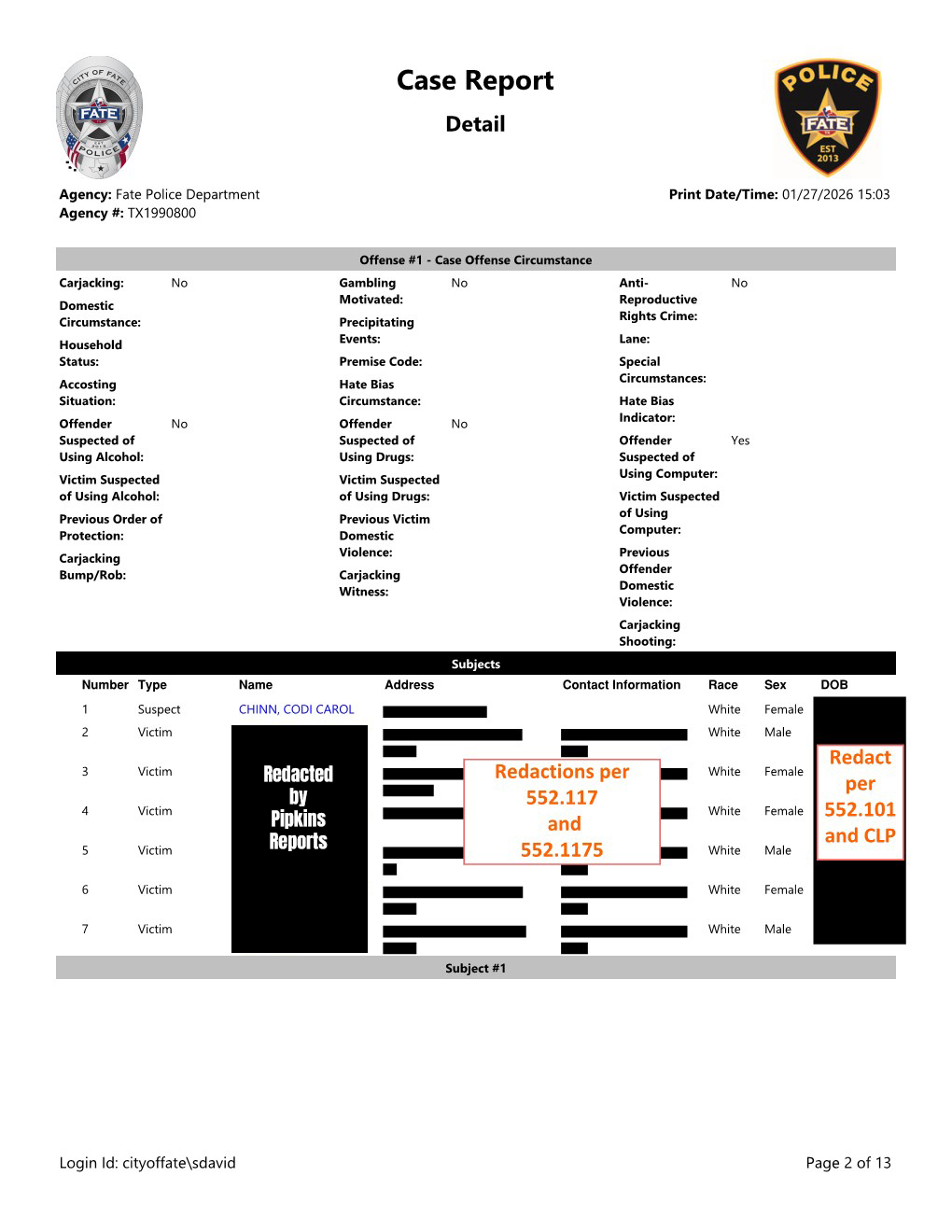
[Pages of complaint against Fate Councilwoman Codi Chinn received via Open Records Request. Pipkins Reports has provided an additional redaction to the victims names.]
What triggered the complaint
According to the complainants, after the recall petition was formally submitted to the City of Fate, the document — which included the names and home addresses of the recall committee members — was distributed by the city manager to all members of the city council, including Chinn. The citizens allege that Chinn later posted images of the unredacted petition pages on Facebook, thereby displaying the names and residential addresses of those responsible for initiating the recall.
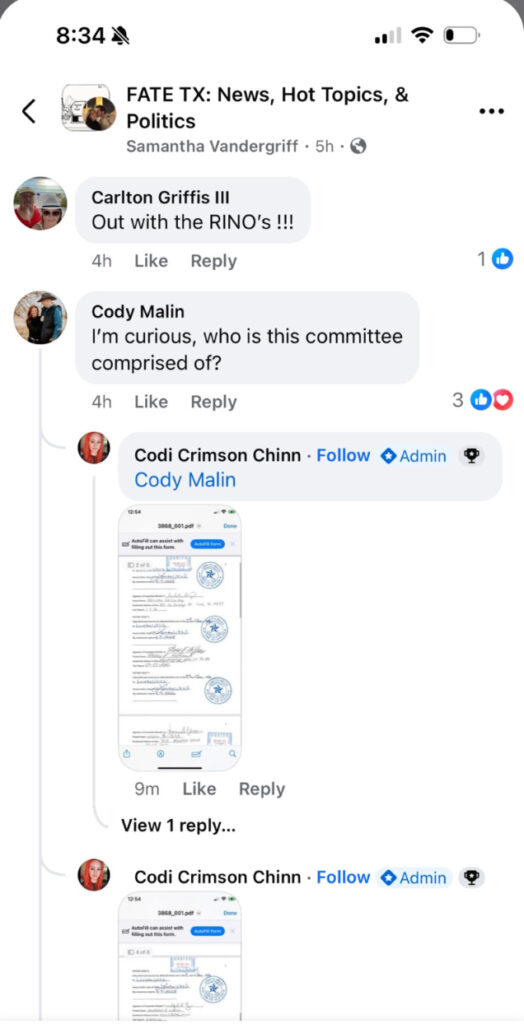
Some of the petition committee members then filed a criminal complaint, asserting the disclosure exposed them to potential harassment and intimidation. The police report reflects that allegation by citing the specific statute related to unlawful disclosure of personal information.
A public statement of fear
During Fate City Council meetings on February 2, 2026 and the following week on February 9, 2026, some individuals spoke during the public comment period and stated, on the record, that they believe the disclosure has placed both themselves and their family in danger. One person spoke about how their children were harassed and frightened. She even spoke about how her children have taken to carry nerf guns … in case something happened to daddy and they needed to protect mommy.
The law at the center of the case
Texas Penal Code §42.074 — Unlawful Disclosure of Personal Information
Texas law makes it a criminal offense to post on a publicly accessible website, or distribute electronically, the home address or telephone number of an individual with intent to cause harm or threaten harm.
- Classified as a Class B misdemeanor
- Elevated to Class A if bodily injury results
- Contains an exemption for public servants only when releasing information as part of their official duties in accordance with law.
The statute does not prohibit publishing a person’s name or signature. It specifically protects residential address and telephone number. Furthermore, the mere posting of an address, absent intent to harm, does not automatically satisfy the statute.
That distinction is central to the complaint.
Why this is unusual
Recall petitions are public political documents. Names of organizers are not confidential. Addresses, however, are often redacted by municipalities before release in open records responses.
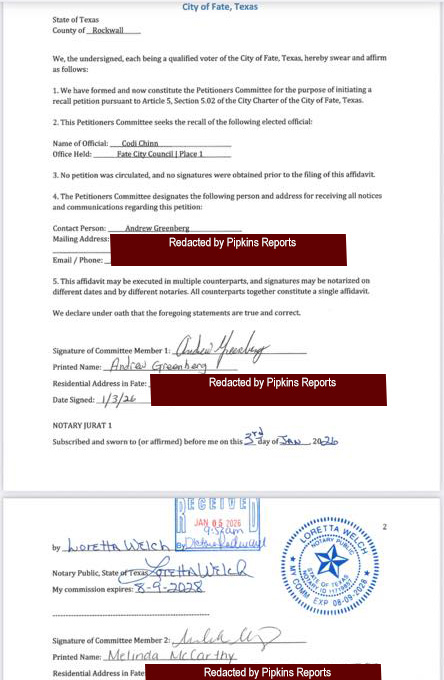
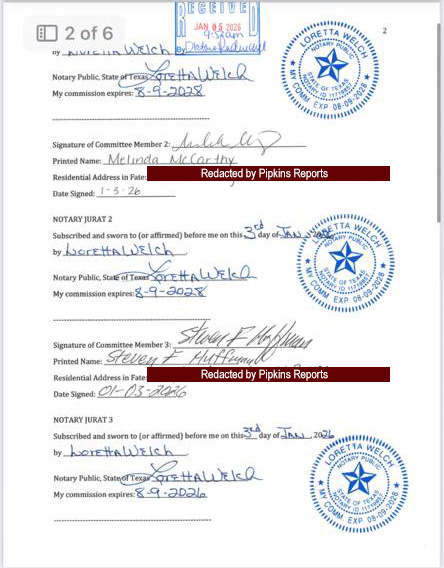
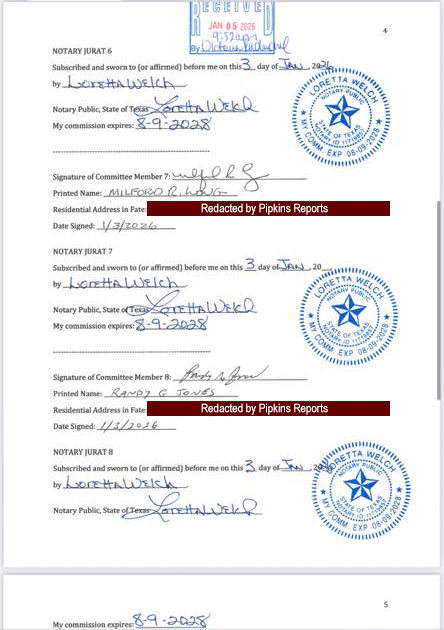
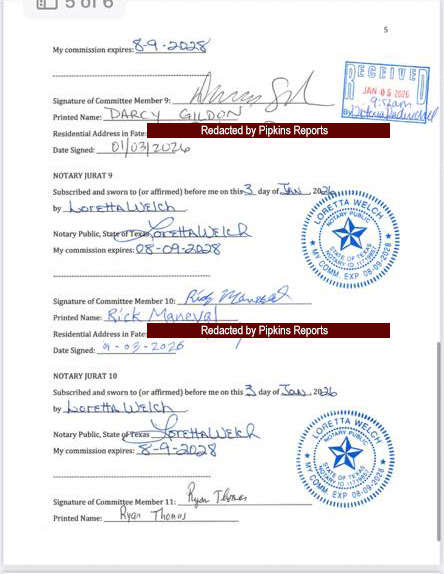
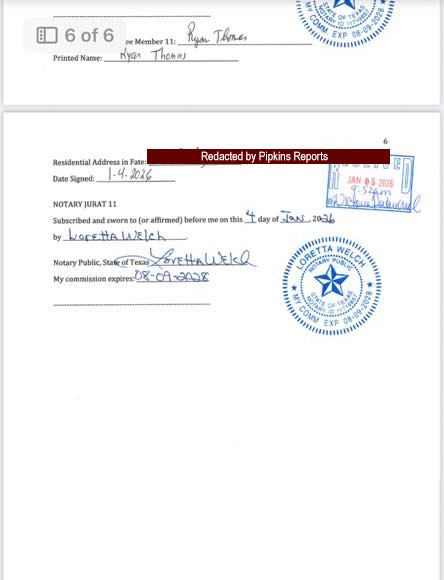
Page Cropping and Redactions by Pipkins Reports.]
The complainants argue that while the petition itself is public, the manner in which it was posted — unredacted, on social media, without city review — falls outside normal procedure and outside any official city function.
There is also no record indicating that Chinn was designated by the city in any official capacity to disseminate public records or communicate such materials to the public. The City of Fate maintains a Public Information Officer (PIO) role specifically tasked with handling the release of documents and public communications.
The police report does not determine intent. It documents that a complaint was made, identifies a statute, and names a suspect.
What the police document confirms
The report confirms:
- A complaint was filed January 5, 2026
- The alleged incident occurred online
- A specific criminal statute was cited
- Chinn is listed as the suspect
- The listed victims are recall participants
- The case is active and under review
It does not state that a crime occurred. It does not assign motive. It does not announce charges. It establishes that law enforcement considered the allegation serious enough to open a formal case.
The public servant exemption question
A key issue likely to be examined by prosecutors is whether Chinn’s posting of the petition falls under the statutory exemption for public servants acting within their official duties. The exemption applies only when disclosure is required by law or when disclosure is performed as part of an official governmental function.
The complainants contend that Chinn is not the city Public Information Officer (PIO) and is not authorized to post information on behalf of the city. They allege that posting the document to a personal Facebook page, without redaction and without city authorization, does not meet that threshold. They allege that the disclosure functioned as retaliation for initiating the recall.
What happens next
The case status of “Ready for Review” indicates the report has been forwarded for prosecutorial consideration. Whether the matter results in charges will be determined by the Rockwall County District Attorney, Kenda Culpepper, after review of the evidence.
Until then, the matter remains an open investigation.
Why this matters beyond Fate
Texas’ unlawful disclosure statute is increasingly cited in cases involving online publication of personal data. The law was designed to address modern forms of harassment often referred to as “doxxing.”
This case tests how that statute applies when the disclosure occurs in the context of a political dispute between elected officials and citizens.
It raises a novel question:
When does sharing a public document cross into unlawful disclosure?
That answer now sits in a police file.
Documentation
All information in this report is drawn from the Fate Police Department case report obtained through an open records request and social media sources. Home addresses, or potential victims’ names from the petition are not presented here to avoid republishing the information at issue in the investigation.
Pipkins Reports reached out to Councilwoman Chinn for comment before publication and received a call from her attorney, Cody Skipper, with Shook & Gunter Attorney at Law. Skipper’s response was, “Codi Chinn has done nothing wrong, nothing illegal, nothing unethical. Codi Chinn has done her job as a public servant.“
We also asked Mr. Skipper if he thought that when she posted the petition, if she was acting in an official capacity. He stated, “Every one of these people are acting in an official capacity.”
We have also verified that the Facebook post containing the recall petition with the committee members’ addresses has been removed. It is unclear when the post was removed.
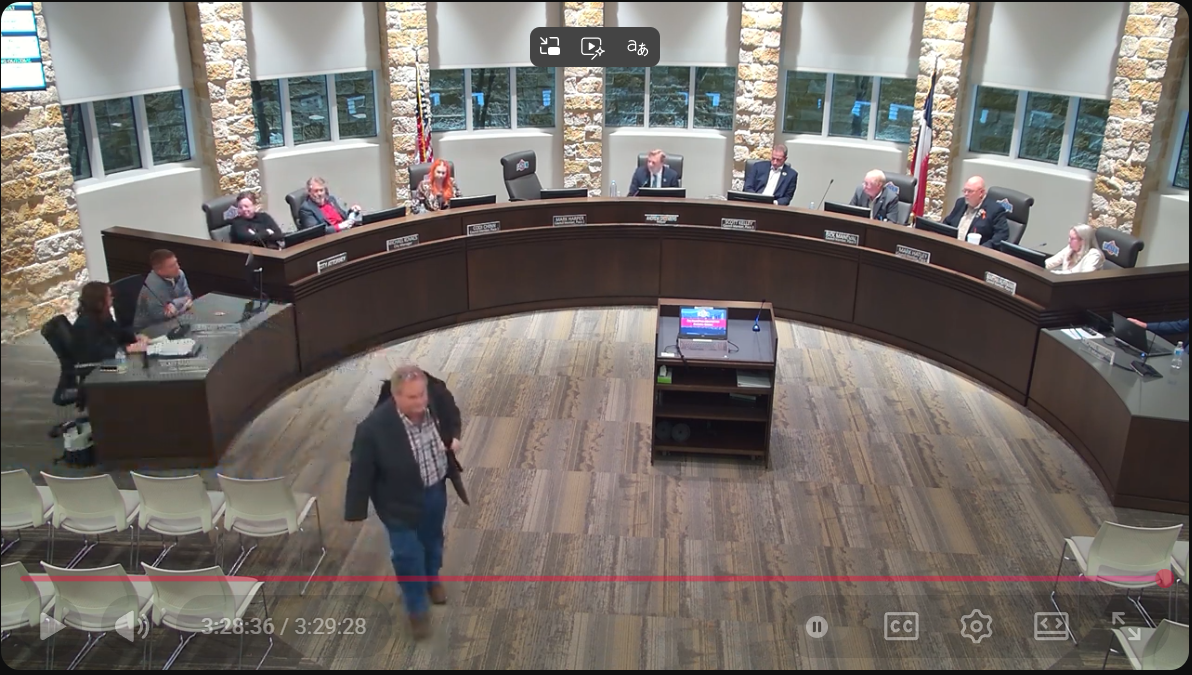
Councilman Mark Harper walks out of meeting before adjournment.
FATE, TX – The Fate City Council voted late Monday night to waive deliberative privilege, opening the door to the public release of secret audio recordings that may have driven a recall election against Councilwoman Codi Chinn. The decision came after hours of public criticism, procedural friction, and a lengthy executive session with legal counsel.
The meeting, held Monday, February 2, was streamed live by the city and is available on YouTube at: https://www.youtube.com/live/zQVN0i-d8C0 (Embedded Below)
(Source: City of Fate, official meeting broadcast)
Timeline for Readers
- 00:33:52 – Public comments begin, largely focused on the recall election of Councilwoman Codi Chinn.
- 00:56:10 – Councilman Harper interrupts public Comment.
- 00:57:00 – Councilman Harper interrupts public Comment.
- 00:58:00 – Councilman Harper interrupts public Comment.
- 02:21:00 – Executive Session – Council enters closed session to consult with legal counsel.
- 03:22:52 – Council reconvenes in open session.
- Primary motion – Council votes to “waive deliberative privilege”, allowing release of disputed audio recordings.
Public Comment and Visible Strain
Public comments began just after the 33 minute mark and quickly centered on the recall election. Speaker after speaker questioned the conduct of city officials and demanded transparency regarding audio recordings that have circulated privately but remained unavailable to the public.
During one speaker’s remarks, critical of Councilwoman Chinn, procedural tension became visible. Three separate times, Councilman Mark Harper interrupted to remind Mayor Andrew Greenberg that the speaker had exceeded the three-minute time limit. Each time, Mayor Greenberg thanked Harper for the reminder, then directed the speaker to continue.
The exchange stood out. While council rules clearly limit speakers to three minutes, the mayor’s repeated decision to allow the speaker to proceed suggested an effort to avoid the appearance of silencing criticism during a highly charged meeting.
Clarifying the Recordings
Contrary to some early assumptions, the audio recordings at issue were not recordings of executive sessions. Instead, they are one-party consent recordings, the existence of which has been previously reported and alluded to on Pipkins Reports. Their precise origin has not been publicly detailed, but their contents have been referenced repeatedly by both supporters and critics of the recall effort.
Behind Closed Doors
Following the public meeting, the council entered executive session to consult with legal counsel. After about an hour, members returned to open session at approximately 3:22:52 .
The primary motion coming out of that session was to “waive deliberative privilege“. The effect of the vote was to remove a legal obstacle to releasing the secret audio recordings that have been at the center of the controversy.
No excerpts were played, and no conclusions were announced. The council did not rule on the legality of the recordings, nor did it weigh in on the merits of the recall election itself.
Why the Vote Matters
The decision does not resolve the recall of Councilwoman Chinn. It does not validate or refute claims made by either side. What it does is shift the debate away from rumor and secondhand accounts.
According to guidance from the Texas Municipal League, governing bodies may waive certain privileges when transparency is deemed to serve the public interest, particularly when litigation risk is balanced against public trust (Texas Municipal League, Open Meetings Act resources).
Opinion and Perspective
The council’s action was a necessary step. Secret recordings, selectively referenced and strategically leaked, undermine confidence in local government. So does a refusal to confront them directly.
Transparency is not about protecting officials from embarrassment. It is NOT the job of the council to assist the city in concealing information that may be used against it in legal proceedings when the City Manager, or Councilmen, may have done bad things. It is about protecting citizens from manipulation. If the recordings exonerate those involved, their release will restore credibility. If they raise concerns, voters deserve to hear them unfiltered before making decisions in a recall election.
Monday night in Fate did not end the controversy. It ended the excuse for keeping the public in the dark.
Pingback: Lombard’s Performance Review – Part 2. How a DPS Chief Got Railroaded due to Politics, Deception & Corruption – pipkinsreports.com