Connect with us

Published

on

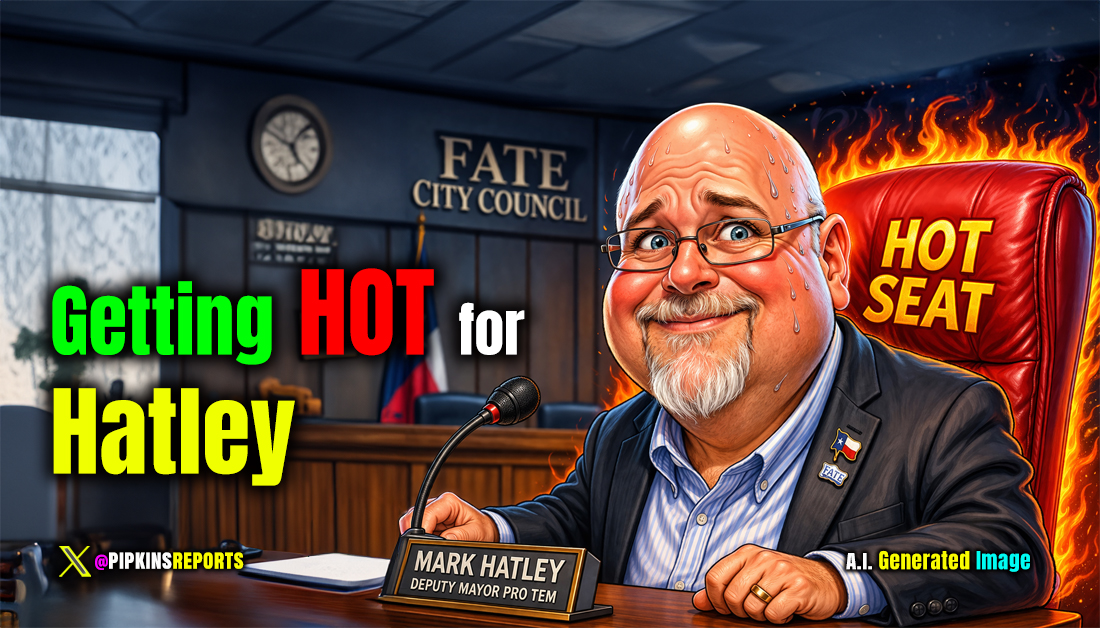
FATE, TX – The City Council voted to investigate Councilman Mark Hatley, setting off a political drama that some view as a battle of power between two diametrically opposed groups.

At the center of the dispute is an ethics complaint filed March 25, 2026, by Councilman Scott Kelley against Deputy Mayor Pro Tem Mark Hatley, tied to audio recordings previously reported by Pipkins Reports. The Fate City Council took up the matter during its April 6 regular meeting at City Hall where members entered executive session to review the complaint under provisions of the Texas Open Meetings Act and personnel deliberation statutes.

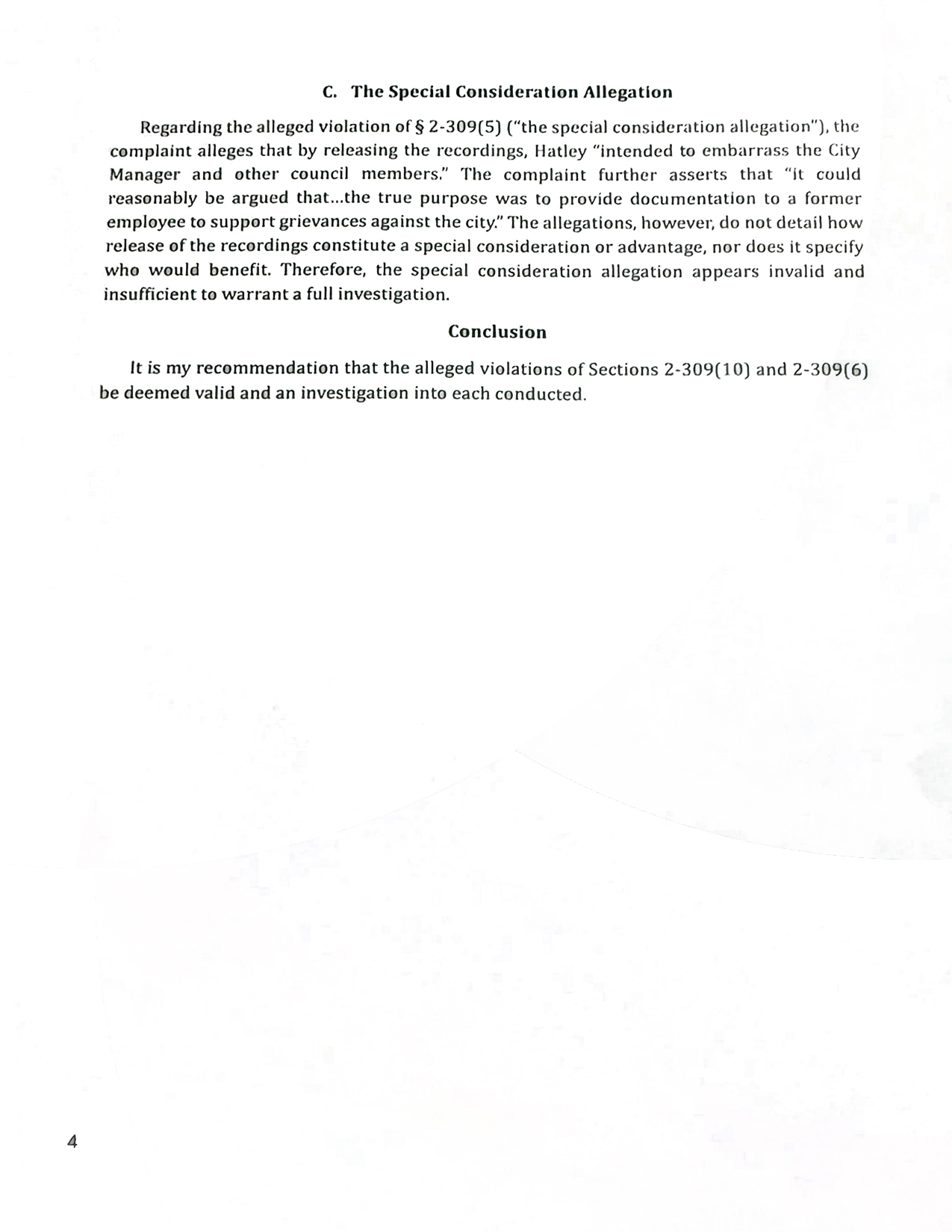
According to the official agenda, council members met privately with legal counsel to conduct an initial screening of the complaint. The session relied on guidance from attorney Ross Fischer of Ross Fischer Law, PLLC, whose memorandum outlined potential violations of the city’s Code of Ethics. That memo, later made public by council vote, identified two allegations as sufficiently credible to warrant further investigation: interference in administrative matters and disclosure of confidential information.
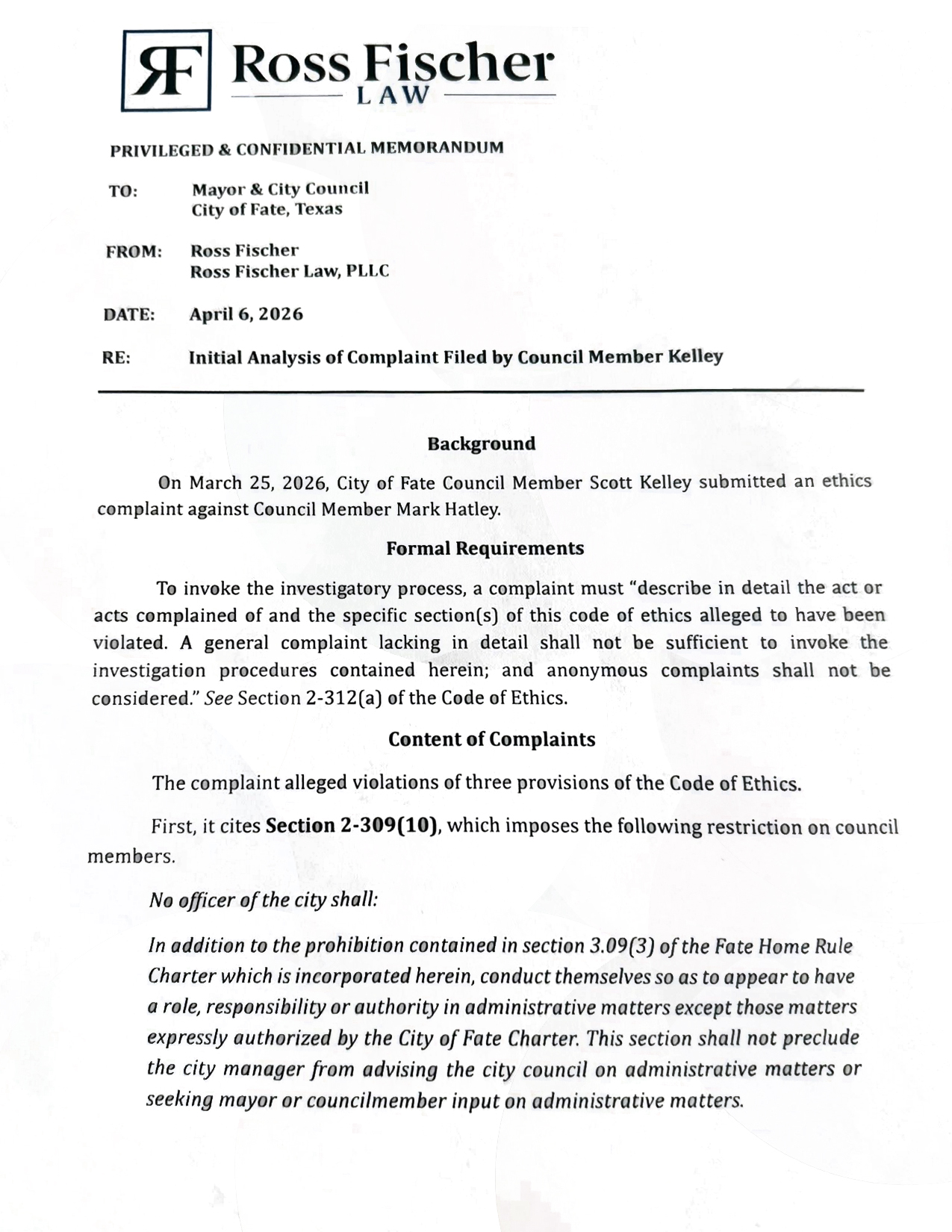
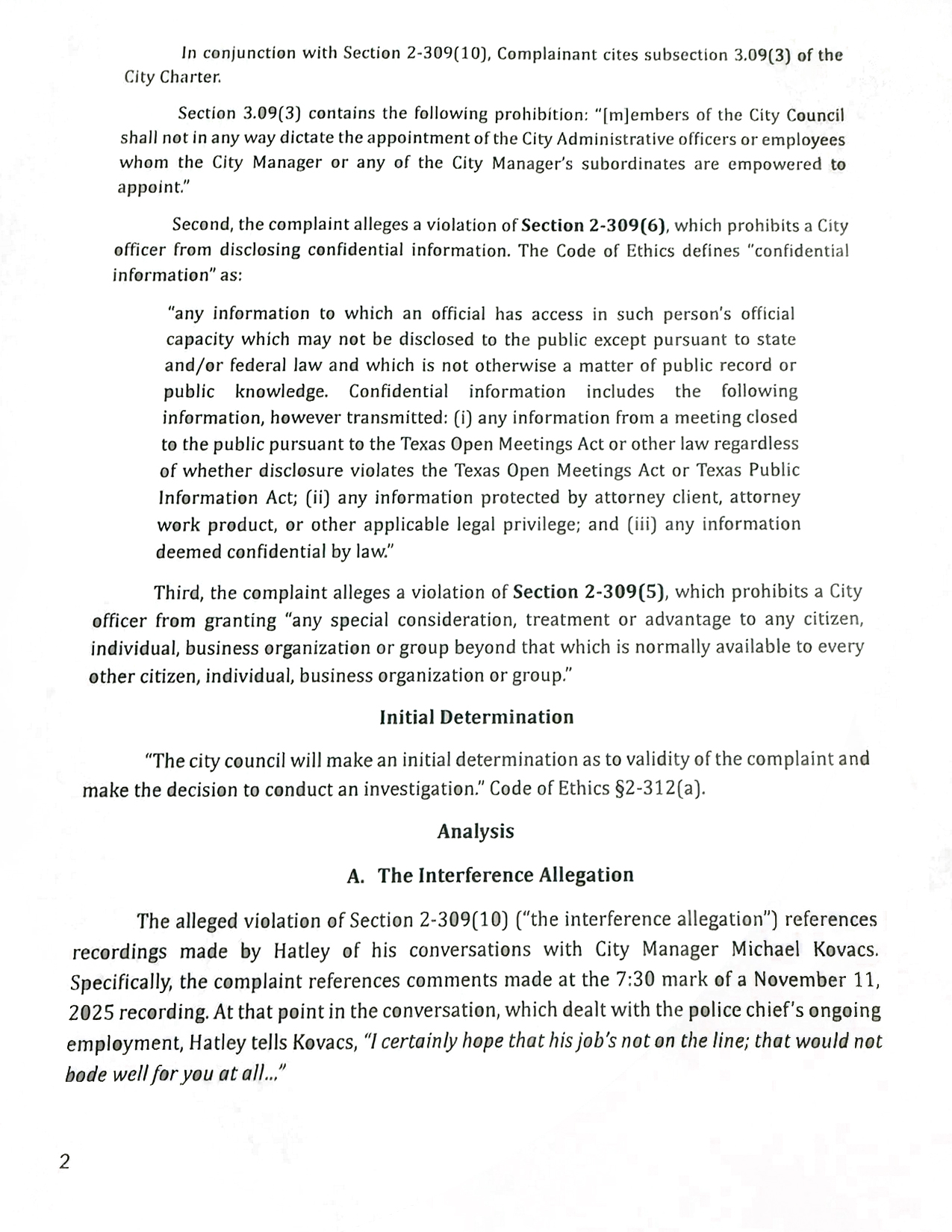
[Memorandum from Ross Fischer]

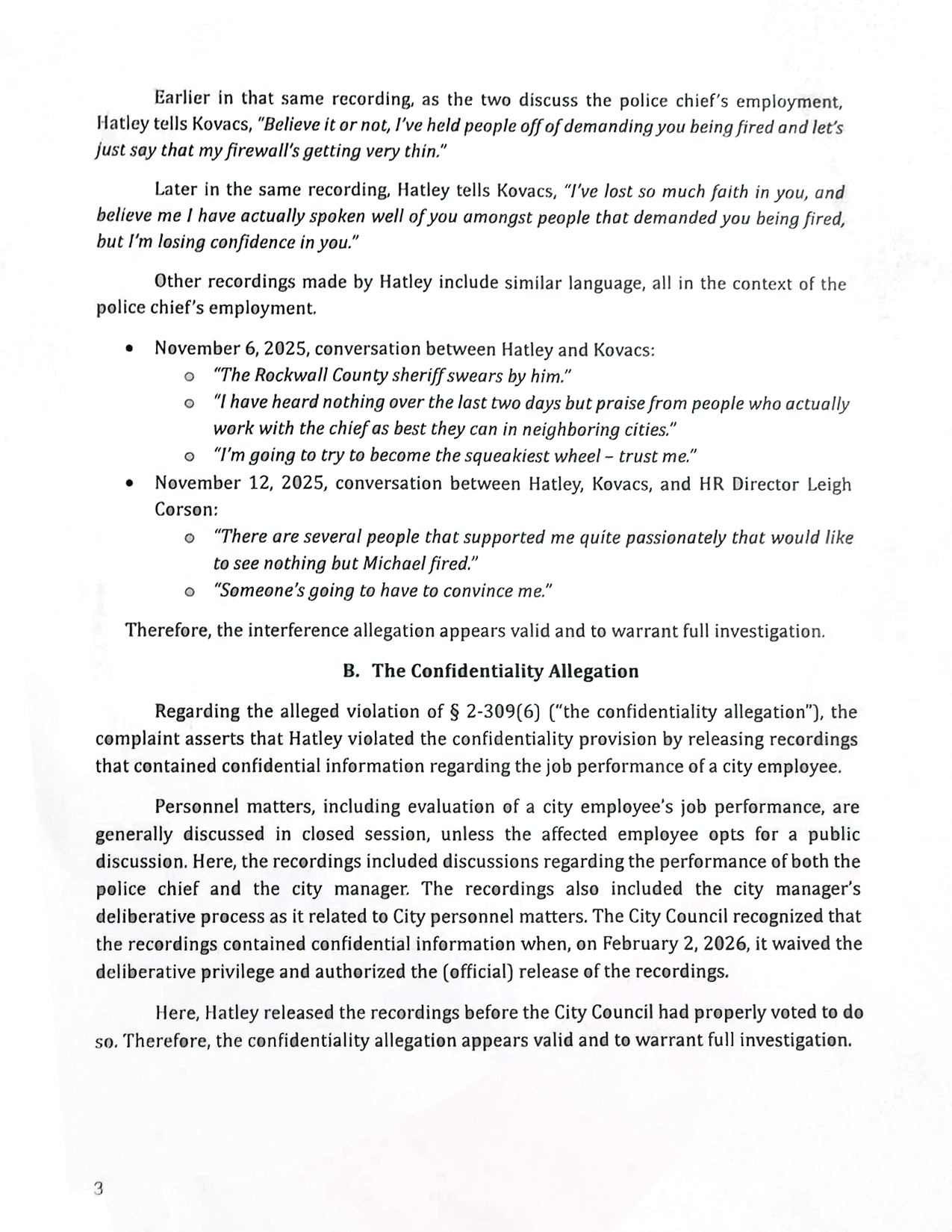
The memorandum detailed specific excerpts from recorded conversations between Hatley and City Manager Michael Kovacs, including alleged remarks suggesting pressure or influence related to the police chief’s employment. In one instance cited in Fischer’s memorandum, Kelley asserts that Hatley allegedly warned Kovacs that the situation “would not bode well” for him, language the memo suggests could be interpreted as administrative interference under Section 2-309(10) of the city’s ethics code.

The second allegation centers on the release of the recordings themselves. Fischer’s analysis concluded that the audio contained discussions about personnel matters typically reserved for closed session, and therefore may constitute confidential information under Section 2-309(6). The memo notes that the City Council later voted to waive privilege and release the recordings officially, but that Hatley had allegedly distributed them prior to that authorization.

During the open session that followed, Councilman Mark Harper moved to make the executive session public, a motion seconded by Councilman Codi Chinn and approved unanimously, 7-0. Councilman Hatley voted in favor of that motion, joining the full council in opening the executive session discussion to the public for transparency.

Councilman Kelley then made a motion to proceed with a formal investigation into Hatley’s conduct, citing the findings outlined in the memo. In doing so, Kelley referred to Pipkins Reports as a “local opinion blogger,” a characterization that may be viewed by some as dismissive.

The council ultimately voted 5-2 to move forward with the investigation. Mayor Greenberg and Councilman Hatley cast the dissenting votes, while the remaining five supported the inquiry. According to Councilman Rick Maneval, Fischer indicated during executive session that he did not expect an investigation to uncover additional substantive facts beyond what was already known, aside from giving Hatley an opportunity to formally respond.

In a separate but related action, the council voted unanimously, 7-0, to dismiss a third allegation from the ethics complaint that falls under Section 2-309(5), which concerns granting special consideration or advantage. Fischer’s memo found that the claim lacked sufficient detail and failed to identify a specific beneficiary, rendering it inadequate under the city’s ethics standards.

The decisions come amid a broader political dispute, as one of the members of a recall petition is now also under investigation for ethics violations.

Mark Hatley is one of three councilmen, along with Rick Maneval and Martha Huffman, plus Mayor Andrew Greenberg, who are currently the subject of a circulating recall petition. Some residents have suggested that effort is, at least in part, a response to a separate recall targeting Councilman Codi Chinn, which is set to appear on the May ballot.

Chinn’s public supporters include Councilman Mark Harper and Councilman Scott Kelley, both of whom now play central roles in the current ethics dispute. Harper has been accused by City Manager Michael Kovacs of making threatening statements, an allegation that has not been adjudicated but adds another layer of tension to an already volatile situation.

From a procedural standpoint, the council’s vote will authorize Ross Fischer to conduct an investigation, as the City’s in-house attorney would have a conflict of interest.

** Mark Hatley couldn’t be reached for comment prior to publication.

Michael Pipkins focuses on public integrity, governance, constitutional issues, and political developments affecting Texans. His investigative reporting covers public-record disputes, city-government controversies, campaign finance matters, and the use of public authority. Pipkins is a member of the Society of Professional Journalists (SPJ). As an SPJ member, Pipkins adheres to established principles of ethical reporting, including accuracy, fairness, source protection, and independent journalism.

Council

Four Candidates Enter Fate City Council Place 1 Race

Published

on

The Replacements

Fate, TX – The race to fill the vacant Fate City Council Place 1 seat vacated by the recall of Codi Chinn, will consist of four candidates. Randy Long, Stephanie Delaine Adams, Joshua Martin and Donovan Heinrich.

Randy Long is a serves as the Rockwall County director for True Texas Project, a conservative grassroots organization.

Stephanie Delaine Adams served 12 years on the Rockwall ISD Board of Trustees, including two years as board president from 2017 to 2019. She is now a Realtor.

Joshua Martin has lived in Fate for approximately six years and is a recruiting manager with QXO. He previously served as president of the Old Shepard Place neighborhood association in Plano.

Donovan Heinrich previously ran for Fate City Council, Place 5, in 2021, receiving 288 votes, or 30.48%, against eventual winner Jim DeLand.

More to follow on each candidate in the upcoming days.

Continue Reading

Council

Refugio’s Government Meltdown: Mayor, Secretary and Three Council Officials Arrested in Two Days

Published

on

Mayor Wanda Dukes and Council Arrested

Refugio, TX — It is one thing when a Texas mayor gets arrested. It is quite another when the mayor, city secretary and three current or former council members are all swept into the same criminal investigation within roughly 48 hours. That is what happened this week in Refugio, a small South Texas town where local government has suddenly become the subject of a Texas Rangers investigation and multiple felony charges.

Mayor Wanda Dukes and City Secretary Callie Shreckengost were arrested Wednesday on first-degree felony charges involving the alleged misapplication of fiduciary property valued at $300,000 or more, according to reporting by Crossroads Today and Texas Municipal Watch. The allegations involve the town’s Economic Development Corporation funds.

Then came Thursday.

Mayor Pro Tem Ixtlazihuatl “Lala” Vasquez, along with former council members Michael Rocha and Frank Hosey, surrendered at the Refugio County Jail and were arrested on third-degree felony charges alleging abuse of official capacity involving government property valued at more than $30,000 but less than $150,000.

The Texas Rangers reportedly told Crossroads Today that Thursday’s arrests stem from the same grand jury indictment that produced the charges against Dukes and Shreckengost. Texas Municipal Watch reported that it had not independently reviewed the indictment and was relying on Crossroads Today’s account of the Rangers’ statement.

Under Texas Penal Code Section 39.02, abuse of official capacity involves a public servant intentionally or knowingly misusing government property, services, personnel or other resources under that official’s control for an improper benefit or to harm or defraud another person. At the dollar range alleged in the Thursday arrests, the offense is classified as a third-degree felony.

The identities of the officials involved are not in question. Refugio County records list Dukes as mayor, Vasquez as Alderman Place 1, Rocha as Alderman Place 3, and Hosey as Alderman Place 4. Town financial records also identify Shreckengost as city secretary.

But there is still a great deal the public does not know.

Texas Municipal Watch reported that the specific conduct allegedly underlying the charges against Vasquez, Rocha and Hosey had not yet been independently confirmed, nor had the outlet confirmed their release conditions or upcoming court appearances. The underlying indictment had also not been obtained at the time of its Thursday report.

The town council has apparently recognized that it has a problem. Council members Robert Jaso and Dana Alsop issued an identical statement Wednesday saying the town was aware of criminal accusations against officials, could not comment on an ongoing investigation, and intended to take steps to protect municipal resources. They also said a special meeting would be held as soon as possible to consider whatever action might be necessary.

Continue Reading

Council

“Not Guilty”: Eva Royer Acquitted After Granbury Election Fraud Prosecution

Published

on

Eva Royer found not guilty

Granbury, TX – A Granbury political fight that escalated into a criminal prosecution has ended with a jury refusing to convict Eva Royer, a Hood County Republican Party official who was arrested after questions arose over the address she used when filing to run for Granbury City Council.

Royer was found not guilty after facing charges of perjury of certain election procedures and election fraud stemming from her 2024 City Council candidacy, according to reporting by Erin Anderson of Texas Scorecard. The verdict closes a case that had already raised uncomfortable questions about how aggressively local government pursued what began as a dispute over residency.

The case began after Royer filed to run for Granbury City Council Place 5 in August 2024. She listed a Granbury address and stated that she had lived within the city for approximately two years and nine months. City officials later questioned whether that address was actually her primary residence.

Royer withdrew her candidacy before a scheduled City Council meeting could determine whether she met the city’s residency requirements. That could have been the end of the matter.

It wasn’t.

In April 2025, Granbury police arrested Royer on one count of perjury of certain election procedures, a state jail felony, and one count of election fraud, a Class A misdemeanor. She posted bond and was released the following day. The charges were based largely on allegations that she used a Granbury property as her residence even though officials believed she primarily lived elsewhere.

The prosecution focused heavily on three locations: Royer’s Granbury property, a home in Pecan Plantation belonging to her former boyfriend, and a Dallas condominium.

The state presented evidence that Royer’s vehicle entered and exited Pecan Plantation regularly. A security director testified that Royer had a guest pass connected to the vehicle, but also acknowledged under questioning from defense attorney Rob Christian that regularly visiting a boyfriend does not necessarily make someone a resident. He further testified that a guest tag indicated the person was not a resident.

Prosecutors also pointed to the fact that Royer’s Granbury property had been approved for short-term rental use. But testimony established that a short-term rental permit did not require the property to be rented for any particular number of days. In other words, having a permit to rent a house does not automatically establish that its owner doesn’t live there.

Then came the homestead exemption argument.

Hood County Chief Appraiser Jeff Law testified that Royer had not claimed a homestead exemption on the Granbury property. Her attorney countered that the property was owned through Royer’s LLC, making her ineligible for the exemption under the circumstances. Royer’s driver license also listed the Granbury address.

The trial also produced testimony about the investigation itself, including the use of license plate reader technology (FLOCK) to locate Royer. Texas Scorecard reported that her former boyfriend’s license plate had been placed on a “hot list” because of his association with Royer. Police eventually arrested Royer after locating her with Bolton.

And there was considerably more.

Defense questioning raised issues involving city officials, police leadership and communications concerning the prosecution. According to Texas Scorecard’s trial coverage, Granbury Police Chief Mitch Galvan acknowledged providing incorrect testimony during earlier proceedings and acknowledged that text messages concerning the case had not initially been produced despite court orders.

Royer’s acquittal ends the criminal case, but it leaves questions about how the dispute escalated to that point. Why was so much pressure brought against her over the address she used on her election paperwork? Why did multiple officials at the City of Granbury become so deeply involved in pursuing the matter after she had withdrawn from the race? And given the issues raised during the trial about the investigation and the handling of evidence, are there additional questions about how and why the case was pursued? Those questions remain unanswered, and whether there is a deeper problem within Granbury’s political or administrative structure is something that warrants further examination.

Continue Reading