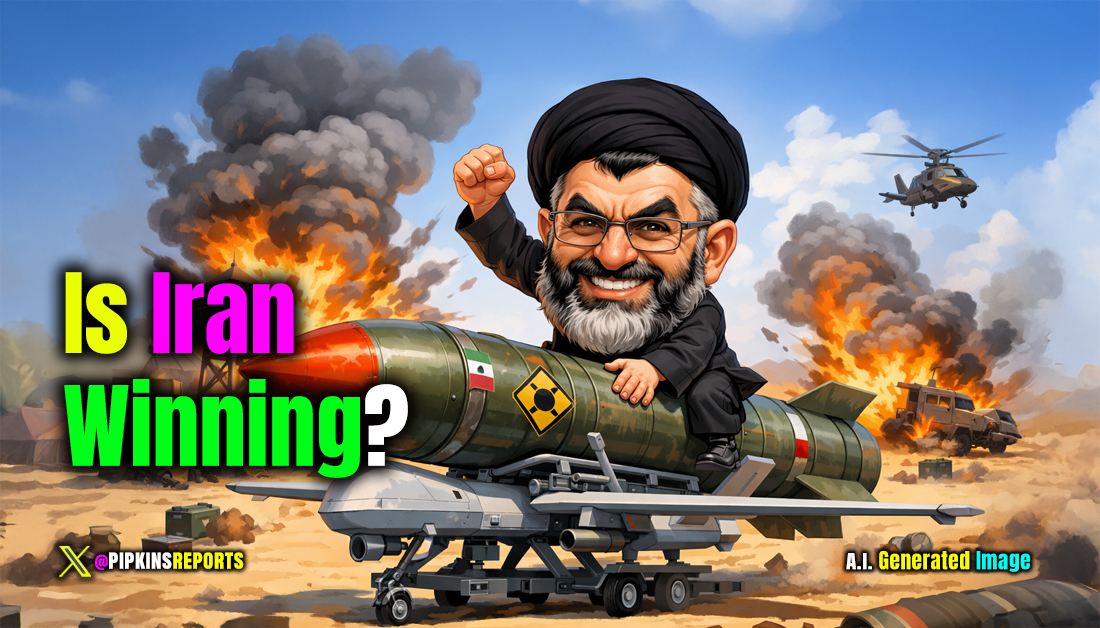
Fake War Footage – Propagandizing You for Clicks.
Iran – The bombs started falling in the Middle East, and within minutes the internet detonated with something just as explosive, a tidal wave of fake war footage across social media.
Scroll through Facebook, X or Instagram and you will see burning U.S. bases. Iranian missiles blasting American jets from the sky. Satellite images of destroyed radar installations. Clever Iranian tricks of a painted airplane silhouette – supposedly humiliating the Pentagon.
Much of it never happened.
Since the United States began striking Iranian targets, the online world has been flooded with fake accounts, AI-generated videos, manipulated satellite imagery, and viral propaganda posts designed to shape global opinion about the conflict. Analysts say the scale of the deception campaign marks one of the first major wars where artificial intelligence is being weaponized at industrial scale in the information space.
Millions Watching Fake War
The misinformation explosion began almost immediately after the strikes.
Researchers monitoring social media say fabricated videos of the war have accumulated tens of millions of views before fact-checkers could intervene. Some clips claimed to show Iranian missile strikes destroying American aircraft or warships.
One particularly dramatic video circulating online showed an Iranian missile destroying a U.S. aircraft in midair. The footage went viral, racking up tens of millions of views, before investigators determined it had been generated entirely using artificial intelligence.
Other viral clips were not even AI. They were lifted from military video games.
A widely shared video claiming to show a U.S. warship shooting down an Iranian fighter jet was eventually traced to gameplay footage from the combat simulation game War Thunder. The clip gained more than seven million views online before being exposed as fictional.
Experts say the tactic works because viewers often encounter these clips in emotionally charged moments, when verification is the last thing on their minds.
The Fake Account Armies
The deception is not random.
Investigators have uncovered organized networks of fake or hacked social media accounts pushing fabricated war footage to millions of users.
In one case uncovered by platform X, at least 31 coordinated accounts were allegedly operated by a man in Pakistan and used to spread AI-generated war videos related to the U.S. strikes on Iran.
Many of the accounts impersonated journalists or eyewitnesses. Some posed as residents near battle zones. Others claimed to be military observers.
By pretending to be on-the-ground witnesses, propagandists can trick audiences into believing fabricated videos are authentic breaking news.
Researchers say this kind of deception campaign is increasingly common during international conflicts, where online narratives can influence global opinion as quickly as military developments.
AI Is Now Faking Satellite Evidence
Perhaps the most alarming development is the manipulation of satellite imagery.
In several viral posts circulating online, images appeared to show U.S. military installations destroyed by Iranian strikes. The images looked convincing, complete with blast craters and damaged buildings.
Investigators later discovered some of the satellite images were AI-altered or entirely fabricated.
One widely shared image, promoted by Iranian media outlets, claimed to show a devastated U.S. radar installation in Qatar. Analysts later determined the image had been digitally manipulated using artificial intelligence.
Experts warn that satellite images are particularly powerful propaganda tools because they appear technical and authoritative.
People tend to trust them without question.
Viral Claims Iran Is Tricking U.S. Satellites
Another category of viral propaganda has taken a different approach, mockery.
Images circulating across social media show large silhouettes of drones and aircraft painted onto the ground inside Iran. The accompanying posts claim Iranian forces created fake targets to trick American satellites.
The narrative accompanying the images is clear and deliberate. According to the viral captions, U.S. intelligence supposedly identifies the fake aircraft as real targets, allowing Iran to make the United States waste millions of dollars destroying empty patches of dirt.
The posts typically end with the same message, Iran is clever, the United States is foolish.
But military historians say the narrative leaves out a key fact. This never happened…the images are Photoshop or A.I..
The deception, to the viewers, is effective because decoys, camouflage, and deception have been standard military tactics for centuries. Inflatable tanks, fake airfields, and painted aircraft silhouettes were used extensively during World War II and are taught in military academies around the world. So the accusations seem plausible…and the fake images seal the deal.
The propaganda lies not in the existence of decoys, but in the framing designed to humiliate the United States and elevate Iran’s image.
State Actors Fuel the Propaganda War
Analysts say the information battlefield is being shaped by a mix of actors.
State-backed propaganda networks have circulated exaggerated claims about Iranian military success, while foreign influence operations have amplified misleading narratives to undermine confidence in American military power. Anti-semite groups capitalize on the opportunity to take swipes at Israel. Democrat operatives live for the opportunity to make President Trump, or Secretary of War, Pete Hegseth, look like a fool.
Researchers studying the phenomenon say the goal is not always to persuade people of a single lie. Instead, the objective is chaos & uncertainty.
Flood the internet with so many competing claims, fake videos, and manipulated images that ordinary people simply stop trusting anything they see.
Opinion: America Is Losing the Information Battlefield
Facts first. Now the uncomfortable truth.
The United States may dominate the skies militarily, but in the information war raging across social media, the battlefield is far murkier.
Artificial intelligence has democratized propaganda. What once required vast intelligence agencies, professional studios, and technical expertise can now be created by anyone with a laptop and the right software.
The viral posts mocking American intelligence over painted decoys illustrate the strategy perfectly. A centuries-old military tactic becomes a viral story about Iranian brilliance and American incompetence.
The objective is not accuracy. The objective is perception.
Every fake video of a burning U.S. base, every manipulated satellite image, every anonymous account posting dramatic “battle footage” pushes the same narrative, America is losing, Iran is winning, and nothing you see can be trusted.
And when truth becomes impossible to separate from fiction, propaganda has already won.
The missiles may be flying over the Middle East.
But the real war for public perception is raging on your phone screen.
Election
$100 Million, No Winner: Cornyn and Paxton Head to High-Stakes Texas Senate Runoff
Cost per Vote Calculated
TEXAS – After more than $100 million in political warfare, Texans woke up Wednesday morning to a simple reality, the Republican primary for U.S. Senate is not over. In fact, it may have only reached halftime.
Incumbent U.S. Sen. John Cornyn and Texas Attorney General Ken Paxton are now headed to a runoff election after neither candidate secured the majority required to win outright in Tuesday’s Republican primary. The contest, widely described as the most expensive Senate primary in American political history, will now stretch another two months before Republican voters decide the nominee.
As of publication, with roughly 94 percent of the vote counted, Cornyn held a narrow lead with 41.9 percent of the vote, totaling 897,187 ballots. Paxton followed closely with 40.7 percent, receiving 871,672 votes. U.S. Rep. Wesley Hunt finished third with 13.5 percent, or 289,403 votes.
Under Texas election law, a candidate must receive more than 50 percent of the vote to win a primary outright. When no candidate crosses that threshold, the top two candidates advance to a runoff election. That runoff is scheduled for May 26.
The results guarantee an extended political showdown between two figures representing sharply different visions of Republican leadership.
Paxton addressed supporters Tuesday night during an election watch event in Dallas hosted by the pro-Paxton Lone Star Liberty PAC. The attorney general framed the outcome as a rejection of the political establishment and a signal from grassroots voters across Texas.
“Together with your support, we just sent a message loud and clear to Washington,” Paxton told the crowd. “Texas is not for sale.”
Paxton also pointed to the massive financial disparity between the campaigns, arguing that despite overwhelming spending by groups aligned with the incumbent senator, Republican voters still rejected the status quo.
“Nearly 60 percent of Texas voters, who have known Cornyn for over 40 years, after hearing $100 million worth of ads, chose to vote against the incumbent,” Paxton said. “That’s historic.”
Cornyn did not host an election night event but briefly addressed reporters Tuesday evening as the vote count continued.
“I’ve worked for decades to build the Republican Party, both here in Texas and nationally,” Cornyn said. “I refuse to allow a flawed, self-centered and shameless candidate like Ken Paxton risk everything we’ve worked so hard to build over these many years.”
Cornyn’s campaign has consistently argued that Paxton represents a risk to the Republican Party’s electoral prospects, while Paxton’s supporters have framed the race as a battle between grassroots conservatives and Washington insiders.
Cornyn campaign spokesman Matt Mackowiak previously told reporters that the campaign would not hold an election night celebration because the team does not “do halftime parties.”
The Cost of Each Vote
The financial dynamics of the race reveal an even more striking contrast between the campaigns.
Based on available spending figures tied to advertising and campaign messaging efforts, Cornyn’s political operation and allied groups spent roughly $70 million supporting his campaign. Paxton’s campaign and aligned efforts spent approximately $4.1 million, while Hunt’s campaign spending totaled about $11.4 million.
When those spending totals are compared with the number of votes received, the results highlight a dramatic difference in campaign efficiency.
- Cornyn’s spending equates to roughly $78.02 per vote, calculated by dividing $70 million by his 897,187 votes.
- Paxton’s campaign achieved nearly the same vote total at dramatically lower cost, spending approximately $4.70 per vote to secure 871,672 votes.
- Hunt’s campaign, which finished third, spent about $39.39 per vote, based on $11.4 million in spending and 289,403 votes.
In practical terms, Paxton’s campaign proved vastly more efficient at converting dollars into voter support, achieving almost the same vote share as Cornyn while spending only a fraction of the money.
Political analysts say the spending gap reflects heavy financial involvement by national Republican organizations and establishment political committees seeking to defend the incumbent senator.
Despite that financial advantage, the spending did not produce the decisive victory many expected.
Instead, it produced a runoff.
What Comes Next
The May 26 runoff now becomes the defining stage of the race. Historically, Texas runoff elections attract significantly lower voter turnout than primary elections, meaning campaigns must rely heavily on organization, messaging, and targeted voter mobilization.
Both candidates are expected to intensify campaigning across the state in the coming weeks, focusing on grassroots engagement, media messaging, and turnout operations.
The runoff will determine which candidate ultimately represents the Republican Party in the general election.
Opinion
One candidate’s role in Tuesday’s outcome should not be overlooked.
Congressman Wesley Hunt finished a distant third, but his presence in the race likely ensured that Paxton would not get the 50% needed to secure the nomination and may have now handed the election over to Cornyn.
It matters because Texas runoff elections tend to favor the campaign with the deeper pockets and stronger political machinery…that’s Cornyn. Cornyn’s access to national Republican fundraising networks and establishment political organizations could translate into a powerful turnout operation. Ground operations, voter targeting, and aggressive get-out-the-vote campaigns often determine the winner when turnout drops.
Paxton, by contrast, will rely heavily on grassroots enthusiasm among voters who see his candidacy as a challenge to what they view as a disconnected Washington political class. Cornyn is deeply hated by the electorate. The only question is, do they hate him enough to come out for a 2nd time to vote against him?
Featured
Markets Plunge as Iran Conflict Escalates, But Oil Reality Tells a Different Story
New York, NY – Global markets convulsed at the opening bell, shedding billions in value as war headlines involving Iran ricocheted across trading floors from New York to Tokyo. Traders reacted swiftly, energy prices spiked, and the financial press warned of supply shocks rippling across the world economy.
According to reporting from The New York Times, major stock indices fell sharply amid intensified military activity tied to Iran. Exchanges in the United States, Europe, and Asia all registered significant losses. Oil futures climbed on fears that instability in the Persian Gulf could disrupt tanker traffic through the Strait of Hormuz, a critical shipping lane for global crude.
The downturn began early in the trading session as reports of expanded strikes circulated. Analysts cited by The New York Times described widespread panic selling, with algorithmic trading accelerating declines once volatility thresholds were breached. Technology and transportation stocks led losses. Defense firms saw modest gains as investors anticipated increased military spending.
Yet beneath the red ink and breathless headlines lies a critical fact often missing from early coverage.
Iran accounts for roughly 2 percent of the global traded oil supply. While it remains a member of the Organization of the Petroleum Exporting Countries, years of sanctions following the U.S. withdrawal from the Joint Comprehensive Plan of Action in 2018 have pushed much of its crude into what analysts call the “grey market.”
Rather than selling transparently on regulated exchanges, Iranian oil typically moves through ship-to-ship transfers, obscured tracking systems, and intermediary traders. China has been a principal buyer of these discounted barrels. Transactions often bypass Western financial clearing systems, making the supply less visible but still economically present.
In short, Iran’s oil is already marginal to formal global trading structures.
Markets nevertheless reacted as though a primary energy artery had been severed. The CBOE Volatility Index surged, reflecting investor anxiety. Safe-haven assets, including gold and U.S. Treasury bonds, drew inflows as portfolio managers sought shelter from geopolitical uncertainty.
Complicating the picture, U.S. military officials confirmed that American forces conducted strikes that neutralized Iran’s naval presence in the Gulf of Oman, according to public statements released by U.S. Central Command. Those operations reportedly destroyed multiple Iranian vessels operating in that theater, significantly degrading Tehran’s ability to threaten commercial shipping lanes in the immediate area.
While independent verification remains limited, the operational effect appears clear: Iran’s capacity to directly interfere with tanker traffic near the Strait of Hormuz has been substantially reduced in the short term.
Energy analysts note that the Strait, while strategically vital, is patrolled by multiple international naval forces. With Iran’s regional naval capabilities diminished, the probability of prolonged shipping disruption appears lower than early market reactions suggested.
Moreover, if sanctions enforcement tightens amid escalating hostilities, nations purchasing discounted Iranian crude may be compelled to source oil from legitimate, regulated markets instead of grey market channels. That shift would not remove supply from the global system. It would redirect demand toward transparent producers.
Historically, geopolitical shocks produce immediate price spikes followed by recalibration once traders assess actual supply data. During prior Middle East conflicts, oil markets often stabilized after initial surges, particularly when physical infrastructure remained intact.
Government officials in several countries have urged calm. At this stage, no confirmed long term production outages have been reported. Strategic reserves among major economies provide additional buffers against short term volatility.
Opinion
Financial markets dislike uncertainty, but they often overprice fear.
When a nation responsible for about 2 percent of global traded supply triggers worldwide selling, the reaction says more about investor psychology than structural fundamentals. Iran’s oil already circulates through shadow networks at discounted rates. If conflict constrains that channel further, buyers such as China would likely pivot toward lawful suppliers, strengthening formal markets rather than collapsing them.
The destruction of Iran’s naval presence in the Gulf of Oman, if sustained, further reduces the specter of prolonged maritime shutdowns. Shipping lanes do not appear poised for indefinite closure.
Panic selling generates drama. It does not automatically generate durable economic damage.
Investors would be wise to separate headlines from hard supply data. Markets tend to correct once reality asserts itself. And reality, at least for now, suggests the global oil system remains far more resilient than Monday’s selloff implied.
Featured
Appeals Court Greenlights Texas Law Banning Drag Shows for Children
SAN ANTONIO, Texas — The U.S. Court of Appeals for the Fifth Circuit has lifted a lower court injunction and allowed Texas’ Senate Bill 12 to take effect, clearing the way for enforcement of new restrictions on certain drag performances in venues where minors are present. The ruling reverses a federal district court’s earlier order that had blocked the law, concluding that Texas may regulate performances deemed “sexually oriented” when accessible to children.
The appellate decision represents a significant legal victory for state officials, including Attorney General Ken Paxton, who defended the statute as a child-protection measure. Opponents, including performers and civil liberties groups, argue the law infringes on constitutionally protected expression and disproportionately targets drag performers.
At the center of the legal fight is not merely drag as an art form, but how Texas defines “sexually oriented conduct” — a term embedded in existing state penal law and incorporated into SB 12.
What SB 12 Does
Senate Bill 12 amends Texas law to prohibit certain performances on public property or in the presence of minors if the performances include “sexual conduct,” as defined by state statute. The law does not use the word “drag” in its operative prohibitions. Instead, it applies to performances that appeal to the prurient interest in sex and involve specific forms of sexualized conduct.
Under the statute, a person commits an offense if they engage in a sexually oriented performance on public property or in the presence of an individual younger than 18 years of age. The law classifies violations as a Class A misdemeanor, with enhanced penalties for repeat offenders.
Supporters argue the statute mirrors longstanding restrictions on sexually explicit performances involving minors. Critics contend it was drafted in response to drag events and creates uncertainty for performers who do not engage in explicit conduct.
The Legal Definition of “Sexually Oriented”
Texas does not rely on a vague or novel definition. Instead, SB 12 draws from the Texas Penal Code’s existing terminology.
Under Texas law, “sexual conduct” includes:
- Sexual intercourse;
- Deviate sexual intercourse;
- Sexual contact; and
- The exhibition of the genitals, anus, or female breast below the top of the areola.
“Sexual contact” is further defined as any touching of the anus, breast, or genitals of another person with intent to arouse or gratify sexual desire.
Additionally, “deviate sexual intercourse” includes contact between the genitals of one person and the mouth or anus of another, or penetration of the genitals or anus with an object.
The statute’s application hinges not on costume or identity, but on whether a performance includes conduct that meets these statutory definitions and is intended to appeal to prurient interests.
In court filings, state attorneys emphasized that the law regulates sexually explicit conduct — not viewpoint or identity — and parallels restrictions already applied to strip clubs and adult cabarets.
The Fifth Circuit’s Reasoning
The Fifth Circuit panel concluded that the district court erred in issuing a sweeping injunction blocking the law before it could take effect. The appellate judges found that Texas demonstrated a substantial likelihood of success on the merits of its argument that the statute regulates conduct, not protected speech.
The court emphasized the state’s “compelling interest” in shielding minors from exposure to sexualized performances, particularly on public property.
While the panel did not issue a final ruling on every constitutional question raised, it determined that the lower court’s injunction was too broad at this preliminary stage.
The earlier district court ruling had found portions of the law unconstitutionally vague, suggesting performers might self-censor out of fear that ordinary drag performances could be prosecuted. The appellate panel, however, concluded that the statutory definitions were sufficiently grounded in established penal law.
The Plaintiffs’ Arguments
The lawsuit challenging SB 12 was filed by performers and advocacy organizations, including the ACLU of Texas. Plaintiffs argued the statute violates the First Amendment by targeting expressive conduct based on content.
They contended that drag is a form of theatrical and political expression protected under the Constitution, and that the law chills speech by creating ambiguity around what constitutes a violation.
In earlier hearings, plaintiffs asserted that drag brunches, Pride events, and theatrical performances could be swept into the law’s scope even if they contained no explicit sexual activity.
The Fifth Circuit did not definitively resolve those broader First Amendment questions but concluded that the challengers had not met the threshold to justify blocking enforcement statewide.
Paxton’s Response
Attorney General Ken Paxton hailed the ruling as validation of Texas’ authority.
In a statement following the decision, Paxton said the court affirmed Texas’ right to protect children from “sexually explicit performances.” His office argued throughout the litigation that the statute mirrors restrictions long upheld by courts when applied to adult entertainment establishments.
Paxton’s office has been active in defending a series of social policy measures in federal court, often before the Fifth Circuit, which has become a focal point for constitutional litigation involving Texas law.
What Happens Next
The law is now set to take effect in March 2026 unless further judicial intervention occurs. Plaintiffs may seek rehearing before the full Fifth Circuit or petition the U.S. Supreme Court for review.
In the meantime, venue owners and performers must evaluate their programming in light of the statutory language. Legal analysts note that enforcement will likely hinge on factual determinations about the content of specific performances.
For prosecutors, the burden will be to demonstrate that a performance involved conduct meeting the precise statutory definitions — not merely gender expression, theatrical exaggeration, or cross-dressing.
You must be logged in to post a comment Login