Connect with us

Published

on

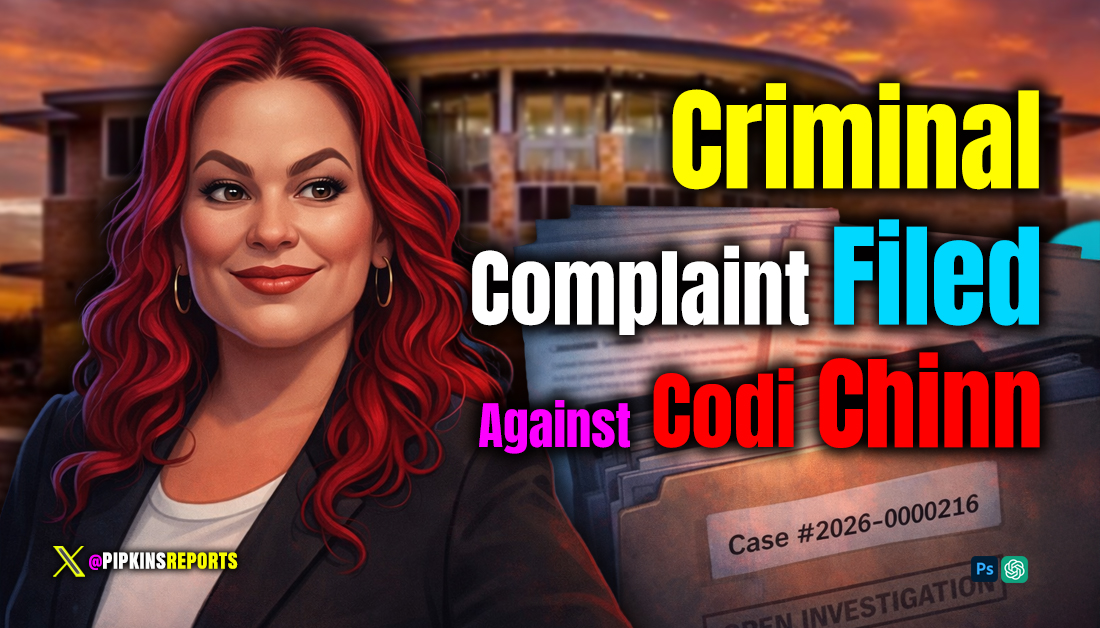
FATE, TX – In the weeks after a citizen-led recall petition was filed against Fate Councilwoman Codi Chinn, the political fight moved from City Hall into a police case file.

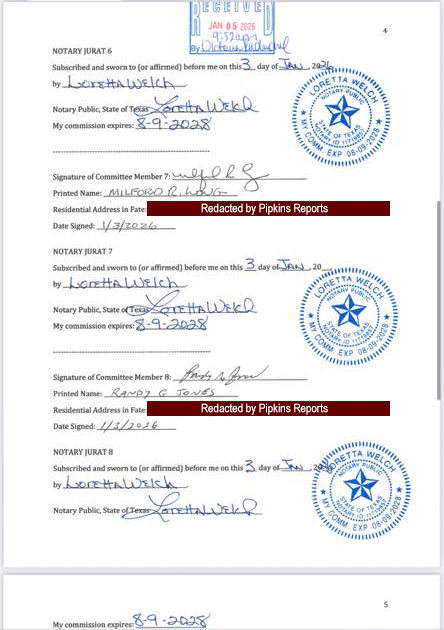
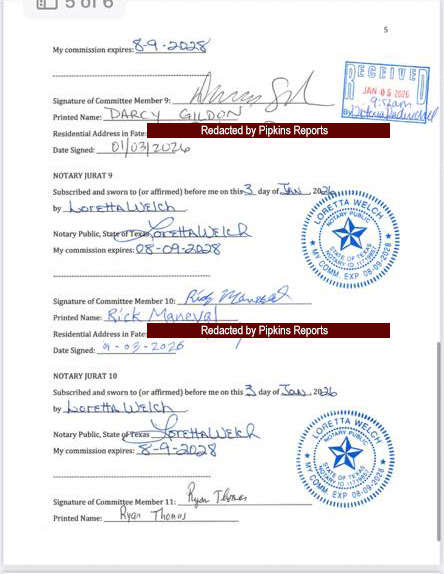
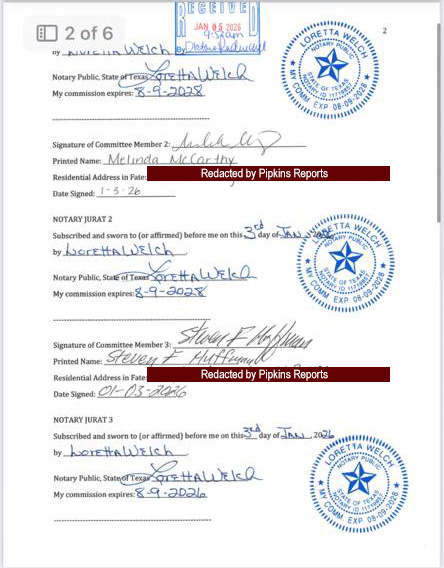
A criminal complaint obtained through an open records request shows the Fate Police Department opened Case #2026-00000216 listing Chinn as a suspect in an investigation under Texas Penal Code §42.074(b)Unlawful Disclosure of Address or Telephone Number. The report classifies the alleged offense as having occurred in “Cyberspace” and notes the offender was suspected of using a computer. The case status is listed as Open / Ready for Review, and no charges have been filed as of publication.

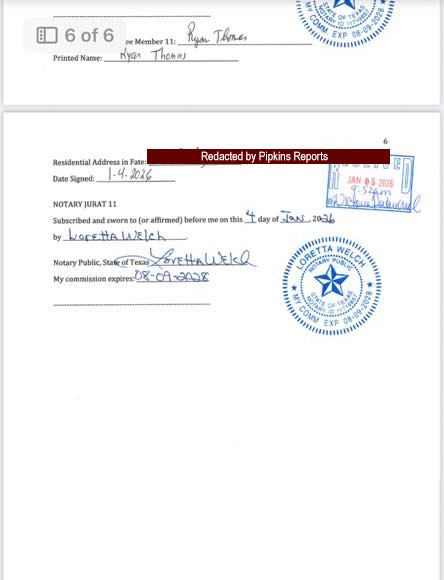
The report identifies multiple Fate residents as victims — whose names we have redacted. The remaining redactions, which includes addresses of the victims as shown on the documents below, were made by the City of Fate.
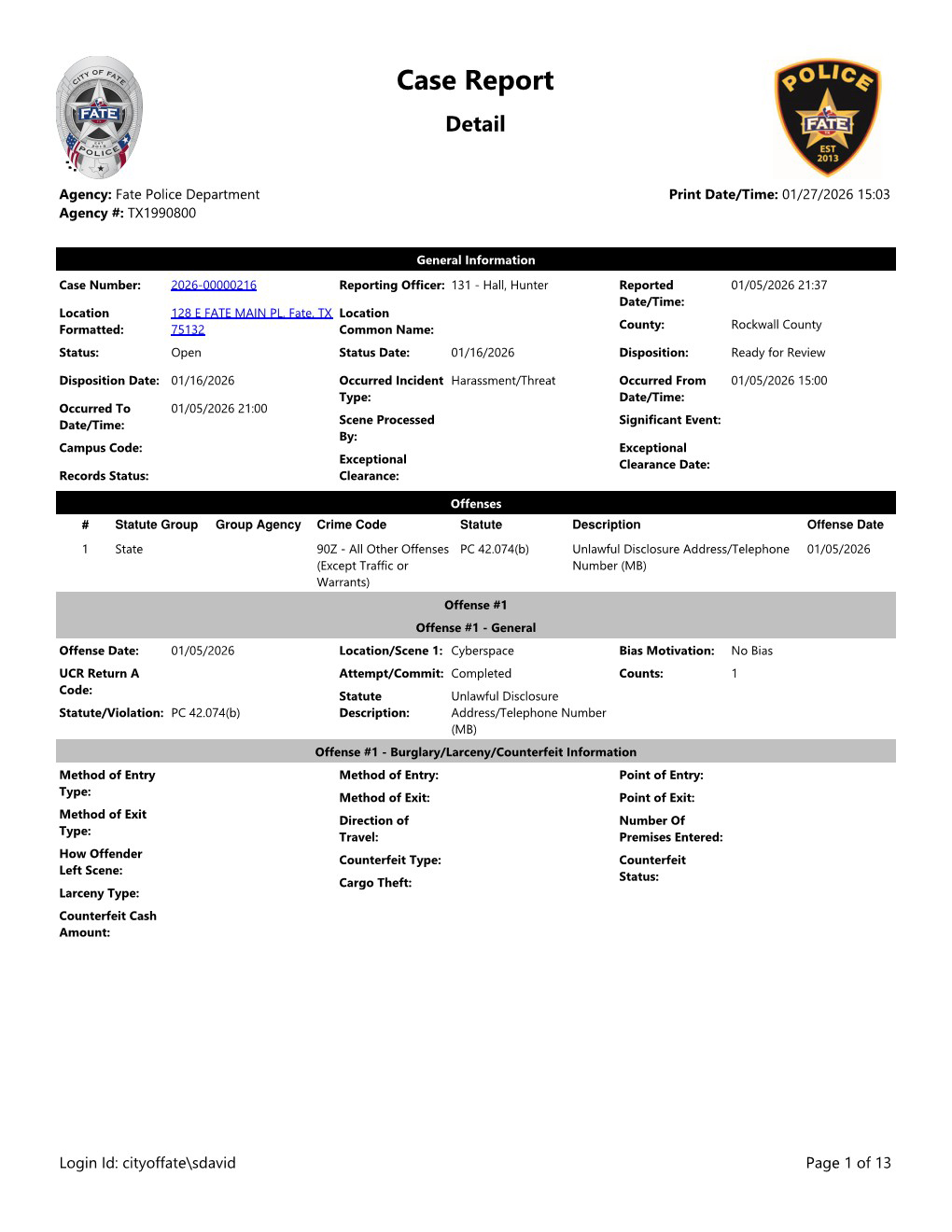
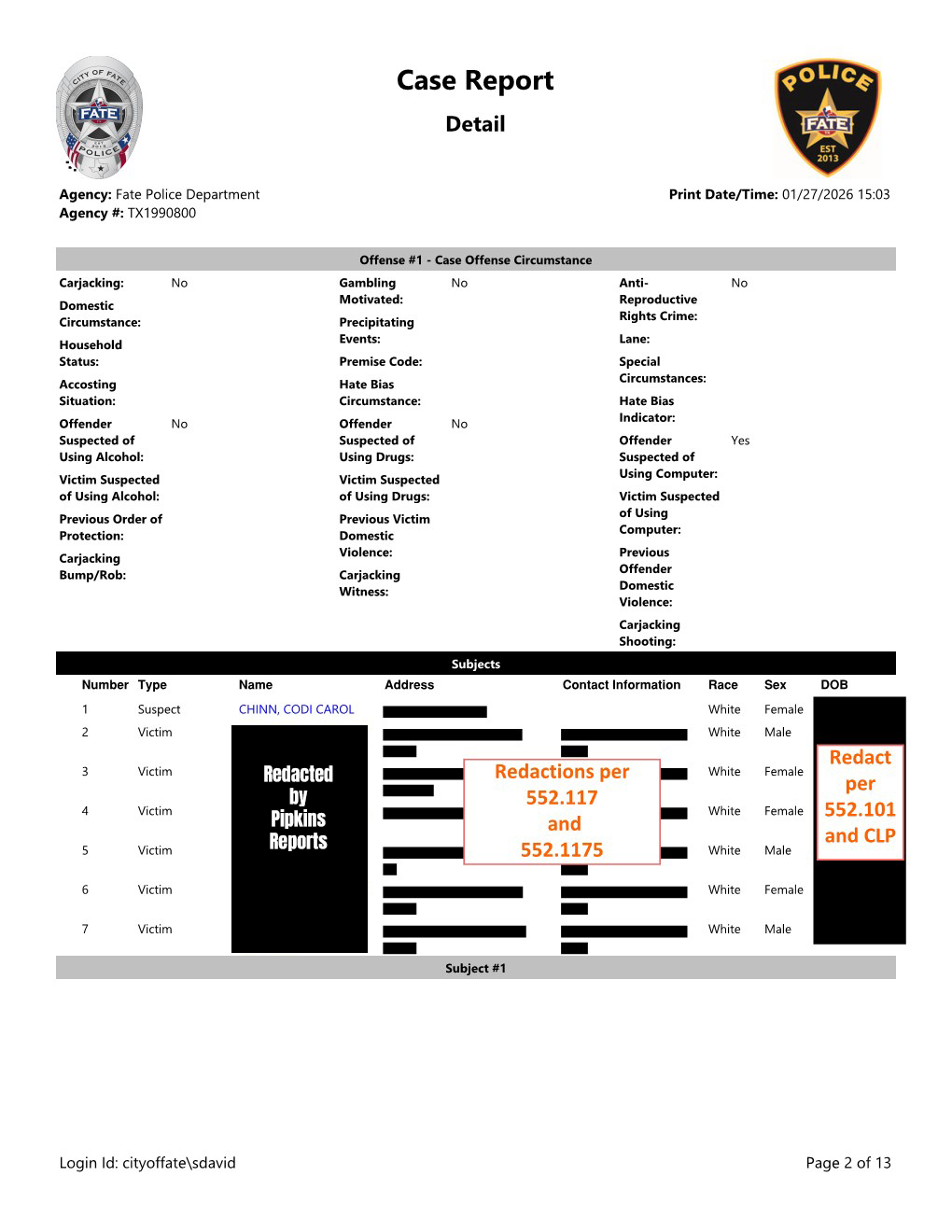
[Pages of complaint against Fate Councilwoman Codi Chinn received via Open Records Request. Pipkins Reports has provided an additional redaction to the victims names.]

What triggered the complaint

According to the complainants, after the recall petition was formally submitted to the City of Fate, the document — which included the names and home addresses of the recall committee members — was distributed by the city manager to all members of the city council, including Chinn. The citizens allege that Chinn later posted images of the unredacted petition pages on Facebook, thereby displaying the names and residential addresses of those responsible for initiating the recall.
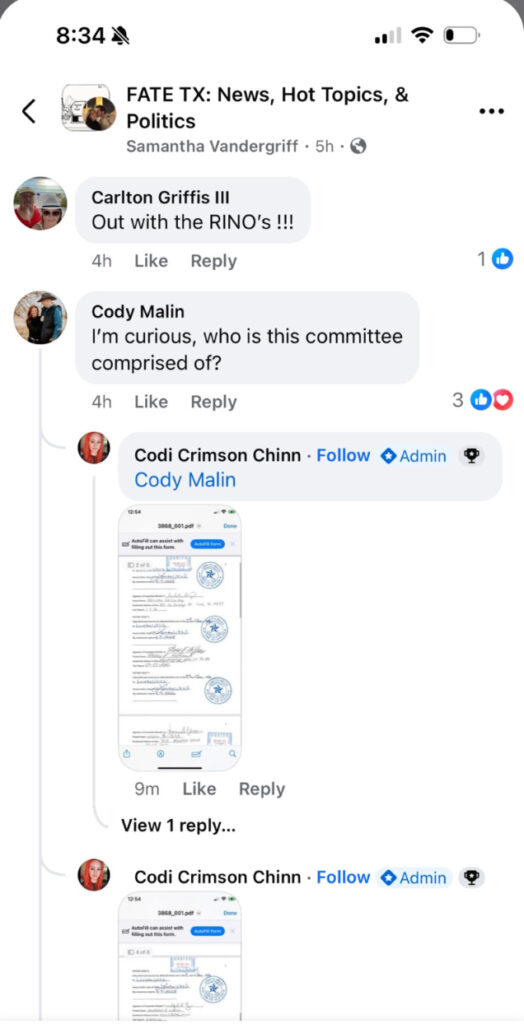
Facebook Post by Codi Chinn

Some of the petition committee members then filed a criminal complaint, asserting the disclosure exposed them to potential harassment and intimidation. The police report reflects that allegation by citing the specific statute related to unlawful disclosure of personal information.

A public statement of fear

During Fate City Council meetings on February 2, 2026 and the following week on February 9, 2026, some individuals spoke during the public comment period and stated, on the record, that they believe the disclosure has placed both themselves and their family in danger. One person spoke about how their children were harassed and frightened. She even spoke about how her children have taken to carry nerf guns … in case something happened to daddy and they needed to protect mommy.

The law at the center of the case

Texas Penal Code §42.074 — Unlawful Disclosure of Personal Information

Texas law makes it a criminal offense to post on a publicly accessible website, or distribute electronically, the home address or telephone number of an individual with intent to cause harm or threaten harm.

  • Classified as a Class B misdemeanor
  • Elevated to Class A if bodily injury results
  • Contains an exemption for public servants only when releasing information as part of their official duties in accordance with law.

The statute does not prohibit publishing a person’s name or signature. It specifically protects residential address and telephone number. Furthermore, the mere posting of an address, absent intent to harm, does not automatically satisfy the statute.

That distinction is central to the complaint.

Why this is unusual

Recall petitions are public political documents. Names of organizers are not confidential. Addresses, however, are often redacted by municipalities before release in open records responses.
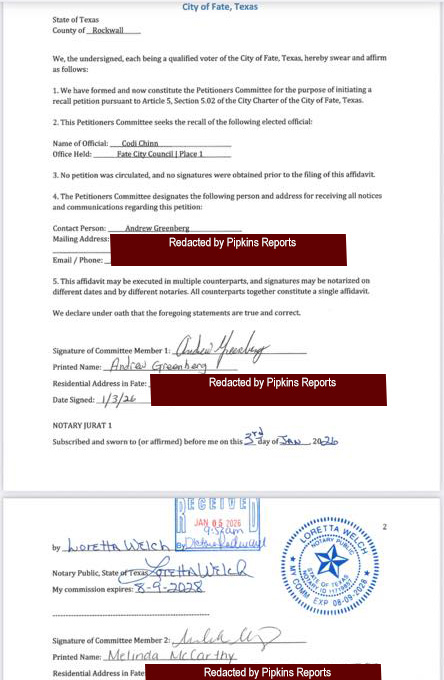
The complainants argue that while the petition itself is public, the manner in which it was posted — unredacted, on social media, without city review — falls outside normal procedure and outside any official city function.

There is also no record indicating that Chinn was designated by the city in any official capacity to disseminate public records or communicate such materials to the public. The City of Fate maintains a Public Information Officer (PIO) role specifically tasked with handling the release of documents and public communications.

The police report does not determine intent. It documents that a complaint was made, identifies a statute, and names a suspect.

What the police document confirms

The report confirms:

  • A complaint was filed January 5, 2026
  • The alleged incident occurred online
  • A specific criminal statute was cited
  • Chinn is listed as the suspect
  • The listed victims are recall participants
  • The case is active and under review

It does not state that a crime occurred. It does not assign motive. It does not announce charges. It establishes that law enforcement considered the allegation serious enough to open a formal case.

The public servant exemption question

A key issue likely to be examined by prosecutors is whether Chinn’s posting of the petition falls under the statutory exemption for public servants acting within their official duties. The exemption applies only when disclosure is required by law or when disclosure is performed as part of an official governmental function.

The complainants contend that Chinn is not the city Public Information Officer (PIO) and is not authorized to post information on behalf of the city. They allege that posting the document to a personal Facebook page, without redaction and without city authorization, does not meet that threshold. They allege that the disclosure functioned as retaliation for initiating the recall.

What happens next

The case status of “Ready for Review” indicates the report has been forwarded for prosecutorial consideration. Whether the matter results in charges will be determined by the Rockwall County District Attorney, Kenda Culpepper, after review of the evidence.

Until then, the matter remains an open investigation.

Why this matters beyond Fate

Texas’ unlawful disclosure statute is increasingly cited in cases involving online publication of personal data. The law was designed to address modern forms of harassment often referred to as “doxxing.”

This case tests how that statute applies when the disclosure occurs in the context of a political dispute between elected officials and citizens.

It raises a novel question:

When does sharing a public document cross into unlawful disclosure?

That answer now sits in a police file.

Documentation

All information in this report is drawn from the Fate Police Department case report obtained through an open records request and social media sources. Home addresses, or potential victims’ names from the petition are not presented here to avoid republishing the information at issue in the investigation.

Pipkins Reports reached out to Councilwoman Chinn for comment before publication and received a call from her attorney, Cody Skipper, with Shook & Gunter Attorney at Law. Skipper’s response was, “Codi Chinn has done nothing wrong, nothing illegal, nothing unethical. Codi Chinn has done her job as a public servant.

We also asked Mr. Skipper if he thought that when she posted the petition, if she was acting in an official capacity. He stated, “Every one of these people are acting in an official capacity.

We have also verified that the Facebook post containing the recall petition with the committee members’ addresses has been removed. It is unclear when the post was removed.


Michael Pipkins focuses on public integrity, governance, constitutional issues, and political developments affecting Texans. His investigative reporting covers public-record disputes, city-government controversies, campaign finance matters, and the use of public authority. Pipkins is a member of the Society of Professional Journalists (SPJ). As an SPJ member, Pipkins adheres to established principles of ethical reporting, including accuracy, fairness, source protection, and independent journalism.

Council

Ethics Fight Ends in Censure of Councilman Mark Hatley

Published

on

Ethics Censure Hatley

FATE, TX — The Fate City Council voted last night to censure Councilman Mark Hatley following a contentious ethics hearing that exposed deep divisions among elected officials.

The censure stems from two ethics complaints alleging Hatley improperly disclosed confidential information tied to internal discussions about the potential firing of former Department of Public Safety Chief Lyle Lombard. According to testimony, Hatley shared details with local journalist Michael Pipkins of PipkinsReports.com, including references to recorded conversations with City Manager Michael Kovacs.

The complaint was filed by outgoing councilman Scott Kelley, who played a central role throughout the proceedings and ultimately did not recuse himself and voted in favor of censure.

Monday’s meeting included a formal evidentiary hearing where Hatley, represented by attorney David Dodd, presented a defense and attempted to question fellow council members. The process, however, was repeatedly constrained by legal warnings from City Attorney Jennifer Richie, who advised council members not to answer questions related to Lombard’s termination due to ongoing litigation. That guidance, issued numerous times during the hearing, limited testimony and narrowed the scope of cross-examination.

The council ultimately split along familiar lines. Kelley was joined by outgoing councilman Mark Harper and recalled councilwoman Codi Chinn in supporting the censure. Mayor Andrew Greenberg and Councilman Rick Maneval opposed it, creating a 3–2 divide before the deciding vote was cast. Councilwoman Martha Huffman ultimately sided with the majority, breaking what would have otherwise been a tie, and would have quashed the censure.

Under Texas municipal norms, a censure is a formal statement of disapproval by a governing body against one of its own members. It carries no direct legal penalty, meaning Hatley retains his elected position and voting authority. However, such a reprimand can damage political standing, limit influence within the council, and shape future electoral prospects…if the electorate so decides.

The underlying controversy traces back to the dismissal of Lombard, which has since evolved into a broader legal dispute involving claims of wrongful termination. During Monday’s hearing, repeated references to that litigation underscored the complexity of the case and the limits placed on public disclosure. Richie’s guidance, aimed at protecting the city’s legal position, effectively curtailed testimony that might have clarified key details. Critics argue this dynamic left Hatley unable to fully defend himself against the allegations.

The political context surrounding the vote is difficult to ignore. This was Chinn’s last meeting, as she was recalled from office by the voters, in part due to her involvement in the Lombard matter. Kelley, who initiated the ethics complaint, participated fully in the decision-making process knowing that this was his last meeting. Harper has also been linked in prior discussions about leadership conflicts within city administration, and for he as well, this was his last meeting. Meanwhile, all three have supported recall efforts targeting Hatley, Greenberg, Maneval, and Huffman, for additional recall, along with two new councilmen who will take their seats at the next meeting.

From a procedural standpoint, the meeting reflected a council operating under significant strain. Testimony was fragmented, legal cautions were frequent, and the final vote appeared to follow established political alliances rather than shifting based on evidence presented during the hearing. Even Hatley’s legal representation struggled to gain traction within the constraints imposed by the city’s legal posture.

Opinion

The battle for power in Fate is very real. What unfolded Monday night was not merely an ethics hearing; it was the visible culmination of an ongoing political battle inside Fate’s leadership. When a complainant votes on his own accusation; when key witnesses are effectively shielded from cross examination; when you have councilmen under recall by the very people bringing charges against their opponents; the process begins to look less like a search for truth and more like a managed outcome. It’s cut-throat politics at its worst.

What’s changed due to this Hearing? Essentially, nothing. Hatley gets a political black eye, but that’s about it. The sides were already defined, and the votes exactly as expected. Councilmen whose terms were ending anyway are now gone after delivering one last poke in the eye to their opponents. And the City Manager, who is at the heart of this debacle because of his employee decisions, and his inability to stand up to influence from Council Members… is still employed.

For residents of Fate, the final result is an up-close view into how dirty local politics can get. It diminishes the desirability of the city to new residents, hurts economic growth, and the entire process gives citizens the perspective that their city government is completely dysfunctional.

Disclosure

The author of this article was referenced during the hearing as a recipient of information discussed in the ethics complaints. The reporting above is based on observations of the public meeting and review of the proceedings.

Continue Reading

Council

Recall Petitions Verified Against Four Fate Officials, Elections to Follow

Published

on

Recall Mob Gets Signatures

FATE, TX — The political battle in Fate has escalated significantly, as Vickey Raduechel, the City Secretary for Fate, has completed her review and verified that the recall petition signatures submitted against four of the city’s top elected officials are “sufficient”.

According to official confirmation obtained by Pipkins Reports, the petitions to recall Mayor Andrew Greenberg, Councilman Rick Maneval, Councilman Mark Hatley, and Councilwoman Martha Huffman have now been verified following their submission on April 6, 2026.

With the verification process complete, the petitions have cleared a critical legal hurdle, setting the stage for recall elections that could reshape the city’s leadership.

Verified Signature Counts

As part of the certification process, the City Secretary validated the number of signatures submitted for each petition to ensure compliance with the city charter requirement of at least 351 qualified voters.

  • Andrew Greenberg, Mayor (contained 385 valid signatures)
  • Richard Maneval, Council Member Place 4 (contained 366 valid signatures)
  • Mark Hatley, Council Member Place 5 (contained 382 valid signatures)
  • Martha Huffman, Council Member Place 6 (contained 353 valid signatures)

*Update: The City of Fate responded to our inquiry and provided the verified signature counts above.

From Petition Drive to Certification

The now-verified petitions mark the culmination of a 30-day signature collection effort launched in early March. Organizers, led by local activists Christopher Rains, and Ashley Rains, who is running for City Council, initiated the recall campaign in response to actions taken by the same officials against Councilwoman Codi Chinn. Chinn is already scheduled to face voters in the May 2nd, 2026 election.

As previously reported by Pipkins Reports , the effort quickly mobilized residents, with organizers establishing signing locations and conducting outreach across the community.

Supporters of the recall effort have framed it as a necessary check on elected officials, while critics have argued it represents political retaliation. The certification of the petitions now shifts the debate from signature gathering to the ballot box.

What Happens Next

Under the Fate city charter, once recall petitions are certified as sufficient, the city council is required to formally call a recall election. That process includes setting an election date and coordinating with election officials to place the measure before voters. It is likely that the recall election will be set for November 2026. Estimates indicate this recall will cost taxpayers up to $15,000.

Unless one of the targeted officials resigns—and the vacancy is filled by the remaining council prior to any election—there is a credible risk of a temporary governance breakdown if voters remove all four members at once, a scenario explored in prior Pipkins Reports coverage examining how a full-scale recall could leave the city unable to function.

The outcome of these efforts could result in a significant shift in the composition of the city council—and potentially the mayor’s office—depending on how voters respond.

This is an ongoing story. Pipkins Reports will continue to provide updates as recall election dates are announced and additional details become available.

Continue Reading

Council

Fate City Council Finds “Credible Evidence” Against Mark Hatley, Moves Toward Hearing

Published

on

Hatley under Oath

FATE, TX — The Fate City Council voted Monday night to formally recognize what it called “credible evidence” that Councilman Mark Hatley may have violated the city’s Code of Ethics, setting the stage for a hearing and potential sanctions, and intensifying an already bitter political divide.

The decision came following an executive session on Monday night, and considered a motion by Councilman Scott Kelley, who was the person who filed the ethics complaint against Hatley. Kelley’s motion asserted that the council had sufficient basis to proceed under Section 2-309.10 of the Fate Code of Ethics and Section 3.093 of the City Charter.

The motion passed with support from Codi Chinn, Scott Kelley, Mark Harper, and Martha Huffman. Mayor Andrew Greenberg and Councilman Rick Maneval voted against the measure, according to the official meeting record and public proceedings.

It remains unclear from the meeting record whether Hatley voted on the motion concerning himself. He was not presented as voting in the negative, yet the Mayor made no mention of him abstaining either.

Mayor Greenberg highlighted that this process is political, not criminal.

Following the vote, Kelley introduced a second motion, requesting that Hatley provide a sworn affidavit within seven days addressing key questions tied to the investigation.

Those questions focused on whether Hatley had shared recorded conversations involving City Manager Michael Kovacs with anyone outside city government, including investigative journalist Michael Pipkins. The motion also sought to compel Hatley to cooperate with any additional information requests from the city’s Ethics Council.

Councilwoman Chinn clarified during the discussion that Hatley is not legally required to submit such an affidavit, implying the request is voluntary rather than enforceable under current rules.

The council set the public hearing for May 4, 2026.

That date falls after the city’s General Election on May 2, but before the results are officially canvassed on May 11, meaning the current council will still be seated at the time of the hearing.

Harper currently holds Place 2, a seat being sought by candidates Lorna Grove and Ashley Rains. Rains is one of the petition members seeking to remove multiple councilmembers, including Hatley, through a new recall effort.

Kelley holds Place 3, which is being sought by former Councilman Allen Robbins and Melinda McCarthy. Robbins is also aligned with those supporting the recall of the four councilmen, while McCarthy supported the recall of Codi Chinn, which is already on the ballot for May 2nd.

Early voting for that election is scheduled to begin April 20.

Continue Reading