Connect with us

Published

on

First Amendment Clash Erupts

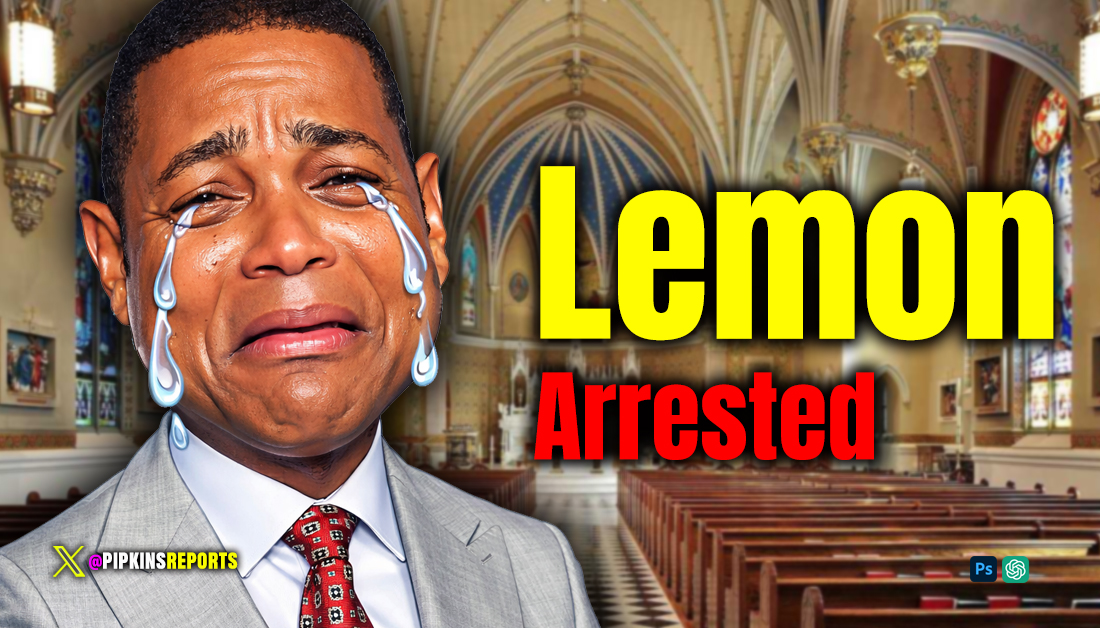
LOS ANGELES, CA – Former CNN anchor and independent journalist Don Lemon was taken into federal custody Thursday night in Los Angeles, in connection with a disruptive protest that entered a St. Paul, Minnesota church during a service on January 18, 2026.

Federal agents, acting on information developed by prosecutors, apprehended Lemon while he was in California covering the Grammy Awards. This stunning development has ignited nationwide debate over protest rights, press freedom, and federal enforcement priorities.

Don Lemon, 60, a former CNN primetime anchor and currently an independent media figure and commentator, is known for his radical leftist ideology and anti-white racist slant in his reporting. After being fired from CNN he started his own podcast which can be seen on YouTube and iHeart.

Abbe Lowell, Lemon’s attorney, confirmed the arrest and provided the account of events to multiple outlets.

Multiple unnamed federal law enforcement sources and government officials are involved in the investigation.

Sources say Lemon was taken into custody under federal authority, though specific criminal charges have not yet been publicly disclosed. Federal agents reportedly acted after a grand jury was empaneled earlier on Thursday, indicating prosecutors are pursuing formal charges tied to the church incident.  

The Minnesota protest targeted a pastor allegedly associated with ICE, and demonstrators called for removal of federal immigration enforcement involvement in local communities. The service disruption drew immediate attention from local media and legal authorities, and the federal government opened a civil rights and enforcement inquiry.  

At least three other individuals connected to the protest have been arrested in connection with civil rights violations related to disrupting the church service. Authorities have indicated that any action in a place of worship, including entering without permission and interrupting religious activities, can invoke both criminal and civil statutes protecting access to houses of worship.

LEGAL BACKGROUND SO FAR

Earlier in the month, a federal magistrate judge refused to approve charges against Lemon, citing insufficient evidence at that early stage. Prosecutors were reportedly instructed to seek a grand jury indictment instead. Subsequently, that path appears to have succeeded, culminating in the arrest.  

At least one federal appellate panel previously declined the Justice Department’s emergency request to authorize an arrest, though one judge acknowledged probable cause existed. This procedural history illustrates the complexity of prosecuting protest-related actions that intersect with press coverage and constitutional protections. The magistrate’s rejection, and subsequent grand jury action, have raised questions about prosecutorial judgment and judicial oversight.  

RESPONSES FROM THE PARTIES

Lawyer Abbe Lowell — representing Lemon — publicly denounced the arrest as an attack on the First Amendment,” asserting Lemon was acting entirely in his capacity as a journalist and that his actions were constitutionally protected reporting. Lowell vowed that Lemon will “fight these charges vigorously and thoroughly in court.”  

Lemon himself has consistently maintained he was present to report and document, not to participate, and that he had no organizational role in the demonstration.  

Federal authorities have not released official statements on the legal basis for the arrest, and charges remain undisclosed in public filings as of this publication. Prosecutors have linked the church disruption to violations of laws designed to protect the free exercise of religion and civil rights, but official charging documents have not yet been filed in open court.  

This arrest marks a rare instance where a national media figure has been taken into custody for coverage of a protest event, particularly one involving the disruption of a religious service. For conservative observers and press freedom advocates alike, the case poses questions about the boundary between journalism and participation in politically charged events, and whether the federal government is setting a precedent for prosecuting media figures covering controversial demonstrations.

Legal scholars note that journalists generally receive broad protection under the First Amendment when documenting events, even if those events turn chaotic or involve other participants committing crimes. The government’s position, as implied by its pursuit of Lemon, suggests prosecutors believe Lemon’s presence and actions may have crossed a legal line — a position his defense vigorously disputes.  

Observers expect formal charges to be announced when Lemon next appears in federal court, potentially in Los Angeles. The case is likely to draw intense scrutiny from press freedom groups, civil liberties advocates, and political commentators nationwide.

Opinion and Analysis

The arrest of Don Lemon raises serious questions: Are journalists being held to the same standards as ordinary citizens when they cover protests? The First Amendment is clear — the freedom to gather news is sacred and necessary to hold government accountable. Yet this case demonstrates how federal enforcement can transform neutral reporting into a prosecutorial target when political sensitivities run high.

If Lemon truly was reporting, walking ahead of protestors who later disrupted a service, then the act of documenting events should be protected. The government’s expansion of enforcement into spaces where journalistic documentation occurs threatens to blur the line between witness and participant — a dangerous ambiguity that chills free speech and press freedom.

Conversely, if Lemon participated in the disruption of worship services by providing aid or assistance in any way, he was no longer a reporter, and his press badge would not act as a shield from prosecution. The federal statutes designed to protect religious gatherings are legitimate insofar as they preserve Americans’ rights to worship without intimidation or interference. Enforcement of those statutes should be even-handed, not influenced by political or media status.

Here’s the critical question: Is the DOJ enforcing law impartially, or choosing political targets? That answer will shape the future of American civil liberties. Lemon’s arrest is not just about one man — it is about the fundamental guarantees of free expression and religious liberty in a democratic society.


Michael Pipkins focuses on public integrity, governance, constitutional issues, and political developments affecting Texans. His investigative reporting covers public-record disputes, city-government controversies, campaign finance matters, and the use of public authority. Pipkins is a member of the Society of Professional Journalists (SPJ). As an SPJ member, Pipkins adheres to established principles of ethical reporting, including accuracy, fairness, source protection, and independent journalism.

Continue Reading
Click to comment

You must be logged in to post a comment Login

Leave a Reply

Election

Texas Conservatives Turn on Cornyn as Paxton Surges

Published

on

Cornyn vs Paxton

OPINION – For years, Texas conservatives have watched Republicans campaign as fighters back home, only to return to Washington and govern like cautious corporate managers. That frustration is now boiling over in the growing divide between Texas Attorney General Ken Paxton and U.S. Senator John Cornyn, a battle that increasingly defines the Republican Party in Texas.

Paxton has become one of the most aggressive conservative legal figures in America. Cornyn, meanwhile, is increasingly viewed by grassroots Republicans as an establishment insider tied to the old Bush era wing of the GOP. The contrast could hardly be sharper.

Paxton built his reputation fighting the Biden administration on immigration, election disputes, COVID mandates, and federal overreach. Supporters say he has consistently used the Attorney General’s office to defend Texas sovereignty and conservative values. President Donald Trump praised Paxton during his 2022 reelection fight, calling him “a true warrior for conservative values” while endorsing him against challenger George P. Bush.

For many Texas Republicans, Trump’s support mattered because Paxton was already viewed as willing to confront Washington directly rather than negotiate with it.

Cornyn has found himself on the opposite side of many of those same debates. Conservatives sharply criticized his role in bipartisan gun negotiations after the Uvalde shooting, but immigration remains the biggest source of anger among the Republican base. Cornyn has long supported expansions of employment based immigration programs, including H1B visa policies favored by major corporations.

Critics argue those programs have displaced American workers in industries like engineering, healthcare, technology, and data services by allowing companies to import cheaper foreign labor. Over the years, outsourcing firms and tech companies have repeatedly faced backlash after replacing American employees with foreign visa workers, sometimes even requiring laid off staff to train their replacements before leaving.

Cornyn argues skilled immigration helps fill labor shortages and strengthens the economy. But many Texas conservatives increasingly see the system as benefiting multinational corporations while middle-class American workers fall behind.

Paxton has aligned himself almost entirely with border hawks and immigration enforcement advocates. He has repeatedly sued the Biden administration over border policies and backed Texas efforts to secure the southern border independently of federal action. Supporters argue those lawsuits helped slow federal policies they believed encouraged illegal immigration and weakened state sovereignty.

Some conservatives also frame the immigration debate in cultural and security terms, warning that unchecked migration and weak assimilation policies can destabilize communities and strain public resources. Paxton supporters often portray him as defending Texas from the kinds of social fragmentation seen in parts of Europe.

Cornyn’s critics increasingly label him a “RINO,” shorthand for Republican In Name Only, arguing that he represents donor class priorities rather than grassroots conservatives. Trump allies have also criticized Cornyn as part of the “old Republican guard” that voters rejected during Trump’s rise. Cornyn’s primary supporter is the Lone Star Freedom Project, a dark money 501c(4) operated by former Texas Governor Rick Perry.

Opinion sections are where political realities become unavoidable. The reality is this: many Texas Republicans no longer want cautious institutional Republicans who focus on compromise while Democrats aggressively push cultural and political change nationwide.

They want confrontation. They want resistance. They want politicians willing to fight publicly and relentlessly.

That explains why Paxton continues to maintain strong support despite years of legal and political attacks. Many conservatives interpret those attacks not as proof he should step aside, but as proof he threatens entrenched political interests.

Cornyn, meanwhile, increasingly represents a Republican era many grassroots voters believe failed to defend the border, protect American workers, or stand firmly against Washington’s expansion of power. In today’s Texas Republican politics, that perception may be impossible to overcome.

Continue Reading

Featured

“Judge Speedy” Hits the Wall: Bexar County Jurist Resigns, Accepts Lifetime Ban from Texas Bench

Published

on

Rosie Speedlin Gonzalez

SAN ANTONIO, Texas — The political and legal downfall of Bexar County Judge Rosie Speedlin-Gonzalez came to a dramatic conclusion after the embattled jurist resigned from office and accepted a permanent lifetime ban from serving on the Texas bench .

The resignation agreement, signed in April and confirmed by the State Commission on Judicial Conduct, ends months of controversy surrounding Speedlin-Gonzalez, who faced criminal charges and multiple judicial misconduct complaints stemming from a heated courtroom confrontation involving a San Antonio defense attorney.

Speedlin-Gonzalez, an openly gay Democrat who had served on Bexar County Court-at-Law No. 13 since 2018, formally agreed she would be, “forever disqualified from judicial service in the State of Texas.” The agreement prohibits her from serving as a judge, accepting judicial appointments, or performing judicial duties in the future.

The scandal centered on a December 2024 courtroom incident involving defense attorney Elizabeth Russell. Prosecutors alleged Speedlin-Gonzalez ordered Russell handcuffed and detained in the jury box during a contentious exchange after accusing the attorney of coaching her client during a probation revocation hearing.

A Bexar County grand jury later indicted the judge on charges of unlawful restraint and official oppression. Court documents alleged that Speedlin-Gonzalez knowingly restrained Russell without consent while acting under the authority of her judicial office.

The incident generated national attention and quickly became one of the most talked about judicial controversies in Texas. Video clips and courtroom details circulated widely online, while critics questioned whether the judge had crossed a clear constitutional line by using courtroom authority against a practicing attorney during active proceedings.

KSAT reported last month that special prosecutor Brian Cromeens later moved to dismiss the criminal charges after Speedlin-Gonzalez agreed to resign and permanently leave the judiciary. According to reports, prosecutors concluded the resignation and lifetime ban sufficiently addressed the public interest concerns surrounding the case.

The resignation agreement also referenced several additional complaints against the now former judge. One complaint alleged she displayed an “unprofessional demeanor” toward a criminal defendant and failed to timely address motions involving bond modifications and habeas corpus requests. Three additional complaints accused her of abusing judicial authority by issuing “no contact” orders restricting communications among court personnel and former employees.

Speedlin-Gonzalez had already faced disciplinary scrutiny before the handcuffing controversy erupted. According to the San Antonio Express-News, the State Commission on Judicial Conduct previously issued a public warning after she congratulated winning attorneys on social media and posted their photographs on her official judicial Facebook page. The commission also reportedly ordered additional education after complaints involving a pride flag displayed inside her courtroom.

In January, shortly after the indictment became public, Speedlin-Gonzalez defended herself in comments to the New York Post.

I’m a proud public servant, I’m LGBTQ, I own a gun, I’m bilingual, I’m an American citizen, and I have every right to defend myself,” Gonzalez told the outlet. “As long as I walk in righteousness and have God at my side I will be fine.

The judge was suspended without pay earlier this year while disciplinary proceedings continued. During that suspension, visiting judges rotated through County Court-at-Law No. 13 to handle pending cases and specialty court matters.

Court-at-Law No. 13 is known in part for overseeing Reflejo Court, a specialty program focused on first time domestic violence offenders and treatment based intervention programs.

The controversy also arrived during a difficult reelection season for Speedlin-Gonzalez. In March, she lost her Democratic primary race to challenger Alicia Perez, effectively ending her political future even before the disciplinary case concluded.

The agreement signed by Speedlin-Gonzalez states that by accepting resignation and permanent disqualification, she does not admit fault or guilt regarding the allegations against her. Such provisions are common in negotiated judicial disciplinary settlements.

One narrow exception remains under the agreement. Speedlin-Gonzalez may still officiate wedding ceremonies, provided she does not wear judicial robes or imply she retains judicial authority while conducting them.

Speedlin-Gonzalez was widely described as the first openly LGBT judge elected in Bexar County. Supporters frequently highlighted that milestone during her tenure on the bench, while critics argued the attention surrounding identity politics often overshadowed concerns about courtroom conduct and professionalism.

Permanent judicial disqualifications remain relatively uncommon in Texas, particularly involving sitting elected county judges. The case now joins a growing list of disciplinary actions taken by the State Commission on Judicial Conduct against jurists accused of misconduct or abuse of authority.

Continue Reading

Featured

UFO Files Released

Published

on

UFO Files Released

Trump’s “UFO Files” Drop Lands With a Thud, Leaving Believers and Skeptics Equally Unsatisfied

Department of War – For years, UFO believers promised the truth was buried somewhere deep inside government vaults, hidden behind classified markings and decades of official denials. The long-awaited disclosure, they said, would prove humanity is not alone. So when the Trump administration released a major archive of UFO-related material this week, anticipation exploded across social media and conspiracy circles alike. The result, however, landed with all the excitement of opening a mystery safe only to discover it filled with newspaper clippings, hobby magazines, and blurry photos of distant lights in the sky.

The files were released through the federal archive portal at www.WAR.GOV/UFO Files and include videos, audio recordings, witness statements, correspondence, and archival documents connected to unidentified flying objects, now often called unidentified anomalous phenomena, or UAPs.

The website also prominently features a statement from Donald Trump posted from Truth Social:

“Based on the tremendous interest shown, I will be directing the Secretary of War, and other relevant Departments and Agencies, to begin the process of identifying and releasing Government files related to alien and extraterrestrial life, unidentified aerial phenomena (UAP), and unidentified flying objects (UFOs), and any and all other information connected to these highly complex, but extremely interesting and important, matters. GOD BLESS AMERICA!”

The Department of War website also states that additional material will continue to be released on a weekly basis, suggesting the current archive represents only the first phase of a broader disclosure effort. That announcement has kept many UFO enthusiasts hopeful that more substantial evidence could still emerge in future document dumps.

For now, however, the initial release appears to contain little that fundamentally changes the public understanding of UFO phenomena.

Despite years of sensational claims about craft performing maneuvers that supposedly “defy physics,” none of the videos included in the archive appear to show anything close to that. The objects captured on camera are consistently small, far away, and moving in mostly straight lines at what appear to be ordinary, subsonic speeds. There are no impossible right-angle turns, no instantaneous acceleration, no sudden stops, and no visible flight characteristics beyond what could plausibly be explained by conventional objects or optical effects.

File: DOD_111688964 – Taken 2024-06-01 – The United States Northern Command submitted a report of an unidentified anomalous phenomenon (UAP) to the All-domain Anomaly Resolution Office (AARO) consisting of 21 seconds of video footage from an infrared sensor aboard a U.S. military platform in 2024. An accompanying mission report, DoW-UAP-D8, described the UAP as consisting of an object with a vertical pole or bar attached to the bottom of the object. The observer also reported that the UAP may instead be a reflection from an object in the water.

Most of the footage consists of little more than bright shiny objects against the sky, filmed from such extreme distances that meaningful identification becomes nearly impossible. A few clips appear consistent with balloons or commercial drones. Others show glowing or reflective orbs with no discernible structure or detail. None of the material independently verifies the extraordinary claims often promoted by UFO media personalities and internet commentators.

The release arrives after years of mounting public fascination with UFOs. Congressional hearings, Pentagon acknowledgements of unexplained aerial sightings, and endless online speculation helped create expectations that the government might eventually reveal evidence of non human intelligence. Those expectations likely contributed to the enormous interest surrounding this document dump.

But much of the archive reads less like disclosure and more like an oversized collection of unresolved anecdotes and cultural memorabilia. Witness statements describe strange lights, odd movements, and unusual sightings, but almost none are supported by physical evidence, radar tracking, or technical analysis capable of independent verification. Some are handwritten personal accounts submitted decades ago by ordinary citizens reporting mysterious experiences investigators apparently could neither confirm nor explain.

A surprisingly large portion of the collection focuses on civilian UFO enthusiast organizations that published magazines and newsletters dedicated to sightings and theories about alien life. Rather than classified military revelations, many files simply document the activities of hobbyist groups fascinated by UFO culture during the Cold War era and beyond.

The archive also includes letters from school children asking the government whether flying saucers and aliens are real. While historically interesting as a reflection of American pop culture and public curiosity, the letters offer no evidentiary value regarding extraterrestrial life. Some of the material feels more appropriate for a museum exhibit on twentieth century UFO fascination than for a headline generating government disclosure project.

NASA related recordings and footage included in the release similarly failed to produce dramatic revelations. Most involve routine aerospace operations, ambiguous observations, or discussions about unidentified objects without any conclusion that they originated from beyond Earth. NASA has consistently maintained there is no confirmed evidence of alien visitation, and nothing in this release appears to alter that position.

Reaction online quickly shifted from excitement to frustration. Some UFO believers claimed the truly important files are still hidden behind classification barriers and that the public release was carefully sanitized before publication. Skeptics argued the archive merely reinforces what critics have long maintained, that UFO mythology survives largely because blurry footage and incomplete information allow people to project extraordinary conclusions onto ordinary phenomena.

Notably absent from the release are the kinds of materials long promised in sensational documentaries and conspiracy forums. There are no recovered alien craft, no biological specimens, no authenticated extraterrestrial communications, and no government memos admitting contact with non human intelligence. More importantly, there is no footage of any object displaying flight characteristics that genuinely challenge known physics.

That disconnect between public expectation and documented reality may ultimately be the biggest story.

For decades, UFO culture has operated on the assumption that earth shattering proof exists just beyond public reach. Every blurry light becomes a possible spacecraft. Every vague government statement fuels another round of speculation. Entire media industries now thrive on the promise that disclosure is always right around the corner.

Yet when the files finally arrived, they mostly revealed what Americans have seen for generations, distant lights, uncertain observations, stories without proof, and a government willing to catalog mystery without necessarily solving it.

Perhaps future weekly releases from the Department of War will contain something more compelling. But if this first archive is any indication, Americans waiting for undeniable proof of alien visitation may need to lower their expectations considerably.

Continue Reading