Connect with us

Published

on

PAC Cash, Secret Alliances, and a Stack of Signs: Fate City Council Candidates Raise Eyebrows and Questions

Fate, Texas—In the small town of Fate, TX, where community events, neighborly chats, and local Facebook groups typically shape civic life—the 2025 City Council elections have taken a sharp turn toward big-money tactics, behind-the-scenes alliances, and political intrigue more befitting of Austin than a quiet Dallas suburb.

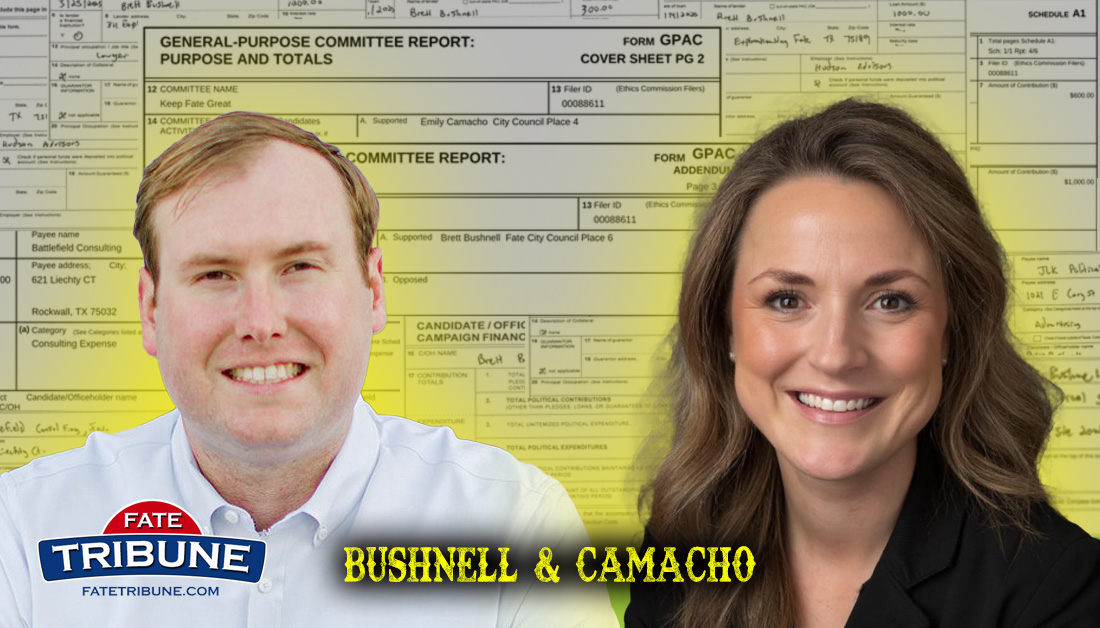
Candidates Emily Camacho and Brett Bushnell have emerged as the subjects of growing controversy, following campaign finance disclosures, reports of political coordination with a deeply unpopular outgoing mayor, and the visible backing of a local political action committee known for its heavy-handed tactics. Camacho faces off against Rick Maneval and George Lewis for Place 4, while Bushnell is challenging Martha Huffman for Place 6. Both seats are open due to incumbents who will not seek re-election.

What has historically been a low-cost, volunteer civic race has turned into a full-blown political operation—with all the red flags that come with it.

A Curious Entrance and a Pseudonymous Past: The Camacho Conundrum

Emily Camacho’s campaign is under scrutiny for how it began—before she even filed. Under the alias “Emily Schmuker,” she quietly joined a private Facebook group called “Fate May 2025,” a digital strategy room created for the explicit purpose of recruiting and promoting candidates who would oppose the current city council. The group had one goal: to flip the council in the next election. Camacho joined, stayed silent, and remained anonymous until after she officially filed to run.

Once discovered, she was promptly removed from the group—reportedly the only candidate to be ousted. The move sparked backlash and suspicion, especially after Camacho posted a self-serving, and defensive explanation on Facebook, complaining about her being removed from the group.

Camacho Facebook Post – Fate May 2025

In her response, Camacho confirmed that the group was created to recruit candidates and acknowledged joining for that very purpose, albeit under a different name tied to her “personal” Facebook account. She claimed she sat quietly to avoid drama, used the alias only for privacy, and “had no hidden agenda.” She further insisted her involvement was motivated by a desire for “transparency,” though the use of a pseudonym, combined with her sudden appearance as a candidate, has led many to question whether that transparency was ever truly intended.

Denials, PAC Money, and the Mayor’s Garage

Perhaps more concerning than her online identity are Camacho’s repeated denials of any political association with outgoing Mayor David Billings. Billings, who took office unopposed and without receiving a single vote, quickly became a deeply unpopular figure for his enthusiastic support of the “Strong Towns” development agenda—a framework that favors dense housing projects, including apartments, and centralized planning. Faced with mounting public pressure, Billings chose not to run for re-election.

Camacho has attempted to distance herself from him, stating plainly that she is not associated with the mayor. But campaign finance disclosures, along with local eyewitness accounts, paint a very different picture.

Both Camacho and Bushnell are endorsed by a local political action committee known as “Keep Fate Great,” a group formed by outgoing Councilman Lance Megyesi – Place 6. Not only is Billings a major donor to the PAC, but multiple residents have reported seeing stacks of Bushnell and Camacho campaign signs stored in the mayor’s garage. Reports also indicate Billings has been actively promoting both candidates and campaigning on their behalf.

Camacho claims her candidacy is powered by “grassroots support,” but the visible and financial backing of a PAC tied to Billings and Megyesi makes that assertion increasingly difficult to defend. Her denial of these connections has only fueled further distrust among voters.

Bushnell’s Big Spending: Six Loans, National Consultants, and a Question of Motive

Even more puzzling is the campaign finance report filed by Brett Bushnell, an attorney affiliated with investment firm Hudson Advisors. In the latest reporting period covering the first three months of 2025, Bushnell disclosed six separate personal loans to his own campaign, totaling over $7,750. This isn’t pocket change—it’s a significant financial commitment for a seat on a mostly, volunteer city council.

Unlike a donation, a loan implies an expectation of repayment. If Bushnell’s campaign raises funds from supporters, those donations could be used to pay himself back—raising ethical questions about how campaign dollars are being used and whether donors are truly aware that their money might be going straight back into the candidate’s wallet. Then there is the question of who are the clients of Hudson Advisors? Do they have any investors interested in Fate? These are valid questions.

Bushnell’s campaign spending has also raised eyebrows for its professional scope. He’s hired Battlefield Consulting, a political firm run by longtime GOP strategist Cindy Horne, who claims to have worked with the campaigns of George W. Bush and John McCain. This is the same exact firm hired by the “Keep Fate Great” PAC, run by Councilman Megyesi, and supported by Mayor Billings. Additionally, Bushnell retained JLK Political Strategies, a Virginia-based firm with national-level experience, including congressional and gubernatorial races.

The involvement of these high-dollar, political consultants for a city council race in Fate—a city whose councilmembers receive only $100 per month in salary—has sparked concerns among voters. What outside interest finds such value in controlling a small-town government?

Missing Agendas and the Elephant in the Room

Despite the political machinery supporting them, neither Bushnell nor Camacho has publicly detailed a policy platform. Their campaigns remain largely void of specifics and more on slogans: “Voices be heard”; “Safe neighborhoods”; “Local businesses thrive”; “Together we build”, yada, yada, yada. Instead, both have stuck to vague, feel-good language about “serving the community”, but nothing about plans on how to accomplish the “vision” or what they will do if actually elected.

Their opponents, by contrast—Huffman, Maneval, and Lewis—have offered clear and concrete proposals. Huffman, is fighting to preserve Fate’s suburban charm, pushing back against dense development. Maneval has called for a return to traditional zoning and fiscal government transparency. At a recent town hall meeting, when the candidates were asked who would have supported the widely unpopular development known as “LaFayette Crossing”? Two hands went up, Bushnell and Camacho. Indicating that if elected, Fate will get more of that.

The silence from Camacho and Bushnell on substantive issues is growing louder. It leaves many asking: Why are these campaigns spending so much money to say so little? It appears that their goal is to keep the status quo.

A Pivotal Election with Outsized Implications

The 2025 elections in Fate may prove to be the most consequential in the city’s history. At stake is not only the ideological direction of the city council, but also the question of whether Fate’s governance will be shaped by its citizens—or by a network of PACs, consultants, and political operatives with goals far removed from the concerns of everyday residents.

The aggressive political spending, shadowy alliances, and lack of transparency surrounding Camacho and Bushnell’s campaigns stand in stark contrast to the small-town values Fate voters hold dear.

Trust, once lost, is hard to regain. In this election, voters will decide whether they want representatives who are of the people—or candidates who answer to political strategists, silent financiers, and the legacy of a failed mayor.

With ballots set and early voting just around the corner, the future of Fate is in the hands of its citizens. And this year, that choice may matter more than ever.

Michael Pipkins focuses on public integrity, governance, constitutional issues, and political developments affecting Texans. His investigative reporting covers public-record disputes, city-government controversies, campaign finance matters, and the use of public authority. Pipkins is a member of the Society of Professional Journalists (SPJ). As an SPJ member, Pipkins adheres to established principles of ethical reporting, including accuracy, fairness, source protection, and independent journalism.

Council

Ethics Fight Ends in Censure of Councilman Mark Hatley

Published

on

Ethics Censure Hatley

FATE, TX — The Fate City Council voted last night to censure Councilman Mark Hatley following a contentious ethics hearing that exposed deep divisions among elected officials.

The censure stems from two ethics complaints alleging Hatley improperly disclosed confidential information tied to internal discussions about the potential firing of former Department of Public Safety Chief Lyle Lombard. According to testimony, Hatley shared details with local journalist Michael Pipkins of PipkinsReports.com, including references to recorded conversations with City Manager Michael Kovacs.

The complaint was filed by outgoing councilman Scott Kelley, who played a central role throughout the proceedings and ultimately did not recuse himself and voted in favor of censure.

Monday’s meeting included a formal evidentiary hearing where Hatley, represented by attorney David Dodd, presented a defense and attempted to question fellow council members. The process, however, was repeatedly constrained by legal warnings from City Attorney Jennifer Richie, who advised council members not to answer questions related to Lombard’s termination due to ongoing litigation. That guidance, issued numerous times during the hearing, limited testimony and narrowed the scope of cross-examination.

The council ultimately split along familiar lines. Kelley was joined by outgoing councilman Mark Harper and recalled councilwoman Codi Chinn in supporting the censure. Mayor Andrew Greenberg and Councilman Rick Maneval opposed it, creating a 3–2 divide before the deciding vote was cast. Councilwoman Martha Huffman ultimately sided with the majority, breaking what would have otherwise been a tie, and would have quashed the censure.

Under Texas municipal norms, a censure is a formal statement of disapproval by a governing body against one of its own members. It carries no direct legal penalty, meaning Hatley retains his elected position and voting authority. However, such a reprimand can damage political standing, limit influence within the council, and shape future electoral prospects…if the electorate so decides.

The underlying controversy traces back to the dismissal of Lombard, which has since evolved into a broader legal dispute involving claims of wrongful termination. During Monday’s hearing, repeated references to that litigation underscored the complexity of the case and the limits placed on public disclosure. Richie’s guidance, aimed at protecting the city’s legal position, effectively curtailed testimony that might have clarified key details. Critics argue this dynamic left Hatley unable to fully defend himself against the allegations.

The political context surrounding the vote is difficult to ignore. This was Chinn’s last meeting, as she was recalled from office by the voters, in part due to her involvement in the Lombard matter. Kelley, who initiated the ethics complaint, participated fully in the decision-making process knowing that this was his last meeting. Harper has also been linked in prior discussions about leadership conflicts within city administration, and for he as well, this was his last meeting. Meanwhile, all three have supported recall efforts targeting Hatley, Greenberg, Maneval, and Huffman, for additional recall, along with two new councilmen who will take their seats at the next meeting.

From a procedural standpoint, the meeting reflected a council operating under significant strain. Testimony was fragmented, legal cautions were frequent, and the final vote appeared to follow established political alliances rather than shifting based on evidence presented during the hearing. Even Hatley’s legal representation struggled to gain traction within the constraints imposed by the city’s legal posture.

Opinion

The battle for power in Fate is very real. What unfolded Monday night was not merely an ethics hearing; it was the visible culmination of an ongoing political battle inside Fate’s leadership. When a complainant votes on his own accusation; when key witnesses are effectively shielded from cross examination; when you have councilmen under recall by the very people bringing charges against their opponents; the process begins to look less like a search for truth and more like a managed outcome. It’s cut-throat politics at its worst.

What’s changed due to this Hearing? Essentially, nothing. Hatley gets a political black eye, but that’s about it. The sides were already defined, and the votes exactly as expected. Councilmen whose terms were ending anyway are now gone after delivering one last poke in the eye to their opponents. And the City Manager, who is at the heart of this debacle because of his employee decisions, and his inability to stand up to influence from Council Members… is still employed.

For residents of Fate, the final result is an up-close view into how dirty local politics can get. It diminishes the desirability of the city to new residents, hurts economic growth, and the entire process gives citizens the perspective that their city government is completely dysfunctional.

Disclosure

The author of this article was referenced during the hearing as a recipient of information discussed in the ethics complaints. The reporting above is based on observations of the public meeting and review of the proceedings.

Continue Reading

Election

Fate Voters Go Familiar: Robbins Edges McCarthy in Tight Place 3 Race

Published

on

Robbins wins race against McCarthy

FATE, TX — Allen Robbins defeated newcomer Melinda McCarthy for Place 3 on the Fate City Council in the May 2, 2026 election, signaling that a slim majority of voters preferred experience over change.

The seat, previously held by Scott Kelley, was open after Kelley declined to seek reelection, setting up a direct contest between Robbins’ prior service and McCarthy’s outsider campaign.

Unofficial results show Robbins winning with 52.22% of the vote, 883 votes, to McCarthy’s 47.78%, 808 votes, out of 1,691 ballots cast. The margin reflects a divided electorate, with nearly half backing a first-time candidate.

Robbins campaigned on experience, but his record on the council became a central issue. Public records show he supported a roughly 5.96 percent property tax rate increase, higher solid waste fees, and a $3 monthly road fee applied broadly to residents.

He also backed zoning changes and approved a 179-unit townhome development, decisions that critics argue contributed to rapid growth and increased density. Some residents have tied those policies to worsening traffic and a perceived decline in quality of life in Fate.

McCarthy’s campaign focused on transparency, responsiveness, and reevaluating growth decisions. Her message resonated with a significant share of voters but fell short against Robbins’ name recognition and governing background.

The results remain subject to canvassing, but Robbins is expected to return to the council as debates over growth, taxation, and infrastructure continue.

Analysis and Commentary

This race underscores a familiar tension in local politics. Voters often voice frustration with growth and rising costs, yet still choose candidates they believe understand the system.

Robbins’ win suggests that, for now, experience outweighs dissatisfaction. But the narrow margin tells a different story beneath the surface.

Nearly half the electorate signaled a desire for change, and those concerns are unlikely to fade. If anything, they will follow Robbins back into office, where the consequences of past decisions, and future ones, will be closely watched.

Continue Reading

Election

Knockout! Rains Beats Grove for Fate City Council – Place 2

Published

on

Rains Beats Grove. Knockout!

FATE, TX — In a decisive and unexpected outcome, Ashley Rains defeated Lorna Grove for Fate City Council Place 2, delivering a clear upset against a candidate backed by a unified slate of local Republican leadership.

Unofficial results from May 2 show Rains winning with 56.38% of the vote (945 votes) to Grove’s 43.62% (731 votes). The margin, more than 200 votes, signals a strong voter preference that defied expectations heading into election night.

The seat opened after Councilman Mark Harper declined to seek reelection, setting up a race that quickly became a referendum on the direction of city leadership.

Establishment Support Falls Short

Grove entered the race with significant political backing, including endorsements from State Senator Bob Hall, Jace Yarbrough, John Stacy, Dennis London, and Darcy Gildon. Fate Mayor Andrew Greenberg and every Republican precinct chair in Rockwall County also supported her candidacy, forming a rare, consolidated front in a local race.

Despite that support, voters broke the other direction.

Rains positioned herself as a grassroots alternative, emphasizing accountability and independence from what some voters viewed as coordinated political influence. The result suggests that message resonated more strongly than institutional endorsements.

Recall Effort Played a Key Role

A secondary, but important, factor in the race was Rains’ leadership role in the ongoing recall effort targeting three council members and the mayor. The effort will likely be placed on the November election ballot, giving Rains elevated visibility and an engaged base of supporters.

While she did not run solely on the recall, her involvement helped frame her candidacy as part of a broader push for change at City Hall. That connection likely contributed to turnout among voters already invested in the issue.

What It Means Going Forward

Rains’ victory may serve as an early indicator of voter sentiment ahead of the November recall election, though the two contests are not perfectly aligned.

With 1,676 total votes cast, turnout was solid for a municipal race, and the nearly 13-point margin suggests a clear mandate—at least in this contest.

The results remain unofficial pending canvassing, but the outcome is unlikely to change.

For now, the takeaway is straightforward: Fate voters rejected a unified political slate and elevated a candidate tied to grassroots activism, signaling a shift in the city’s political landscape with more tests to come this fall.

Continue Reading