
The Case for Freezing Property Taxes for Seniors
We discuss the rationale for providing tax relief to seniors in our civil society.

As societies age and life expectancy increases, it becomes increasingly important to address the unique needs and challenges faced by the elderly population. One crucial aspect that demands attention is the impact of property taxes on seniors. A compelling argument can be made for freezing property taxes for individuals over 65 years old, as this measure not only recognizes their contributions to society but also ensures their financial stability and fosters a sense of community continuity. In this article, we explore the rationale behind freezing property taxes for seniors and its potential benefits.
Recognizing Lifelong Contributions:
Seniors have played an essential role in building the communities we inhabit today. Throughout their lives, they have worked, contributed to the economy, and paid their fair share of taxes. Freezing property taxes for this age group is a way of acknowledging their longstanding contributions and granting them the peace of mind they deserve during their retirement years.
Fixed Incomes and Limited Resources:
One of the primary reasons for freezing property taxes for seniors is the fixed nature of their retirement incomes. Many elderly individuals rely on pensions, Social Security benefits, and savings as their main sources of financial support. These income streams are often insufficient to keep pace with rising property tax rates. By freezing property taxes, we can alleviate the financial burden placed on seniors, ensuring they can maintain their homes and sustain a comfortable lifestyle.
Supporting Aging in Place:
The desire to age in place is prevalent among seniors, as it allows them to maintain familiar surroundings, social networks, and community ties. However, increasing property taxes can force some seniors to consider selling their homes and relocating, disrupting their lives and causing unnecessary stress. By freezing property taxes, we create an environment that encourages aging in place, promoting community stability and reducing the strain on local services that may arise from frequent relocations.
Encouraging Responsible Homeownership:
Freezing property taxes can serve as an incentive for seniors to become homeowners and invest in their communities during their working years. Knowing that their property tax obligations will remain stable after retirement, seniors may be more inclined to purchase homes and contribute to neighborhood development. This can lead to increased community engagement, fostering a sense of pride and ownership among the elderly population.
Less Strain on Public Services:
Seniors generally use fewer public services compared to younger households. With fewer school-age children and a reduced likelihood of commuting to work, their impact on local infrastructure and resources is relatively lower. By freezing property taxes for this age group, we ensure that they are not unfairly subsidizing services they may not actively utilize.
Preserving Social Cohesion:
Stable property taxes for seniors contribute to social cohesion within communities. Retirees who have lived in their homes for decades have likely formed strong bonds with their neighbors and local organizations. Allowing them to remain in their homes without facing substantial tax increases maintains these social connections, fostering a stronger sense of community and mutual support.
Conclusion:
Freezing property taxes for individuals over 65 years old is a policy that embodies compassion, fairness, and social responsibility. By recognizing the lifelong contributions of seniors, supporting aging in place, and alleviating financial burdens, we can create a more inclusive and harmonious society. It is essential for policymakers to seriously consider this measure to ensure the well-being of our aging population and promote the stability and prosperity of our communities.







FATE, TX – Voters in Fate may soon face a familiar name on the ballot, but beneath the surface of Allen Robbins’ political comeback lies a record that could reshape how residents view his return. As the May 2026 city council election approaches, Robbins, a former Fate councilman, is seeking another term, bringing with him a documented voting history that raises pointed questions about taxes, fees, and development decisions that directly affected residents’ wallets and the city’s character.
Public records from the City of Fate show that during his previous tenure, Robbins not only introduced a series of consequential motions, but in each instance, those motions ultimately passed the council. The result was a slate of enacted policies that increased costs and advanced higher-density development, leaving a clear legislative footprint for voters to evaluate.
Below are seven key actions tied to Robbins’ record that voters may weigh as they consider his candidacy.
1. Ratifying a Property Tax Increase
Robbins made the motion to approve Ordinance No. 0-2023-036, ratifying a property tax increase embedded in the adopted budget for fiscal year 2023–2024. The motion passed, formally locking in the increased tax burden tied to that budget cycle.
2. Supporting a 5.96 Percent Tax Rate Increase
Robbins also made the motion to adopt Ordinance No. 0-2023-037, setting the property tax rate at $0.26421, an effective increase of approximately 5.96 percent. The council approved the measure, resulting in a higher rate applied to property owners across the city.
3. Approving Increased Solid Waste Fees
Through Ordinance No. O-2023-038, Robbins moved to approve updated rates for solid waste and refuse collection services. The motion passed, leading to increased service charges for residents.
4. Road Fee Adoption
Although introduced by another council member, Robbins voted to approve Ordinance No. 0-2023-039, establishing a $3 road fee for both single-family and multi-family residential units. The measure adds a recurring fee impacting nearly all households.
5. Zoning Change with Financial Penalties
Robbins made the motion to approve Ordinance No. O-2023-021, which amended zoning classifications on approximately 3.18 acres from Mixed Use to Mixed Use Transition for a Townhouse Development.
6. Approval of a 179-Unit Townhome Development
Through Resolution No. R-2023-055, Robbins moved to approve a Type III development plan for a 179-unit townhome project on approximately 13.9 acres. The council approved the motion, clearing the way for the higher-density development to proceed.
7. Advancing a Maximum Tax Rate Above Key Thresholds
Robbins also made the motion to approve Resolution No. R-2023-058, setting a maximum tax rate that exceeded both the no-new-revenue rate and the voter-approval rate, within the de minimis threshold allowed under Texas law. The motion passed, advancing the process for adopting the higher rate and triggering required public notices and hearings.
Context and Verification
Each of these actions is documented in official City of Fate council records from 2023. Motions made by a council member are a critical procedural step in municipal governance, and in these cases, each motion successfully resulted in council approval, meaning the policies were not merely proposed, but enacted.
Municipal leaders often justify such decisions as necessary responses to growth, infrastructure demands, and service costs. Fate, like many North Texas communities, has experienced rapid expansion, increasing pressure on roads, utilities, and public services.
The Stakes in 2026
As Robbins seeks a return to office in May 2026, voters are presented with a clear and verifiable record of policy actions that translated into tangible outcomes, higher taxes, new fees, and expanded development density.
Whether those outcomes are viewed as responsible governance or excessive government expansion will likely shape the election.
Opinion: A Pattern, Not an Accident
Seven motions. Seven approvals. One consistent direction.
That pattern is difficult to dismiss as coincidence. Robbins’ record reflects a governing philosophy that leans toward increasing revenue through taxation and fees while accommodating denser residential growth.
Supporters may argue these were necessary decisions in a growing city. That is a fair argument. Growth requires infrastructure, and infrastructure costs money.
But voters should also ask whether every increase was necessary, whether alternatives were explored, and whether the cumulative impact on residents was fully considered.
Because while each individual vote might be explained away, together they tell a broader story, one of a councilman comfortable with expanding both the cost and scope of local government.
In a community like Fate, where many families moved seeking affordability and space, that story carries weight.
And in May 2026, voters will decide whether it carries enough weight to keep Allen Robbins out of office, or return him to it.

FATE, Texas — A growing recall effort targeting four of the seven members of the Fate City Council is being framed by supporters as a necessary corrective to alleged misconduct. But if the effort succeeds, the consequences could extend far beyond a reshuffling of elected officials. In fact, under a straightforward reading of municipal governance rules and typical Texas city procedures, a full recall victory could leave Fate functionally unable to govern itself for months.
At the center of the issue is a simple but critical number: FOUR. That is both the number of council members being targeted and the number required to maintain a quorum on a seven-member council. Remove all four at once, and the remaining body drops to three—below the threshold needed to legally conduct city business.
What follows is not a political argument, but a procedural reality with tangible implications for residents, developers, and city operations.
What Happens If the Recall Petition Succeeds
If recall organizers gather enough valid signatures under the city’s charter, the targeted officials would be placed on the ballot for a recall election, likely in November. Voters would then decide whether each of the four officials should be removed from office.
If voters reject the recall, the matter ends there.
But if voters approve all four recalls, the result is immediate and structural: upon canvassing of the election results, those four seats are vacated simultaneously.
That leaves three sitting council members—insufficient to meet quorum requirements.
The Quorum Problem: Government at a Standstill
In Texas municipalities, a quorum is generally defined as a majority of the governing body. For a seven-member council, that means at least four members must be present to conduct official business.
Without a quorum, the council cannot:
- Pass ordinances
- Approve budgets or expenditures
- Conduct public hearings
- Approve or deny development applications
- Rule on zoning or land-use changes
- Hear appeals on code enforcement actions
- Enter into contracts
- Take formal votes of any kind
In short, the machinery of local government STOPS.
Routine administrative functions carried out by staff may continue in a limited capacity, but any action requiring council approval would be frozen.
Two Possible Paths Forward—and Both Have Consequences
Once a quorum is lost, Fate would face two options, neither of which provides an immediate solution.
Option 1: Wait Until the Next Regular Election (May)
One possibility is that the city simply waits until the next scheduled municipal election in May to fill the vacant seats.
This approach avoids the cost and complexity of a special election, but it comes with a significant downside: a governance vacuum lasting several months.
From November to May, the city would effectively operate without a functioning legislative body. During that period:
- No new development projects could receive approval
- Zoning changes would be stalled indefinitely
- Builders and investors would face uncertainty or delay
- Residents would have no elected body to address grievances requiring council action
- ZERO Budget adjustments or emergency appropriations could not be made. Without a budget for the upcoming fiscal year, layoffs might ensue. DPS might lose equipment. The new buildings can’t go forward. For a fast-growing city like Fate, such a pause could have ripple effects across the local economy.
Option 2: Seek a Court-Ordered Special Election
Alternatively, the city could petition a court to authorize a special election to fill the unexpired terms.
This route is more proactive but still far from immediate.
The process would likely involve:
- Legal action to establish the need for a special election
- Court review and issuance of an order
- Coordination with election authorities
- Scheduling and conducting the election
Even under an expedited timeline, this process could take weeks or months, during which the city would still lack a quorum.
In other words, while a special election may shorten the disruption, it does not eliminate it.
The Development Freeze: Real-World Impact
One of the most immediate and visible consequences of a non-functioning council would be a halt in development activity.
Fate, like many North Texas cities, relies on council approvals for:
- Site plans
- Plat approvals
- Zoning changes
- Variances and special exceptions
Without a quorum, none of these items can move forward.
Developers could find themselves in limbo, unable to proceed with projects that may already be in progress. That uncertainty can lead to:
- Delayed construction timelines
- Increased costs
- Potential withdrawal of investment
- Lawsuits against the city
For a city positioning itself for controlled growth, even a temporary freeze could have lasting effects.
Zoning, Enforcement, and Appeals: No Relief Valve
Beyond development, the absence of a quorum would also affect everyday governance.
Residents seeking to:
- Appeal zoning decisions
- Challenge code enforcement actions
- Request variances or accommodations
would have no forum for resolution.
This creates a situation where administrative decisions stand without recourse, not because they are unchallengeable, but because the body that hears those challenges cannot convene.
Budgetary Constraints and Financial Oversight
Municipal budgets are not static documents. Councils routinely:
- Amend budgets
- Approve expenditures
- Allocate funds for unexpected needs
Without a quorum, these functions are suspended.
While some essential services may continue under previously approved budgets, the city would have limited flexibility to respond to changing conditions.
Representation Gap: Citizens Without a Voice
Perhaps the most fundamental issue is representation.
City councils serve as the primary interface between residents and local government. They are the venue where citizens:
- Speak during public comment
- Petition for change
- Hold officials accountable
If the council cannot meet, that channel effectively disappears.
For months, residents could find themselves without a functioning body to hear concerns or take action.
A Structural Risk, Not a Hypothetical One
The scenario outlined here is not speculative in the abstract—it is a direct consequence of how quorum requirements and recall mechanisms intersect.
Recall is a legitimate democratic tool, designed to give voters a mechanism to remove officials they believe are not serving in the public interest.
But like any tool, its use carries consequences.
When applied to a majority of a governing body simultaneously, recall has the potential to disable the very institution it seeks to reform, at least temporarily.
The Central Question for VotersAs the recall effort unfolds, voters may ultimately face a decision that goes beyond the merits of individual officials.
The question becomes:
- Is the perceived benefit of removing four council members worth the potential for a months-long interruption in city governance?
That is not a legal question, but a practical one—one that weighs accountability against continuity.
Conclusion: Accountability vs. Continuity
Be careful what you wish for, you might get it. The Fate recall effort highlights a tension inherent in local governance: the balance between holding officials accountable and maintaining the continuity of government operations.
A successful recall could achieve the former, but at the cost of the latter—at least in the short term.
For residents, businesses, and stakeholders, the implications are clear. The outcome of the recall, if it proceeds, will not only determine who sits on the council, but whether the council can function at all in the months that follow.
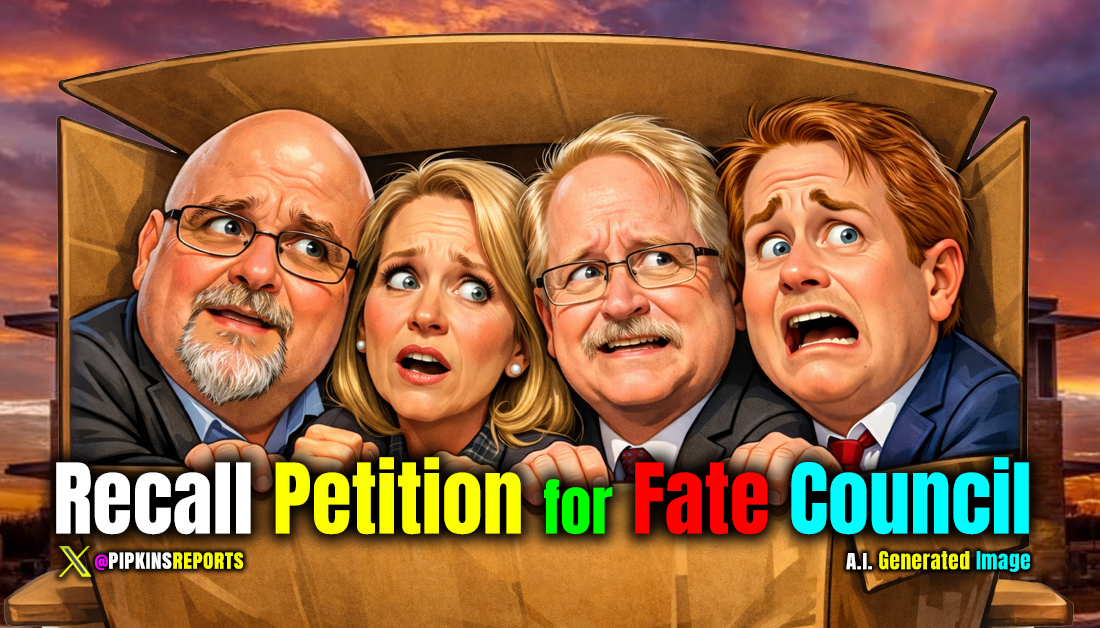
FATE, Texas — The political temperature in Fate, TX is getting hotter. A new recall effort, this time targeting four of Fate’s top elected officials, has been launched by local residents who say the city’s leadership crossed a line when they pursued the removal of a fellow council member.
According to statements circulating among Fate residents and online posts from local activist Christopher Rains, petitioners have begun the first formal steps to recall Mayor Andrew Greenberg, Councilman Mark Hatley, Councilman Rick Maneval, and Councilwoman Martha Huffman. The effort comes just months after the same officials were involved in advancing a recall petition against Councilwoman Codi Chinn, whose recall is already scheduled to be on the May 2026 ballot.
According to documents filed with the city, Rains submitted the paperwork on March 9th to start a 30-day window in which the organizers must gather enough signatures from registered voters in Fate to force recall elections against the four officials. For this election, the magic number is 351 verified signatures, according to city guidelines. There is a separate petition for each member.
Rains, who has been active in the local political dispute, announced the development in a public message on Facebook.
“As promised, after several weeks of work, the petitioners affidavits for the Recall of Mayor Greenberg, Councilman Hatley, Councilman Maneval and Councilwoman Huffman have been filed with city officially kicking off the phase two, signature collection,” Rains wrote.
In the past week, organizers have been setting up locations where residents can sign the petitions, while also encouraging interested voters to contact organizers directly through an email account established for the effort.
“As we push forward, we have 30 days to collect signatures from the public,” the statement continued. “We have all witnessed the different things that have taken place since last May. Now we can remind the city council that the job is to work for the city of Fate and its residents, not their own agendas.”
The previous affidavit against Chinn reached the minimum required signatures in less than 7 days. As previously reported by PipkinsReports, officials certified the petition against Chinn, paving the way for voters to decide her political fate during the May 2026 election.
That earlier effort galvanized some of Chinn’s supporters, with some arguing this new recall is a legitimate accountability measure against those who sought to undo an election, while others view the move as political revenge on behalf of a Councilmember who may be recalled for ‘Conduct Unbecoming,’ which critics define as repeatedly insulting constituents on social media.
Pipkins Reports received a copy of the new “Affidavit of Petitioners’ Committee” late Monday afternoon from the city. The documents reveal that the organizer of the petition is Christoper Rains, whose spouse, Ashley Rains, is running for Fate City Council – Place 2, and is also a member of the Petitioners Committee.
There are four separate Affidavits, one for each councilman being recalled. They are essentially identical, with the only exception being that one person signed on as a committee member for all affidavits except for that of Martha Huffman.
In addition to the Rains’, the other committee members are: Chrystal Powers, Les Darlington, Amanda Archer – Damle, Kaylyn Cowan, Mario Ramos Jr., Michael Brandon Vines, Brenda Rekieta, Brittany Otten, Daniel Otten, Nikki Robinson, Avah Helton, Amanda Oldfield, and Juan Avila.
Lance Megyesi signed on for Greenberg, Hatley & Maneval, but not for Huffman.
[Image of petition against Mayor Greenberg. Other petitions are similar as noted above.]
Side Note: In an unusual twist, the Affidavit copy that we received from the City of Fate had no redactions. This is a matter we will need to investigate further, as this action appears to be a change from previous documents we have received. Pipkins Reports has taken the proactive step to redact all persons’ addresses, as we have done previously.
Recall petitions are not unprecedented, but they are uncommon in most Texas municipalities. However, a recall effort critics characterize as retaliatory is so rare that we could not immediately find a comparative example. Texas law allows cities with charter provisions permitting recall to remove elected officials before their terms expire if voters determine the officials have lost the public’s confidence.
In Fate’s case, the situation has become particularly unusual because the political weapon may soon become pointed in both directions.
At this time, it remains to be seen whether the new petition effort will gather the number of signatures required to trigger recall elections. Still, the effort signals that the dispute inside Fate’s political community is far from over.
*This is an ongoing story. Follow Pipkins Reports on Facebook or X for updates.
You must be logged in to post a comment Login