COVID 19 Business closures could cost the US $3-$5 trillion, Study finds.
The COVID-19 pandemic could result in net losses from $3.2 trillion and up to $4.8 trillion in U.S. Real Gross Domestic Product (GDP) over the course of two years, a new USC study finds.

1-Dec-2020 12:05 PM EST, by University of Southern California (USC)
Newswise — The COVID-19 pandemic could result in net losses from $3.2 trillion and up to $4.8 trillion in U.S. Real Gross Domestic Product (GDP) over the course of two years, a new USC study finds.

USC researchers project three scenarios that span from March 2020 through February 2022, accounting for hospitalizations, deaths and illnesses and their potential impact on the economy.
The pandemic’s economic impact depends on factors such as the duration and extent of the business closures, the gradual reopening process, infection rates and fatalities, avoiding public places, and pent-up consumer demand, according to the research by the USC Center for Risk and Economic Analysis of Terrorism Events (CREATE).
Real GDP is a measure, adjusted for inflation, that reflects the value and the quantity of final goods and services produced by a nation’s economy in a given year.
“In a best-case scenario, we would see containment measures, such as masks and social distancing become more widespread, and possibly even a vaccine by next year, and then businesses and institutions would be able to reopen at an accelerated pace,” said Adam Rose, study team leader who is the director of CREATE and a research professor at the USC Price School of Public Policy.


“But in a worst-case scenario, these countermeasures wouldn’t materialize, and reopenings would happen slowly, particularly because we would continue to see waves of infection,” he said. Then, more people would likely lose their jobs, and the impacts of this disaster would continue to mount.”
The researchers found that the mandatory closures and partial reopenings alone could result in a 22% loss of U.S. GDP in just one year and an even greater loss of GDP over two years. Other key factors, though, will influence how disastrous the losses may be, they noted.
The research team noted that China has not sustained such losses due to aggressive containment measures resulting in a shorter lockdown period. They project that in a worst-case scenario, the U.S. GDP loss due to COVID will more than quadruple that of China.
The study was published on Nov. 30 in the journal Economics of Disasters and Climate Change.
In early March, several states responded to a rise in COVID-19 cases by ordering the closures of non-essential businesses such as restaurants, bars, salons and retail stores. Many also halted or reduced public services to limit the spread.
Researchers at CREATE who are experts on modeling economic consequences of disasters analyzed the potential economic impact in three scenarios ranging from moderate to disastrous.
Using a computerized economic model, the researchers accounted for these other factors in the three scenarios. They varied the decline in the workforce due to workers becoming sick with or dying of the virus, workers adopting new behaviors like staying home to avoid infection, increased demand for COVID healthcare, potential resilience through telework, increased demand for communication services, and increased pent-up consumer demand.
The researchers conducted a synthesis of the literature of projections on the severity and possible duration of the pandemic. For the scenarios, which span from March 2020 through February 2022, this compilation of findings indicated that the number of COVID-related deaths in the United States could range from more than 300,000 to, in a worst-case scenario, 1.75 million.
Anywhere from 365,000 to as many as 2.5 million COVID patients could end up in the ICU, while another 860,000 to nearly 6 million patients may be hospitalized but not treated in the ICU. The projected number of people who will be treated for COVID as outpatients may vary from about 2.6 million to 18 million.
Among other highlights of the study, the researchers projected:
- 54 million to 367 million work days would be lost due to people getting sick or die from COVID
- 2 million to nearly 15 million work days would be lost due to employees staying home to care for sick loved ones.
- Job losses could range from 14.7% to 23.8%, and in the worst case affect an estimated 36.5 million workers.
- Demand for health care has risen with COVID infections. Medical expenses due to COVID-19 from March 2020 to February 2022 could range from nearly $32 billion to $216 billion.
- A loss in demand for some services — such as the use of public transit and school attendance, restaurant dining and travel — as people avoid public places and services to reduce their risk of exposure.
- An uptick in demand for communication services, as many employees during this pandemic have had to work from home.
An increase in pent-up demand will arise since consumers are unable to spend money on big-ticket items such as cars, as well as on travel, restaurants, hotels, merchandise, fitness, sporting events and concerts during the closures, and, to a lesser extent, during the phased reopenings.
While the researchers have found that the mandatory closures and re-openings are the most influential factor in the economy’s decline, consumer avoidance behavior also has a significant effect.
For the study, the researchers assumed that various people avoided work, did not attend in-person classes at schools, and stopped going to restaurants, activities and social gatherings to reduce their risk of infection.
“Because people have had to avoid activities, this has had a significant impact on economic losses,” said Dan Wei, a CREATE research fellow and research associate professor at the USC Price School for Public Policy. “Based on our model, we estimate that avoidance behavior can result in nearly $900 billion losses in U.S. GDP in the worst-case scenario. Because consumers in places like California can’t engage in many activities like eating inside a restaurant, they are saving their money.”
The economic losses from closures and avoidance behavior could be partly offset by increased consumer spending after reopening, the researchers said.
“Pent-up demand is one of the most influential factors for the economy in this pandemic. While the mandatory closures and partial reopenings drive most of the economic decline, the extent to which pent-up demand leads to an increase in consumption after reopening, can be crucial to the economic recovery,” said Terrie Walmsley, a USC CREATE research fellow and an adjunct assistant professor of practice in economics at the USC Dornsife College of Letters, Arts and Sciences.
“The key question is: When will we see a complete reopening across this country? We simply cannot predict that, especially in light of the fact that we have not gained control of the spread of the disease,” Rose said.
###
The work was supported by a U.S. Department of Homeland Security Center for Accelerating Operational Efficiency (CAOE) research contract.
USC CREATE, which is affiliated with the USC Price School for Public Policy and the USC Viterbi School of Engineering, was the first of several research centers in various academic disciplines that the U.S. Department of Homeland Security helped establish in the wake of the terrorist attacks on Sept. 11, 2001.





San Angelo, TX – San Angelo’s battle over massive data centers has moved from City Hall chambers to the ballot box, and two council members could soon have to defend their seats before voters angry about how the city has handled the projects. What began as a fight over water, power, development and transparency is now a full-blown political revolt, with recall efforts targeting Council Members Harry Thomas and Joe Self.
And the controversy comes at an interesting moment for Texas. Gov. Greg Abbott has ordered state regulators to conduct a comprehensive audit of data centers moving through the state’s electric grid interconnection process, saying the review must be completed before any data center project moves forward. ERCOT subsequently told Fox News Digital that Abbott’s directive “effectively pauses all data center projects” while the state reviews their demands on the grid.
That means the questions being shouted at San Angelo City Hall are no longer merely local complaints from residents opposed to a particular development. Texas officials are now asking some of the same questions.
Abbott directed the Public Utility Commission of Texas and ERCOT to examine pending data center projects and gather information, including projected annual and peak electricity demand, water consumption, water sources, and whether facilities intend to generate some of their own electricity. ERCOT reported that roughly 90 percent of the 474 gigawatts of large-load interconnection requests currently under review are associated with data centers, more than five times Texas’ record peak electricity demand.
Back in San Angelo, the San Angelo Data Center Citizen Coalition has been pushing its own accountability campaign.
A petition seeking the recall of Council Member Harry Thomas, who represents Single Member District 3, was submitted July 15 with more than the required signatures. The city clerk later certified the petition after determining 53 signatures were sufficient, clearing the way for a recall election.
Following public comment, the City Council voted 6-1 to call the recall election.
Thomas has maintained that he has no intention of resigning.
“I weigh every decision I’ve ever made on behalf of the 100,000 citizens in San Angelo,” Thomas said after the petition was submitted. “Every time I vote, I vote for all the citizens. I have no plans to resign from my position.”
Self is now facing his own recall effort.
The coalition submitted an affidavit seeking Self’s recall and subsequently collected the signatures necessary to move forward. On Aug. 6, Self issued a statement saying he supports residents’ right to seek a recall but rejected what he described as misinformation about his involvement with data centers.
“I have not signed any non-disclosure agreements,” Self said. “I have not benefited financially. I have not voted in favor of a data center.”
Self said the council has instead voted on regulations that would apply if a data center is established in San Angelo.
That distinction between approving a specific project and approving regulations governing potential projects has become one of the central arguments in the political fight. San Angelo officials have considered rules addressing land use, water and wastewater issues as the city confronts proposals for large-scale data center development.
The proposed Skybox project has become particularly contentious. City officials have described it as a potential $7.2 billion investment, while opponents have raised concerns about water consumption, electricity demand, infrastructure, noise and transparency surrounding the development process.
The political consequences are spreading beyond San Angelo.
Residents in Temple and Granbury have also launched recall or charter efforts amid disputes over data center development. In Temple, opponents have cited concerns about land, water consumption and heat generated by facilities. In Granbury, activists gathered signatures seeking recalls involving the mayor and most members of the City Council.
Austin
‘The Taxpayer’s Comptroller’: Don Huffines Sworn In, Refuses Salary and Pledges to Slash Waste

Austin, TX — Don Huffines officially took the oath of office Saturday as Texas Comptroller, beginning his tenure as the state’s chief financial officer with a series of promises aimed squarely at fiscal conservatives: refuse a taxpayer-funded salary, root out government waste, pursue additional property tax relief, and faithfully administer Texas’ new school choice program.
Huffines was sworn into office after being appointed by Gov. Greg Abbott to fill the vacancy created by the resignation of former Comptroller Kelly Hancock. As Comptroller, Huffines will oversee the state’s accounting systems, tax collections, revenue estimates, and fiscal management while serving as one of Texas’ highest-ranking statewide officials.
The ceremony marks the beginning of Huffines’ service as comptroller ahead of the November general election, where he will appear on the ballot seeking a full term against Democratic nominee and State Sen. Sarah Eckhardt. Entering the race as the incumbent provides Huffines with both the visibility and responsibilities that come with holding statewide office.
Refusing a Taxpayer-Funded Salary
One of Huffines’ first announcements after taking office was that he will not accept the Comptroller’s salary.
The decision mirrors his previous service in the Texas Senate, where he also declined compensation, arguing that public office should be about serving Texans rather than collecting a government paycheck.
“I will not accept a salary,” Huffines said, emphasizing his belief that elected officials should demonstrate fiscal restraint beginning with themselves.
While the Comptroller’s salary represents only a tiny fraction of the state’s overall budget, the move is intended to reinforce Huffines’ message that government leaders should model the same financial discipline they expect from taxpayers.
Property Tax Relief Remains Top Priority
Huffines also made clear that reducing Texans’ property tax burden will be one of his central objectives.
Although the Comptroller does not directly set property tax rates, the office plays a significant role in state finances and revenue forecasting. Huffines said he intends to use the position to encourage local governments to reduce property taxes instead of expanding spending as state sales tax revenues continue to grow.
Property taxes have become one of the most contentious issues in Texas politics in recent years. Despite multiple rounds of tax relief approved by the Legislature, many homeowners have continued to see rising tax bills due to increasing property values and local government spending.
Huffines has long advocated for more aggressive property tax reductions and used his swearing-in ceremony to reaffirm that commitment.
Promising a More Aggressive Watchdog
Beyond taxes, Huffines pledged to aggressively identify wasteful government spending.
He said the Comptroller’s office should function as a watchdog over taxpayer dollars, focusing on eliminating waste, fraud, abuse, and unnecessary expenditures throughout state government.
The comments are consistent with Huffines’ long-standing reputation as one of the Legislature’s more fiscally conservative voices and suggest he intends to bring a more activist approach to the Comptroller’s office than simply managing the state’s books.
As the state’s chief financial officer, the Comptroller prepares revenue estimates that guide legislative budgeting and oversees billions of dollars in state finances, giving the office substantial influence over fiscal policy even without direct legislative authority.
School Choice Program Now Under His Oversight
Huffines also assumes responsibility for overseeing the financial administration of Texas’ new Education Freedom Account program, one of Gov. Abbott’s signature legislative accomplishments.
The program allows qualifying families to use state funds for approved educational expenses outside the traditional public school system. Because the Comptroller’s office is responsible for administering the program’s financial operations, Huffines will immediately play a central role in ensuring the initiative functions as intended.
Supporters view the program as expanding educational opportunities and parental choice, while critics have questioned its impact on public education funding. Regardless of the political debate, the Comptroller’s office will be responsible for ensuring taxpayer dollars are properly managed and accounted for.
Abbott Praises Huffines’ Private-Sector Experience
Gov. Greg Abbott praised Huffines during the transition, pointing to his business background and commitment to conservative fiscal principles.
Abbott has said Huffines’ experience in the private sector makes him well suited to oversee the state’s finances and continue Texas’ reputation for responsible fiscal management.
Huffines built his career in real estate development before entering public service and previously represented portions of Dallas County in the Texas Senate.
Looking Toward November
Although Huffines is now serving as Comptroller, Texas voters will still decide in November who will hold the office for the coming term.
His appointment gives Republicans an incumbent candidate heading into the election while allowing Huffines to begin implementing his priorities immediately rather than waiting until after Election Day.
His opening message leaves little doubt about the direction he intends to take the office: emphasizing smaller government, increased accountability, reduced spending, and continued efforts to lower the tax burden on Texans.
Whether those priorities translate into measurable policy changes will become clearer in the months ahead, but Huffines began his tenure with a clear signal to taxpayers that he intends to make fiscal conservatism the defining theme of his administration.
Business
Big Brother Just Leveled Up: If You Thought Flock Cameras Tracked Your Car, SignalTrace Tracks You
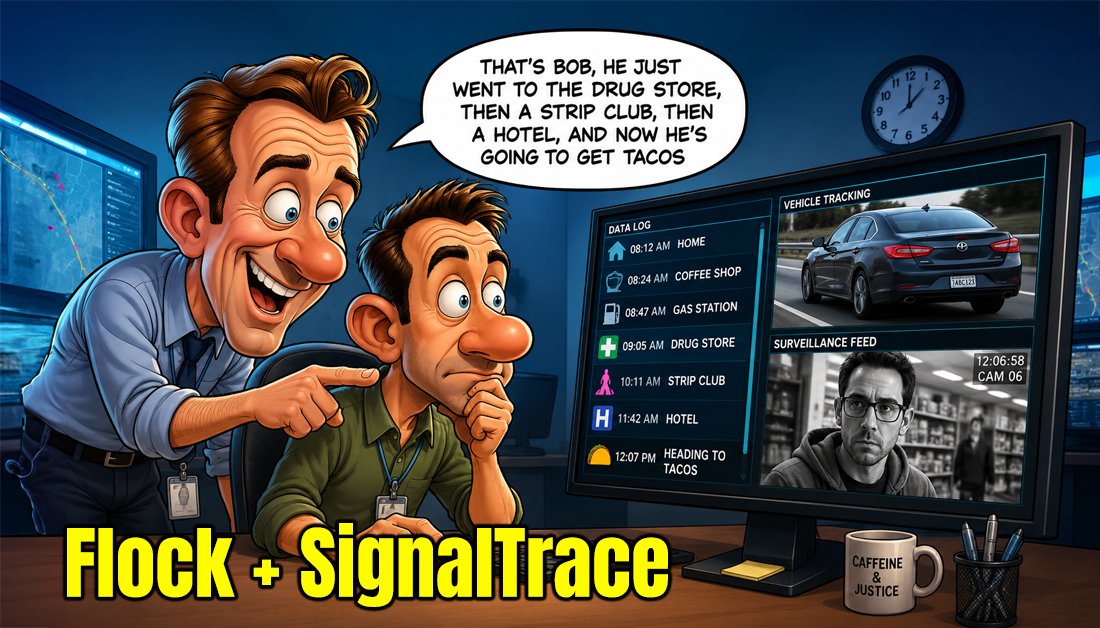
Your Town, USA – For years, Americans have debated the rapid expansion of automatic license plate reader (ALPR) systems like Flock Safety. Supporters argued the cameras simply photographed license plates visible from public roads. Critics warned they were quietly building a nationwide database of vehicle movements and violating the rights of every single American.
Now comes the next evolution.
Instead of merely tracking the vehicle, a new technology called SignalTrace™ is designed to identify and follow the person inside it by creating what its manufacturer calls a unique electronic fingerprint assembled from the wireless devices they carry and the electronic systems built into their vehicle.
If Flock Cameras know where your car has been, SignalTrace is designed to know where you have been—even if you change vehicles, remove your license plate, attempt to conceal your identity or just walk down the street.
Developed by Leonardo US Cyber and Security Solutions, LLC under its ELSAG brand, SignalTrace represents a significant expansion in surveillance technology. The system can combine traditional license plate recognition with passive radio-frequency collection to correlate dozens of electronic signals into a single profile that investigators can search historically or monitor in real time.
Beyond the License Plate
Traditional ALPR systems capture a photograph of a license plate along with the date, time, and location. SignalTrace expands that concept dramatically.
According to Leonardo’s product literature, the system installs sensors alongside existing ELSAG ALPR cameras (or it can operate independently) that continuously listen for publicly broadcast wireless signals emitted by nearby electronic devices.
Those signals are then correlated with nearby license plates.
Over time, the software learns which devices consistently travel together.
Instead of simply identifying a Toyota Camry with Texas plate ABC-1234, SignalTrace may recognize something far more specific:
- iPhone
- Apple Watch
- AirPods
- Vehicle tire pressure sensors
- Vehicle infotainment system
- Wi-Fi hotspot
- Bluetooth-enabled dashboard components
Collectively, those devices become what Leonardo calls an “electronic fingerprint.”
That fingerprint becomes associated with a particular vehicle, license plate, date, time, and location. Once established, investigators can potentially locate that same electronic fingerprint again—even if the vehicle’s plate changes or disappears.
How SignalTrace Works
Unlike wiretaps or cell-phone intercept devices, SignalTrace does not claim to capture communications. Instead, it passively listens for the electronic “handshakes” devices routinely broadcast into the air. According to Leonardo, the sensors detect publicly available radio-frequency identifiers from technologies.
The software then applies algorithms to identify groups of devices that repeatedly appear together across multiple locations and times. Leonardo describes this process as recognizing “convoys” of electronic devices. Those recurring combinations are linked to ALPR camera detections whenever a license plate is available.
All of the resulting information is stored within Leonardo’s ELSAG Enterprise Operations Center (EOC), allowing investigators to perform historical searches or monitor activity as new detections occur.
The sensors are not limited to highways. Leonardo says they can also be deployed in:
- Shopping centers
- Malls
- Stadiums
- Event venues
- Rail stations
- Parking facilities
- Virtually anywhere people gather
That greatly expands surveillance beyond traditional roadway cameras.
What Devices Can It Detect?
Perhaps the most striking aspect of SignalTrace is the sheer number of electronic devices that may contribute to a person’s digital fingerprint. Leonardo’s documentation lists several categories.
Bluetooth Devices
Nearly everyone carries Bluetooth-enabled electronics. These include:
- Smartphones
- Smartwatches
- Fitness trackers
- Wireless earbuds
- Wireless headphones
Wi-Fi Devices
The system can also detect Wi-Fi sources such as:
- Smartphones
- Tablets
- Laptops
- Vehicle Wi-Fi hotspots
Vehicle Electronics
Modern vehicles constantly broadcast signals from numerous onboard systems. SignalTrace can associate identifiers from:
- Tire Pressure Monitoring System (TPMS) sensors
- Vehicle safety systems
- Security sensors
- Infotainment systems
RFID Devices
Radio-frequency identification tags also become part of the picture. Examples include:
- Employee key cards
- Asset tracking tags
- Warehouse pallet transmitters
- Pet microchips
- Toll Tags
Individually, many of these identifiers may not uniquely identify someone. Together, however, they become remarkably distinctive. A phone alone may be common.
A phone plus a smartwatch, wireless earbuds, vehicle TPMS sensors, infotainment system, and Wi-Fi hotspot traveling together every morning creates an electronic signature that is far more difficult to confuse with someone else’s.
An Electronic Fingerprint
Leonardo openly markets this capability. Rather than relying upon one device, SignalTrace builds a composite identity. Imagine two identical pickup trucks.
Their license plates differ. Their owners both carry iPhones. Traditional ALPR systems distinguish them only by plate. But SignalTrace instead recognizes that one truck consistently travels with:
- Phone A
- Apple Watch A
- AirPods A
- TPMS Set A
- Infotainment System A
The other truck carries:
- Phone B
- Samsung Galaxy Watch
- Bose headphones
- TPMS Set B
- Vehicle hotspot B
Those collections become unique fingerprints. Even if one owner changes license plates—or drives another vehicle while carrying the same electronics—the fingerprint may remain recognizable.
In effect, investigators are no longer simply tracking a vehicle. They’re tracking the collection of electronic devices that travels with a person.
Law Enforcement Benefits
Leonardo promotes SignalTrace as an investigative force multiplier. Among its advertised capabilities:
- Integrates directly with existing ELSAG ALPR infrastructure.
- Identifies suspects through recurring electronic signatures.
- Recognizes vehicles using electronic fingerprints.
- Detects movement patterns and recurring travel.
- Identifies convoys.
- Assists investigations involving gangs.
- Supports human trafficking investigations.
- Expands surveillance beyond fixed ALPR locations.
- Enables both real-time monitoring and historical searches.
The company says sensors can be added to existing deployments, reducing implementation costs for agencies already operating ELSAG license plate readers.
Leonardo Says It’s Privacy Respecting
Leonardo argues SignalTrace remains privacy conscious because it captures only publicly broadcast signals. According to the company, the system:
- Does not decrypt communications.
- Does not intercept phone calls.
- Does not read text messages.
- Does not capture email contents.
- Does not access files stored on devices.
Instead, it collects only identifiers that devices voluntarily transmit over public radio frequencies. Leonardo compares the process to photographing a visible license plate on a public road.
From the company’s perspective, it is simply observing information already being broadcast into public space.
Privacy Advocates See Something Different
Privacy organizations and technology researchers have expressed far greater concern.
Critics argue SignalTrace fundamentally changes what ALPR systems are capable of doing. Instead of merely documenting where a vehicle traveled, they contend the technology enables persistent tracking of individuals through the electronic devices they carry every day.
Several researchers note that while modern smartphones increasingly randomize Bluetooth and Wi-Fi MAC addresses to reduce tracking, not every broadcast identifier is randomized.
Vehicle tire pressure monitoring systems, for example, often transmit fixed identifiers.
Likewise, combining multiple partially stable identifiers into one composite fingerprint may overcome many of the privacy protections built into individual devices. In other words, even if one identifier changes periodically, the surrounding collection of devices may remain recognizable.
Privacy advocates argue that this transforms anonymous radio emissions into something much closer to a persistent personal identifier.
Current Deployment
As of mid-2026, Leonardo is actively marketing SignalTrace and promoting it as an enhancement for existing ELSAG ALPR customers.
Public documentation indicates the sensors are intended to integrate with existing deployments, although no specific police department or municipality has publicly confirmed an operational deployment.
The underlying technology received a U.S. patent in March 2024 and was previously marketed in related forms under the name EOC Plus.
The Bigger Question
Supporters will argue SignalTrace is simply another investigative tool—one that relies only upon publicly available radio signals rather than private communications.
Critics see something far more consequential.
For decades, the debate centered on whether government should be able to track where your vehicle travels. SignalTrace moves beyond the automobile. It creates a persistent electronic identity assembled from the devices most Americans carry every day.
For decades, this author has maintained that there is no technology that exists, that the government will not eventually use against its own citizens.