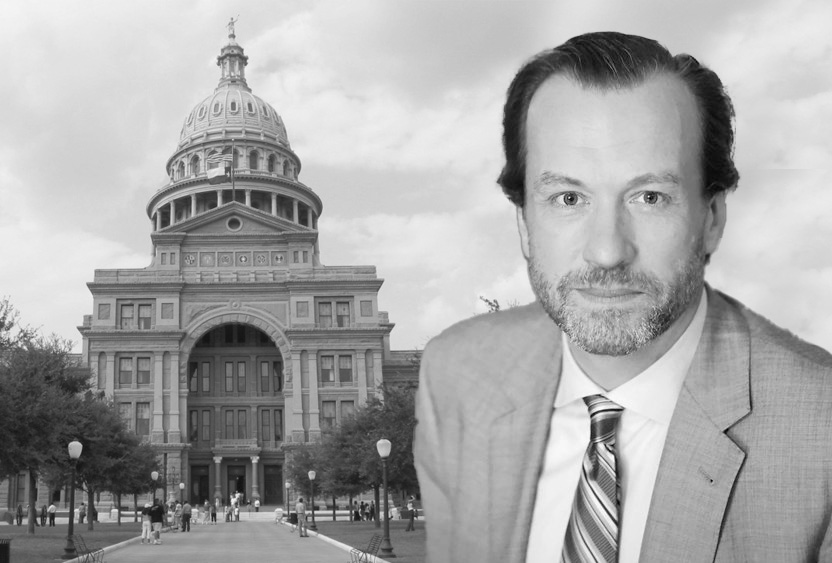
Behind Closed Doors: Fate’s Tax Dollars and Secret Lobbying

In the quaint town of Fate, Texas, nestled away from the bustling cities of the Lone Star State, residents believed that their hard-earned tax dollars were being used to improve their lives and support their community. However, a shocking revelation that has come to light raises questions about the allocation of public funds.
Fate’s city council, in a quite motion that flew in under the radar as just ‘proceedure’, approved Resolution R-2022-066 in 2022. This resolution authorized the city to enter into a contract with Focused Advocacy, LLC., a consulting firm headed by CEO Curt Seidlits and his partners, Brandon Aghamalian and Snapper Carr.
Under the guise of an “independent consultant,” Focused Advocacy was granted a lucrative monthly fee of $4,166.67, along with an additional $350 for expenses, and the possibility of seeking further compensation at a staggering $8,333.33 per month… for extended services … if needed.

Records show that the taxpayers in Fate have paid Focused Advocacy $149,000.00 in the last year and the contract has been renewed for another $149,000.00. This figure is enough to fund the cost of at least one, if not two additional police officers for our community.
This substantial financial commitment by the city to an entity with questionable ties raises significant concerns among Fate’s residents. The situation becomes even murkier when examining the involvement of Snapper Carr, who is not only a partner in Focused Advocacy but also a registered lobbyist.
Snapper Carr’s involvement takes on an ominous hue as it is revealed that he operates the “Focused Advocacy Political Action Committee (PAC),” a organization that channels funds to various political figures. While political contributions are not uncommon, what sets this situation apart is the absolute lack of transparency in how funds are distributed, leaving the citizens of Fate in the dark about the true intentions of these financial transactions.
Our investigation has uncovered that the Focused Advocacy PAC has made substantial contributions to several key political figures, including:
- $500 to Justin Holland,
- $5,500 to Dade Phelan (the second-largest contribution),
- $3,000 to Tan Parker,
- $2,000 to Dustin Burrows,
- $1,000 to the House Democratic Caucus, and
- $750 to John W. Bryant.
- A short list of dozens of political donations
Perhaps you don’t support these candidates, or any of dozens of other candidates. Whether you did or not, your tax money found its way into their campaign pockets because the sole benefactor of the PAC contributions appears to be Focused Advocacy itself … thus, Snapper Carr. Whom the town has contracted in order to provide legislative assistance.
Basically, our city gives our money to Mr. Carr and he gives the money to the candidates. Leaving the citizens of Fate left to wonder how these contributions were decided upon, and whether they serve the best interests of the community. In case you were wondering … to the best of our understanding, this is all 100% legal according to Texas law.

Despite our efforts to seek answers, Snapper Carr has chosen not to respond to our inquiries, further deepening the shadows of secrecy surrounding the activities of Focused Advocacy and its PAC. This lack of transparency raises questions about the motivations behind these political contributions and their alignment with the interests of Fate’s citizens.
In 2019, the online newspaper, “Stateline” reported the five lobbyists at Focused Advocacy represent more than 20 Texas cities before the legislature. In that year, the firm tracked 3,300 municipal-related bills during that year’s 140-day session.
Enter the Texas Municipal League
Adding to the web of intrigue is the revelation that Snapper Carr has previously served as legislative counsel for the Texas Municipal League (TML), an organization that the City of Fate also contracts with for various services, including lobbying efforts aimed at state legislators.
Fate City Manager Michael Kovacs served on the Legislative Policy Summit Committee for the Texas Municipal League in the last quarter of 2022. He and Mayor David Billings spoke to the committee to advocate for changes in local Zoning Reform.
According to a letter obtained by the Fate Tribune under an Open Records Request, Mr. Kovacs sent a letter to the Texas Municipal League and advocated that they support the following with regard to Zoning Reform:
“This moves the required ownership percentage of protests within 200 feet of a zoning change that would trigger a super-super majority of a 75% vote needed by a City Council, from 20% to 50%.
This change would enhance liberty and property rights while allowing the majority will of citizens in cities to advance quality projects for the public good to ensure housing affordability by raising supplies. The concept, that we think is logical, is that if a majority of nearby property ownership interests will protest a zoning change, then they can make it difficult for a majority of the cities’ citizens’ local representatives to pass a project, but a small minority should not be able to stop a project’s property owners and developers. This will have the biggest impacts in large cities and first ring suburbs.”
Translation: Make it harder for citizens to successfully oppose zone changes proposed by developers.
The TML has been a significant player in Texas politics and has been known to wield considerable influence in the state legislature. The City of Fate’s association with both Focused Advocacy and the TML raises concerns about the potential for conflicts of interest and the influence of outside entities on local decision-making.
It’s important to understand that the Texas Municipal League represents and advocates for its member Cities … NOT citizens. Their goal is the empowerment of city governments. They lobby to take power from the State to give to the City. They lobby for laws that take decisions away from the People to give to the City Governments. In short, they are not your friends… unless you are part of a City Government.
The citizens of Fate, who entrust their elected officials with their hard-earned tax dollars, deserve better. They deserve a transparent and accountable government that prioritizes their welfare above all else. The revelations surrounding Resolution R-2022-066 and the city’s association with Focused Advocacy and the TML cast a dark shadow over the integrity of Fate’s local governance.
The lack of transparency and accountability in the decision-making process surrounding these contracts and political contributions raises troubling questions about who truly benefits from Fate’s finances.
Citizens should not have to go through endless open record request documents to learn about the objectives and actions being taken by their City Manager, or Mayor, with regard to lobbying activity. It ought not to take sleuthing skills to unravel an undisclosed decision-making process that is spoken only when the council is not in session. It is exactly this kind of backroom actions taken without full public transparency that erodes trust in our institutions.
Fate’s residents deserve nothing less than a thorough investigation and a commitment to transparency from their city’s leadership. It is only through vigilance and unwavering commitment to accountability that the citizens of Fate can hope to regain their trust in their local government and ensure that their tax dollars are used to benefit all residents.
###
Further Resources
Editor’s Note:
This article investigates public records, city contracts, and lobbying activities related to the City of Fate, Texas. All figures and documents cited are drawn from official city resolutions, open records requests, and publicly available lobbying filings. Some statements in the article represent analysis and interpretation of these records; they are not intended to assert wrongdoing by any individual or organization. Readers are encouraged to review the cited public documents to form their own conclusions regarding the transparency and use of public funds.


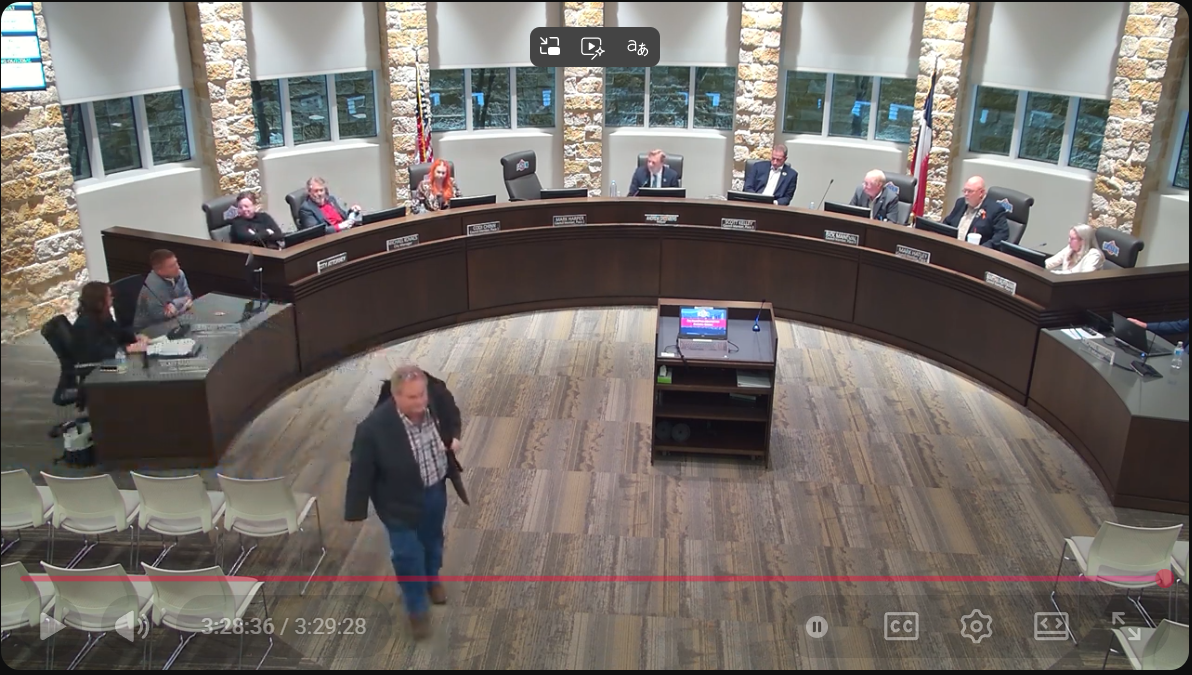
Councilman Mark Harper walks out of meeting before adjournment.
FATE, TX – The Fate City Council voted late Monday night to waive deliberative privilege, opening the door to the public release of secret audio recordings that may have driven a recall election against Councilwoman Codi Chinn. The decision came after hours of public criticism, procedural friction, and a lengthy executive session with legal counsel.
The meeting, held Monday, February 2, was streamed live by the city and is available on YouTube at: https://www.youtube.com/live/zQVN0i-d8C0 (Embedded Below)
(Source: City of Fate, official meeting broadcast)
Timeline for Readers
- 00:33:52 – Public comments begin, largely focused on the recall election of Councilwoman Codi Chinn.
- 00:56:10 – Councilman Harper interrupts public Comment.
- 00:57:00 – Councilman Harper interrupts public Comment.
- 00:58:00 – Councilman Harper interrupts public Comment.
- 02:21:00 – Executive Session – Council enters closed session to consult with legal counsel.
- 03:22:52 – Council reconvenes in open session.
- Primary motion – Council votes to “waive deliberative privilege”, allowing release of disputed audio recordings.
Public Comment and Visible Strain
Public comments began just after the 33 minute mark and quickly centered on the recall election. Speaker after speaker questioned the conduct of city officials and demanded transparency regarding audio recordings that have circulated privately but remained unavailable to the public.
During one speaker’s remarks, critical of Councilwoman Chinn, procedural tension became visible. Three separate times, Councilman Mark Harper interrupted to remind Mayor Andrew Greenberg that the speaker had exceeded the three-minute time limit. Each time, Mayor Greenberg thanked Harper for the reminder, then directed the speaker to continue.
The exchange stood out. While council rules clearly limit speakers to three minutes, the mayor’s repeated decision to allow the speaker to proceed suggested an effort to avoid the appearance of silencing criticism during a highly charged meeting.
Clarifying the Recordings
Contrary to some early assumptions, the audio recordings at issue were not recordings of executive sessions. Instead, they are one-party consent recordings, the existence of which has been previously reported and alluded to on Pipkins Reports. Their precise origin has not been publicly detailed, but their contents have been referenced repeatedly by both supporters and critics of the recall effort.
Behind Closed Doors
Following the public meeting, the council entered executive session to consult with legal counsel. After about an hour, members returned to open session at approximately 3:22:52 .
The primary motion coming out of that session was to “waive deliberative privilege“. The effect of the vote was to remove a legal obstacle to releasing the secret audio recordings that have been at the center of the controversy.
No excerpts were played, and no conclusions were announced. The council did not rule on the legality of the recordings, nor did it weigh in on the merits of the recall election itself.
Why the Vote Matters
The decision does not resolve the recall of Councilwoman Chinn. It does not validate or refute claims made by either side. What it does is shift the debate away from rumor and secondhand accounts.
According to guidance from the Texas Municipal League, governing bodies may waive certain privileges when transparency is deemed to serve the public interest, particularly when litigation risk is balanced against public trust (Texas Municipal League, Open Meetings Act resources).
Opinion and Perspective
The council’s action was a necessary step. Secret recordings, selectively referenced and strategically leaked, undermine confidence in local government. So does a refusal to confront them directly.
Transparency is not about protecting officials from embarrassment. It is NOT the job of the council to assist the city in concealing information that may be used against it in legal proceedings when the City Manager, or Councilmen, may have done bad things. It is about protecting citizens from manipulation. If the recordings exonerate those involved, their release will restore credibility. If they raise concerns, voters deserve to hear them unfiltered before making decisions in a recall election.
Monday night in Fate did not end the controversy. It ended the excuse for keeping the public in the dark.

The dispute began publicly in Fate, Texas, when I was accused by Councilwoman Codi Chinn’s husband, William Marcus Chinn, of concealing material facts. WM Chinn asserted that I “knew” that Mayor Andrew Greenberg was responsible for placing Chief of DPS Lyle Lombard into executive session long before a controversial letter ever surfaced, and (he asserts) that I was deliberately lying to protect him … as well as shedding false light on his wife.
So I did what journalists are supposed to do when confronted with claims that purport to be factual. I pulled the records.
What those records show is not a cover-up or collusion, but a collapse of a narrative. Click here for further information regarding the timeline of events.
The Claim
Mr. Chinn asserted that Mayor Greenberg initiated an executive session involving Chief Lombard on or before November 10, 2025, well before later events that have since become the subject of political dispute. He further claimed the mayor supported Lombard’s firing, and accused me of knowingly concealing those facts.
Those are serious allegations against a sitting mayor and a journalist. They are also verifiable.
The Records
On January 15, 2026, I filed an open records request with the City of Fate seeking all emails from Mayor Greenberg calling for an executive session to discuss Lyle Lombard prior to November 11, 2025. The City of Fate Public Records Office acknowledged the request and produced responsive documents through its public records portal.
The emails produced do not support the accusations made by Mr. Chinn.
Instead, the correspondence shows a discussion in late September 2025, specifically September 22 and 23, between City Manager Michael Kovacs, Councilman Mark Harper, and Mayor Greenberg. The topic was not the discipline, termination, or performance of Chief Lombard. It was regarding the DPS as a whole, and whether or not it should be separated into distinct divisions.
The email exchange centered on “Executive Session Meeting for DPS“, not Lyle Lombard. Under Texas law, such matters are commonly discussed in executive session due to personnel and strategic considerations. Kovacs even goes further to include that “IF” the discussion moves into discussing Lombard, they will have to make changes to the forum.
There is no evidence in the records that Mayor Greenberg sought to discuss Lombard personally, or that he anticipated the executive session would involve anything beyond the DPS split.
On the Record Confirmation
To remove any ambiguity, I spoke directly with Mayor Greenberg, on the record. He confirmed that his sole interest in the executive session discussion was the potential separation of the DPS into standalone Police and Fire departments. He stated he did not believe, at the time, that the executive session would be used to address Chief Lombard personally.
His statement aligns with the documentary evidence.
What Changed, and Who Changed It
Email we received on November 25, 2025 from Shelbi Stofer, PIO Officer for the City of Fate, states the facts, “Below you will see the press release regarding our leadership change at the City of Fate. Additionally, you asked about the councilmembers that [sic: who] asked for the agenda item and they were Councilmember Chinn and Councilmember Kelley (2nd).” Referring to the councilmen who requested that the chief be placed into executive session.
The email concluded with the public “Announcement of Leadership Transition” (Lyle Lombard)
The records show no mayoral email initiating an executive session for the purpose of discussing Lombard. The testimony and sources indicate the executive session was desired by Councilwoman Chinn, seconded by Councilman Kelley. The records reviewed do not substantiate the accusations made by WM Chinn or Councilwoman Codi Chinn that the Mayor had any involvement. By association, Pipkins Reports can’t have had any other knowledge to the contrary.
The Rhetoric Behind the Scenes
Politics is rarely polite, and Fate is no exception.
According to sources, after the council meeting in October 2025, Councilman Mark Harper referred to Mayor Greenberg as a “sellout” during internal discussions, a remark that reflects political frustration rather than documented fact. Separately, in a later recorded conversation with Pipkins Reports, Councilwoman Chinn referred to the mayor as a “Ken Doll,” adding a crude remark and referencing the doll’s genitalia as a metaphor regarding the mayor’s lack of courage. (We are paraphrasing, of course.)
Those statements are not evidence of wrongdoing. They are evidence of animus against the Mayor for his desire not to be involved with an employee dispute, which falls under the purview of the City Manager.
Opinion and Analysis
Here is where interpretation belongs.
What this episode reveals is not a secret scheme, but a familiar tactic. Make a claim forcefully enough, shout it into a microphone in a city hall meeting, and hope the accusation itself becomes the evidence. When challenged, attack the journalist. When records contradict the story, change the subject.
Texas open records law exists to protect the public from exactly this kind of political fog. When the documents are pulled, narratives either stand or fall. In this case, they fell.
No evidence has emerged showing Mayor Andrew Greenberg initiated an executive session to target Chief Lombard. No records show he supported Lombard’s termination prior to the events already publicly known. Those facts matter, regardless of personal grievances or political alliances.
If Councilwoman Chinn, her husband, or anyone else possesses documentary evidence to the contrary, it should be produced. Until then, accusations remain accusations, and the record remains clear.
Council
Snowstorm Showdown: Fate Recall Vote Advances as Councilwoman Chinn Accuses Mayor of Endangering Public Safety

Fate, Texas — A routine procedural vote to advance a recall election against Fate City Councilwoman Codi Chinn has escalated into a sharp political confrontation, as Chinn and her supporters accuse Mayor Andrew Greenberg of disregarding safety concerns and acting out of what they describe as personal animus.
The meeting, scheduled for Monday, January 26th, 2026, includes consideration of a Certificate of Sufficiency necessary to formally set the recall election, which has become the latest flashpoint in an increasingly bitter feud between Chinn and the mayor. Her supporters now argue the recall effort is driven by personal grievances rather than civic concerns, and some have begun openly discussing the possibility of filing a counter-recall against the mayor himself.
At issue is a recall petition that gathered more than 400 signatures from Fate residents seeking to remove Chinn from office. According to city verification records, 396 of those signatures were deemed valid—more than enough to meet the statutory threshold required to place the recall on the ballot.
Chinn and her allies do not dispute the number of verified signatures. Instead, they argue that the process, and the timing of the meeting to advance it, reflects political hostility rather than concern for good governance.
“He’s Willing to Put Ppl in Danger”
COUNCILWOMAN CODY CHINN REGARDING MAYOR GREENBERG.
In a Facebook post, Chinn accused the mayor of recklessly jeopardizing public safety in order to ensure the recall vote moved forward before key election deadlines expired. Chinn created a poll on Facebook, asking social media whether the meeting should be canceled due to weather. However, critics note that Chinn did not reference the recall timeline when raising concerns about the weather.
When Pipkins Reports asked her, “You should be honest with people and tell them why you want this.” Chinn responded:
“No the MAYOR should be honest with why he’s jeopardizing the safety of city staff, the ppl who want to comment, and city officials,” Chinn wrote. “This is the last meeting he can have me recalled because HE waited until it’s too late to put me on the May ballot.”
She continued by asserting that the mayor’s motivations were personal rather than procedural.
“He’s willing to put ppl in danger for his petty little grudge!” she wrote.
Chinn further argued that any leader genuinely concerned about residents would have postponed the meeting if road conditions deteriorated.
“Anyone with an ounce of integrity and care for his citizens would cancel the meeting if there’s ice on the roads,” she wrote. “But he wants me recalled MORE than he cares about ppls lives!”
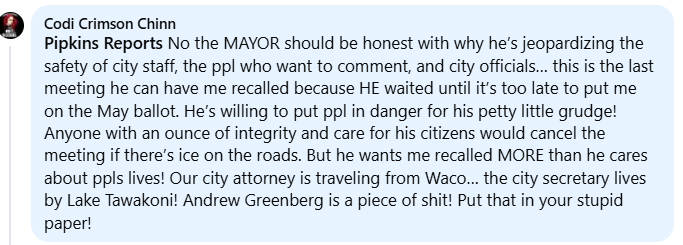
Her post also highlighted the travel required of city staff and officials, underscoring her claim that the meeting posed unnecessary risk. In doing so, she exposed the hometown of the City Secretary. Her message concluded with profanity directed at the mayor and a disparaging remark about this publication.
A Recall Driven by Conduct, Not Weather
While Chinn and her supporters frame her as a victim and the recall as retaliation for her political positions, the general basis for the recall effort centers largely on her conduct and language while serving on the council. Critics of Chinn cite what they describe as a confrontational style and the use of sharp language during her tenure, which is incompatible with the decorum expected of an elected official. Supporters of the recall argue that her latest post reinforces their concerns.
Supporters of the recall argue that the very Facebook post Chinn used to denounce the mayor illustrates the problem voters are seeking to address. They contend the recall is not about silencing dissent, but about restoring professionalism and civility to city government.
Chinn, however, rejects that characterization, maintaining that her blunt language is being weaponized against her by political opponents unwilling to tolerate her criticism.
The Procedural Flashpoint
The City Council meeting at the center of the controversy was not the recall election itself, but a legally required step to advance it. Under Texas law, once a recall petition is certified as sufficient, the governing body must issue a certificate of sufficiency, triggering the scheduling of the election. It’s a process that must go forward … by law.
Chinn is correct about the timing. With the May election approaching, failure to act now would likely have pushed the recall into the November election, or potentially a standalone Special Election, increasing costs to the taxpayers.
Mayor Greenberg has issued the following statement on Facebook:
Supporters Escalate the Fight
As the recall process moves forward, Chinn’s supporters are signaling they are not content to play defense. Several have openly discussed the possibility of initiating a counter-recall against Mayor Greenberg, arguing that his decision to proceed with the meeting demonstrates poor judgment and disregard for public safety.
While no counter-recall petition has yet been filed, the threat alone marks a significant escalation in Fate’s already volatile political climate. What began as a recall of one council member now risks expanding into a broader referendum on the city’s leadership.
What Comes Next
If the Certificate of Sufficiency is finalized Monday night, voters will ultimately decide whether Chinn’s conduct warrants removal from office. The recall election would give residents the opportunity to weigh her style, language, and performance against her claims of political persecution.
Should her supporters follow through on threats of a counter-recall, Fate could soon find itself mired in overlapping recall efforts.
Even as weather conditions improve, tensions surrounding the recall remain unresolved. As the recall advances, the question before Fate voters is no longer simply whether Councilwoman Chinn should remain on the council, but whether the standards of conduct at City Hall have reached a breaking point.
Editor’s Note:
This article includes direct quotations from social media posts and statements made by public officials regarding an ongoing recall process. Allegations, interpretations, and characterizations attributed to elected officials or their supporters are presented as claims and opinions, not findings of fact. Pipkins Reports relies on public records, verified statements, and publicly available posts in its reporting. Readers are encouraged to review source materials and attend public meetings to form their own conclusions.
You must be logged in to post a comment Login