
Texas Man gets 33 Months for Threatening ICE, Trump Threats Dismissed

Fort Worth, TX – A North Texas man who threatened to meet Immigration and Customs Enforcement agents with a gunfight will spend nearly three years in federal prison. He also threatened to murder President Donald Trump, but those presidential threat charges were dismissed under a plea agreement that left him convicted of a single count involving a federal law enforcement officer.
Francisco Jesus Mena, 37, of Springtown, was sentenced October 9 by Chief U.S. District Judge Reed O’Connor in the Northern District of Texas to 33 months in prison, followed by three years of supervised release. The judgment also restricts his access to social media and requires ongoing computer and internet monitoring. The sentence followed a June 10 guilty plea to threatening a federal law enforcement officer.
According to the indictment, Mena posted a series of threatening messages between May 13 and May 25, 2025. Some were directed at Trump, including repeated calls to “KILL TRUMP.” Others targeted ICE officers. In one message, Mena warned that if ICE came to his home, he would “respond with a gunfight.”
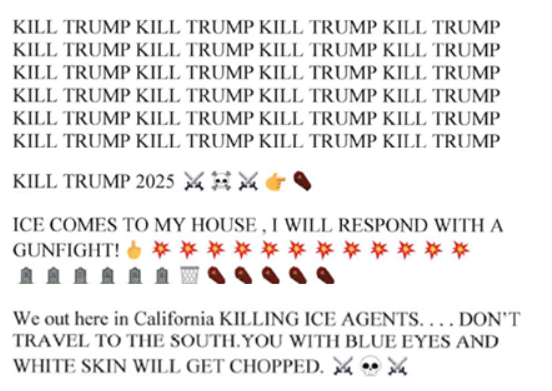
This was not merely an allegation that Mena had used harsh language online. In a factual resume filed with his plea agreement, Mena admitted that he intended the gunfight statement as a threat and made it to retaliate against ICE officers for performing their official duties.
The document also says Mena stipulated that he had made more than two additional threats against ICE agents and Trump.
The First Amendment Challenge Failed
Mena initially challenged the indictment, arguing that the charges involving Trump were based on hyperbolic, vague and contradictory statements that did not qualify as criminal threats. He also argued that the charges involving unnamed ICE agents failed to identify specific officers.
Judge O’Connor rejected those arguments on March 9, 2026.
The judge ruled that an objectively reasonable person could interpret the statements directed at Trump as serious threats of harm. Whether they actually constituted true threats was a question for a jury, not a basis to dismiss the charges before trial.
The judge also rejected the argument that prosecutors had to identify a single, specific federal officer for the ICE-related charges to proceed.
But Mena never faced a jury. Instead, he entered into a plea agreement with federal prosecutors in June, pleading guilty to Count Three, which concerned the threatened gunfight if ICE agents came to his residence.
The agreement called for prosecutors to dismiss the remaining charges after sentencing. The final judgment confirms that the other nine counts were dismissed upon the government’s motion. That means Mena was not convicted of the separate counts involving threats against Trump, even though his factual resume acknowledged additional threats against the president and ICE agents.
A Prison Sentence and Digital Restrictions
The plea agreement exposed Mena to a maximum of 10 years in prison, a fine of up to $250,000 and as much as three years of supervised release. Prosecutors recommended a sentence within the advisory federal sentencing-guideline range, but the agreement left the final decision to the judge.
O’Connor imposed 33 months behind bars. Mena was ordered to surrender to the Bureau of Prisons by November 10, 2026. The judge recommended placement as close as possible to a federal correctional institution in Texarkana, Texas, if his classification permits it.
The judgment imposes restrictions that will follow Mena after prison. He may not maintain or create accounts on social networking sites, including Facebook, YouTube, X, Instagram and TikTok, without permission from his probation officer. He must also provide account information upon request and participate in a computer and internet monitoring program.
The court did not impose a fine or incarceration costs, finding that Mena lacked the financial resources or future earning capacity to pay them. No restitution was ordered because there were no outstanding losses owed to a victim.
The Questions the Plea Leaves Behind
The case presents a familiar tension in constitutional law: political speech receives strong protection, but genuine threats of violence are not insulated from prosecution simply because they appear online. Here, the judge allowed the indictment to proceed, and Mena ultimately admitted that his ICE-related statement was intended as a threat and retaliation.
For Texans, the case is a reminder that online threats can carry real consequences, even when no physical attack occurs. It is also a reminder that a criminal indictment is not the same as a conviction, and that plea bargains can dramatically narrow the charges a defendant ultimately faces.
Mena admitted threatening ICE officers in retaliation for their official duties. He was sentenced accordingly. The Trump-related counts, however, were dismissed, so we will never know the outcome of those charges.






You must be logged in to post a comment Login