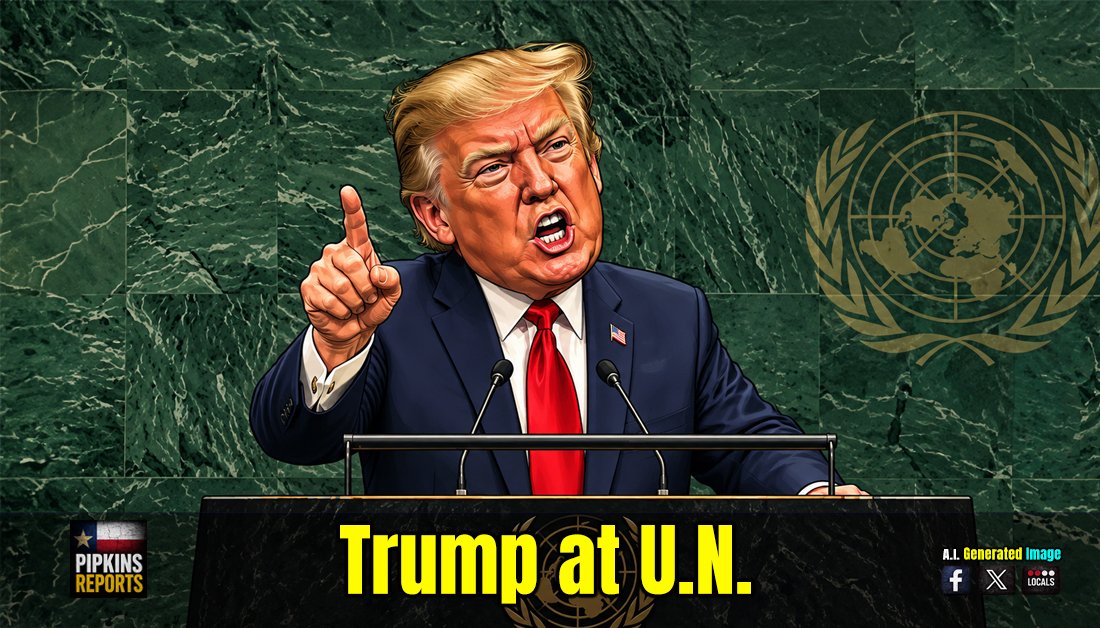
Trump’s 7-Point U.N. Warning: America Comes First – Video

United Nations – New York, NY – President Donald Trump walked into the United Nations on Tuesday and delivered a message that probably wasn’t what the global bureaucracy wanted to hear: America is not asking permission anymore.
( Video Credit: White House Pool Feed )
In a 37-minute address to the 81st U.N. General Assembly in New York, Trump defended his administration’s military actions against Iran, warned Tehran that the United States could “annihilate” the Islamic Republic if negotiations fail, attacked uncontrolled immigration and global governance, and told the assembled nations that America intends to remain in charge of its own borders, laws and technology.
For anyone wondering what “America First” actually looks like when the president takes it to the world stage, this speech provided a pretty good answer.
Trump opened by declaring that “America is back,” then launched into a lengthy defense of his administration’s economic, military and domestic record. He claimed the United States is stronger than ever, citing job creation, household income, stock-market performance, investment commitments and what he described as historic reductions in crime and illegal immigration.
Some of those claims have since been challenged by independent fact-checkers. The Associated Press and PolitiFact identified multiple statements in the speech that they characterized as false, misleading or exaggerated.
But the speech wasn’t really about statistics, it was about sovereignty. And Trump made that point repeatedly.
Iran Was the Big One
The most consequential portion of the speech concerned Iran.
Trump defended the decision to use American military force against Tehran, arguing that previous governments allowed the Iranian nuclear threat to grow while international institutions talked about it.
Trump said he had been unwilling to wait.
He accused Iran of supporting terrorism throughout the Middle East and again pledged that Iran would never obtain a nuclear weapon while he is president. He also claimed that more than 72,000 Iranians had been killed by their government this year, including 10,000 protesters. Those casualty figures were presented by Trump and should not be treated as independently established figures without further verification.
Then came the warning.
Trump said the United States faces a choice between reaching a deal with Iran and potentially “annihilating” the Islamic Republic. Reuters reported that Trump simultaneously expressed optimism that diplomacy could still produce an agreement.
That combination, military pressure backed by a diplomatic off-ramp, was central to Trump’s presentation of American power.
The U.N. Got a Lecture, Too
Trump wasn’t particularly interested in pretending the United Nations is beyond criticism.
He declared, “There is no global government,” and said there would be no global taxes while he is president. He also attacked the U.N. Human Rights Council over its criticism of U.S. immigration policies and other domestic issues.
His argument was simple: nations can cooperate without surrendering sovereignty.
That is a distinctly different proposition from allowing international institutions to dictate domestic policy.
Trump also attacked what he considers uncontrolled mass migration, declaring that there is no human right to illegal immigration but that nations have a right to remain sovereign.
For a president speaking inside the United Nations, it was a fairly remarkable thing to say.
And he clearly meant it.
Cartels, Cuba and the Western Hemisphere
Trump also warned that the United States will not permit hostile forces to establish themselves in the Western Hemisphere.
He described Mexican and other regional drug cartels as terrorist organizations and defended the administration’s use of military force against cartel operations. He claimed U.S. strikes had destroyed 97% of drugs entering through the ocean and sea, another assertion that requires independent scrutiny before being accepted as fact.
Trump also singled out Cuba, declaring that “freedom will be coming to Cuba.”
The message was unmistakable: the administration views the Western Hemisphere as an area where American security interests will be enforced, not politely discussed until everyone gets tired.
And Then There Was AI
One of the stranger moments came when Trump announced that artificial intelligence would henceforth be called “Super Intelligence.”
He rejected international efforts to establish what he described as a global system of AI control, arguing that American technological leadership must not be surrendered to international regulators.
Reuters reported that Trump also said the Justice Department would monitor the AI industry and intervene if necessary, while continuing to oppose new AI regulations.
Whatever one thinks of the terminology, the underlying policy message is clear. Trump sees technological dominance as a national-security issue.
So does China.
The Bigger Message
Trump’s U.N. speech wasn’t a plea for international approval. It was a declaration of terms.
America will negotiate. America will cooperate. America will make deals. But, according to the president, America will decide who crosses its borders, how its economy operates, how its military is used and how its technology is developed.
That’s the common thread running through Iran, immigration, cartels, AI and the United Nations itself.
Sovereignty.
There is plenty in Trump’s speech that deserves scrutiny. His economic statistics, crime figures, immigration claims and assertions about foreign conflicts should be checked against the underlying data rather than accepted simply because they came from the podium at the United Nations. AP and other fact-checkers have already identified several claims requiring correction or qualification.
But the larger policy direction wasn’t difficult to decipher.
Trump went to the United Nations and essentially told the assembled governments that the United States intends to remain the United States.
For Americans watching from Texas, that isn’t some abstract argument happening 1,500 miles away in a Manhattan conference hall.
It goes straight to a question that has been debated since the nation’s founding: Who gets to decide how Americans live, Americans or somebody else?
Trump’s answer on Tuesday was blunt, America decides. And he didn’t appear particularly interested in asking the U.N. for permission.








You must be logged in to post a comment Login