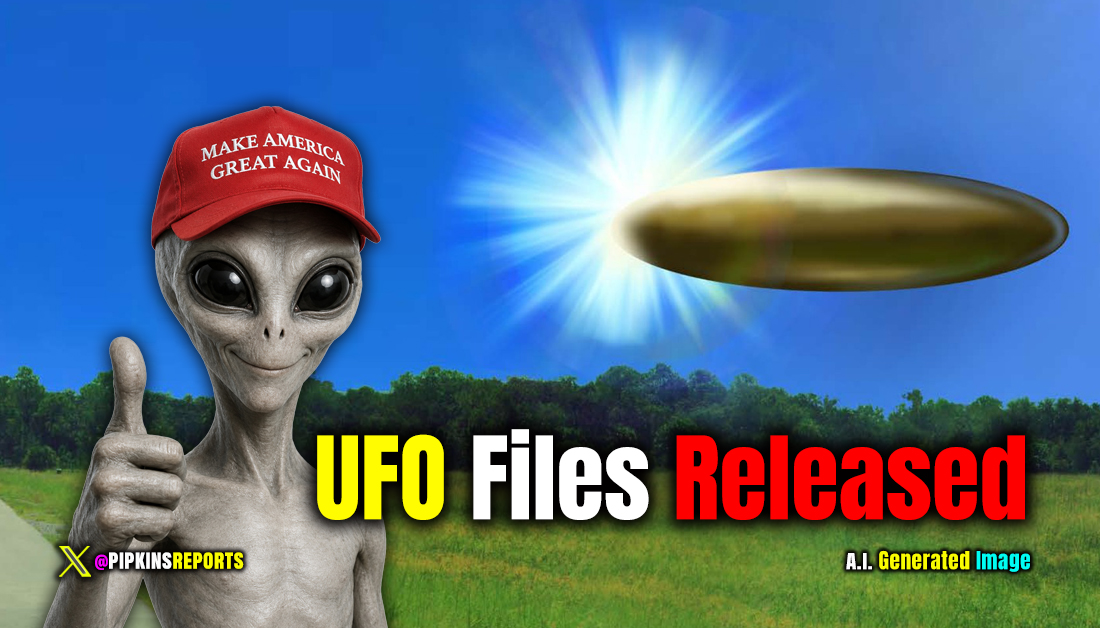
UFO Files Released
Trump’s “UFO Files” Drop Lands With a Thud, Leaving Believers and Skeptics Equally Unsatisfied
Department of War – For years, UFO believers promised the truth was buried somewhere deep inside government vaults, hidden behind classified markings and decades of official denials. The long-awaited disclosure, they said, would prove humanity is not alone. So when the Trump administration released a major archive of UFO-related material this week, anticipation exploded across social media and conspiracy circles alike. The result, however, landed with all the excitement of opening a mystery safe only to discover it filled with newspaper clippings, hobby magazines, and blurry photos of distant lights in the sky.
The files were released through the federal archive portal at www.WAR.GOV/UFO Files and include videos, audio recordings, witness statements, correspondence, and archival documents connected to unidentified flying objects, now often called unidentified anomalous phenomena, or UAPs.
The website also prominently features a statement from Donald Trump posted from Truth Social:
“Based on the tremendous interest shown, I will be directing the Secretary of War, and other relevant Departments and Agencies, to begin the process of identifying and releasing Government files related to alien and extraterrestrial life, unidentified aerial phenomena (UAP), and unidentified flying objects (UFOs), and any and all other information connected to these highly complex, but extremely interesting and important, matters. GOD BLESS AMERICA!”
The Department of War website also states that additional material will continue to be released on a weekly basis, suggesting the current archive represents only the first phase of a broader disclosure effort. That announcement has kept many UFO enthusiasts hopeful that more substantial evidence could still emerge in future document dumps.
For now, however, the initial release appears to contain little that fundamentally changes the public understanding of UFO phenomena.
Despite years of sensational claims about craft performing maneuvers that supposedly “defy physics,” none of the videos included in the archive appear to show anything close to that. The objects captured on camera are consistently small, far away, and moving in mostly straight lines at what appear to be ordinary, subsonic speeds. There are no impossible right-angle turns, no instantaneous acceleration, no sudden stops, and no visible flight characteristics beyond what could plausibly be explained by conventional objects or optical effects.
File: DOD_111688964 – Taken 2024-06-01 – The United States Northern Command submitted a report of an unidentified anomalous phenomenon (UAP) to the All-domain Anomaly Resolution Office (AARO) consisting of 21 seconds of video footage from an infrared sensor aboard a U.S. military platform in 2024. An accompanying mission report, DoW-UAP-D8, described the UAP as consisting of an object with a vertical pole or bar attached to the bottom of the object. The observer also reported that the UAP may instead be a reflection from an object in the water.
Most of the footage consists of little more than bright shiny objects against the sky, filmed from such extreme distances that meaningful identification becomes nearly impossible. A few clips appear consistent with balloons or commercial drones. Others show glowing or reflective orbs with no discernible structure or detail. None of the material independently verifies the extraordinary claims often promoted by UFO media personalities and internet commentators.
The release arrives after years of mounting public fascination with UFOs. Congressional hearings, Pentagon acknowledgements of unexplained aerial sightings, and endless online speculation helped create expectations that the government might eventually reveal evidence of non human intelligence. Those expectations likely contributed to the enormous interest surrounding this document dump.
But much of the archive reads less like disclosure and more like an oversized collection of unresolved anecdotes and cultural memorabilia. Witness statements describe strange lights, odd movements, and unusual sightings, but almost none are supported by physical evidence, radar tracking, or technical analysis capable of independent verification. Some are handwritten personal accounts submitted decades ago by ordinary citizens reporting mysterious experiences investigators apparently could neither confirm nor explain.
A surprisingly large portion of the collection focuses on civilian UFO enthusiast organizations that published magazines and newsletters dedicated to sightings and theories about alien life. Rather than classified military revelations, many files simply document the activities of hobbyist groups fascinated by UFO culture during the Cold War era and beyond.
The archive also includes letters from school children asking the government whether flying saucers and aliens are real. While historically interesting as a reflection of American pop culture and public curiosity, the letters offer no evidentiary value regarding extraterrestrial life. Some of the material feels more appropriate for a museum exhibit on twentieth century UFO fascination than for a headline generating government disclosure project.
NASA related recordings and footage included in the release similarly failed to produce dramatic revelations. Most involve routine aerospace operations, ambiguous observations, or discussions about unidentified objects without any conclusion that they originated from beyond Earth. NASA has consistently maintained there is no confirmed evidence of alien visitation, and nothing in this release appears to alter that position.
Reaction online quickly shifted from excitement to frustration. Some UFO believers claimed the truly important files are still hidden behind classification barriers and that the public release was carefully sanitized before publication. Skeptics argued the archive merely reinforces what critics have long maintained, that UFO mythology survives largely because blurry footage and incomplete information allow people to project extraordinary conclusions onto ordinary phenomena.
Notably absent from the release are the kinds of materials long promised in sensational documentaries and conspiracy forums. There are no recovered alien craft, no biological specimens, no authenticated extraterrestrial communications, and no government memos admitting contact with non human intelligence. More importantly, there is no footage of any object displaying flight characteristics that genuinely challenge known physics.
That disconnect between public expectation and documented reality may ultimately be the biggest story.
For decades, UFO culture has operated on the assumption that earth shattering proof exists just beyond public reach. Every blurry light becomes a possible spacecraft. Every vague government statement fuels another round of speculation. Entire media industries now thrive on the promise that disclosure is always right around the corner.
Yet when the files finally arrived, they mostly revealed what Americans have seen for generations, distant lights, uncertain observations, stories without proof, and a government willing to catalog mystery without necessarily solving it.
Perhaps future weekly releases from the Department of War will contain something more compelling. But if this first archive is any indication, Americans waiting for undeniable proof of alien visitation may need to lower their expectations considerably.
Featured
America’s Forgotten First Constitution: The Articles Came Before the Constitution
HISTORY – As Americans prepare to celebrate the 250th anniversary of the Declaration of Independence, it’s worth remembering something many school textbooks and social media historians tend to skip these days. The Constitution that hangs behind glass in the Rotunda for the Charters of Freedom, was not America’s first constitution.
It was the second.
Long before James Madison and the delegates gathered in Philadelphia in 1787, the young nation experimented with another system of government, one born amid war, shaped by distrust of centralized authority, and ultimately abandoned when its flaws became impossible to ignore.
On July 4, 1776, the Continental Congress adopted the Declaration of Independence, formally announcing that the Thirteen Colonies of Britain considered themselves free and independent states. Yet true independence would have to be won on the battlefield.
The Revolutionary War had already begun more than a year earlier with the battles of Lexington and Concord in April 1775. For eight years, General George Washington‘s Continental Army fought the British Empire through defeats, shortages, and brutal winters. Victory was never guaranteed. It would end with Britain’s surrender at Yorktown in October 1781, although the war was formally concluded with the Treaty of Paris in September 1783.
However, while the war was still raging, Congress recognized that the new nation, if it were to be successful in its rebellion, needed a framework for government.
Delegates drafted the Articles of Confederation in November 1777. After years of debate among the states, the Articles were finally ratified on March 1, 1781, becoming America’s first constitution.
The Articles established what was essentially a loose alliance of 13 sovereign states. Congress could conduct diplomacy, declare war, and manage western territories, but its powers were intentionally limited. There was no president. No national judiciary. Congress could request money from the states, but had no authority to compel payment or levy taxes.
At the time, the arrangement made sense.
Americans were still fighting for independence, and few had any appetite for creating a strong national government that might resemble the British system they were trying to escape. Nobody wanted to trade George III for another distant authority. So the states retained most of their power, and Congress remained intentionally weak.
But peace exposed weaknesses that war had masked.
States often ignored Congress. They imposed tariffs against one another, printed competing currencies, and frequently refused to contribute money to the national government. War debts mounted. Foreign powers questioned whether the United States could survive as a unified nation. There was no executive branch to enforce laws and no national courts to settle disputes.
Then came Shays’ Rebellion in 1786.
Shays’ Rebellion erupted in western Massachusetts in the fall of 1786, when farmers burdened by debt and heavy taxes faced foreclosures and possible imprisonment. Many were Revolutionary War veterans who believed they had sacrificed for independence only to find themselves losing their farms.
Led by former Continental Army captain Daniel Shays, groups of armed men shut down courts to prevent foreclosures and, in January 1787, attempted to seize the federal arsenal at Springfield. The uprising was ultimately suppressed by a privately funded state militia, but the episode sent shockwaves throughout the country. To many national leaders, the rebellion exposed the inability of the Confederation government to maintain order or provide for the common defense.
The uprising by Massachusetts farmers alarmed George Washington, James Madison, and Alexander Hamilton. Washington even wrote in a letter to Henry Lee that he was, “mortified beyond expression” and worried that Americans were proving incapable of self-government. James Madison viewed the rebellion as proof that excessive democracy and weak national authority endangered republican government, and Alexander Hamilton practically used the rebellion as Exhibit A to propose a stronger central government. It became painfully clear that merely tweaking the Articles would not solve the problem.
So delegates assembled in Philadelphia in May 1787 with the stated purpose of revising the Articles of Confederation. But instead, they scrapped them altogether.
Over the course of four months, the Constitutional Convention produced an entirely new framework. Completed in September 1787, the United States Constitution officially took effect on March 4, 1789. It created three branches of government, gave Congress the power to tax and regulate commerce, and established a system of checks and balances intended to preserve liberty while providing enough national authority to hold the republic together.
Most importantly, the States regained most of their independence. With the Federal Government becoming the arbitrator of conflict between them. Any power not specifically specified as belonging to the federal government is reserved for the States, or the People.
Over the years, many amendments have been made. Perhaps the most disastrous amendment that is still in effect today is the 17th amendment … which stripped away representation by the States, which were so important to our founding fathers.
Opinion
Modern political debates often treat the Constitution as though it sprang into existence fully formed in 1787, but those of us who follow history understand another side of the story.
With the Articles of Confederation, the Founders first tried a decentralized system that left most authority with the States. But they learned through experience that a weak national government could be nearly as dangerous as one that is too strong.
That doesn’t mean they intended to create the sprawling administrative state Americans know today. Far from it. Their goal was balance, national unity without sacrificing liberty, federal authority restrained by checks, balances, and state sovereignty.
As the nation approaches its semiquincentennial (250th anniversary), Americans should remember that the Constitution itself was born from a humble trial and error. The Founders recognized when their first attempt wasn’t working, and had the wisdom to take steps and fix it.
It’s a reminder that self-government requires both principle and the willingness to confront reality when facts demand it.
Featured
Why America Should Repeal the 17th Amendment and Give the States Their Voice Back
OPINION
The United States of America – The framers of our Constitution weren’t building a pure democracy; they were building a balancing act. And they knew exactly what they were doing.
The original Constitution divided political power among different interests. The People elected the House of Representatives. State legislatures selected Senators. The Executive branch was headed by a President chosen through the Electoral College. Everybody had skin in the game. Everybody had a seat at the table. And nobody got all the power.
That arrangement wasn’t some accident buried in old parchment. It was deliberate.
Article I, Section 3 of the Constitution plainly stated that senators would be “chosen by the Legislature” of each state. According to James Madison in Federalist No. 62, appointment by state legislatures was designed to create a direct connection between the states and the federal government. He wrote that this method would “form a convenient link between the two systems.” The Senate was never intended to represent the passions of the public. The House already did that. The Senate represented the states themselves.
And that’s because the United States was formed by sovereign states entering into a union, not by Washington handing power down from on high.
During the Constitutional Convention of 1787, delegates spent weeks fighting over representation. Large states wanted population-based representation. Smaller states feared being steamrolled. The eventual Connecticut Compromise created two chambers, one representing the People and one representing the States. It was a compromise that helped save the convention from collapse. Benjamin Franklin himself urged concessions to preserve the union.
Madison argued repeatedly that the Senate’s structure would act as a stabilizing force. The upper chamber would provide experience and continuity while insulating the country from sudden swings in public opinion. The U.S. Senate’s own historical records note that senators were intentionally made older and selected by state legislatures to provide stability and restraint.
Then came 1913.
The Seventeenth Amendment fundamentally changed the arrangement by transferring the election of senators from state legislatures to popular vote. Supporters argued it would reduce corruption and legislative deadlocks. It certainly changed things, but it also removed the states themselves from direct representation in Washington. The National Constitution Center describes the amendment as the only major constitutional change affecting the structure of Congress since the Bill of Rights.
Since then, senators have become national politicians rather than ambassadors of their state governments. Their incentives changed. Governors and legislatures may protest federal mandates, but their senators often answer first to national donors, party leadership and television cameras.
That’s a very different system than the one the founders designed.
State governments today have no institutional voice inside Congress. They sue Washington. They lobby Washington. They beg Washington. But they no longer possess representation within Washington itself, which is exactly what the original Senate provided.
Supporters of the Seventeenth Amendment point to corruption scandals that occurred before 1913. Those problems were real. But replacing one flaw with another doesn’t necessarily count as progress, history is full of reforms that created new problems while solving old ones.
The Constitution was built on competing interests checking one another. The House represented the people. The Senate represented the states. The president represented the nation as a whole. It wasn’t complicated.
We’ve drifted far from that arrangement.
Today Washington treats states less like partners and more like administrative districts. Federal agencies dictate policy, Congress spends borrowed money with abandon, and senators spend more time chasing campaign cash than defending state sovereignty.
Maybe the old system wasn’t perfect. Nothing designed by human beings ever is. But the framers understood something modern politicians often forget… Power needs rivals.
Repealing the Seventeenth Amendment wouldn’t weaken democracy. It would restore federalism. It would give state governments a genuine stake in the game again and force Washington to remember that the states created the federal government, not the other way around.
We shouldn’t expect the people who benefit from the current arrangement to voluntarily surrender power. Congress is not likely to repeal the Seventeenth Amendment, and senators certainly aren’t inclined to vote themselves out of their present status. The framers anticipated moments like this.
That’s why Article V of the Constitution gives the states another path, a convention for proposing amendments called by two-thirds of the state legislatures. If Americans truly want to restore federalism and return the states to their rightful place in the constitutional order, the answer probably won’t come from Washington. It’ll have to come from the states themselves, from the People. The people created the states, the states created the federal government, and sometimes it’s necessary to remind Washington who’s really supposed to be in charge.
For those who believe the time has come to restore the constitutional balance our founders envisioned, organizations like Convention of States Action are already leading the fight. Visit https://conventionofstates.com/, get informed, and get involved, because Washington isn’t going to limit itself unless the states and the people demand it.
Sources: Article I of the Constitution, James Madison’s Federalist No. 62, Madison’s notes from the Constitutional Convention, and historical material from the U.S. Senate and Library of Congress.
Election
Why the DOJ Will Never Find ‘Widespread Fraud’ in California Elections
OPINION
California – Don’t expect a dramatic press conference from the Trump administration declaring California’s elections clean. More likely, the investigations will quietly fade into the background and eventually disappear from the headlines without any grand conclusion.
In my view, that outcome is almost inevitable. The reason is simple. California’s election laws have been written in such a way that many practices critics consider vulnerable to abuse are perfectly legal. If the conduct itself is authorized by law, federal investigators are unlikely to ever establish the kind of “widespread fraud” that many Americans are expecting them to uncover.
President Donald Trump recently accused Democrats of cheating in California’s primary election, prompting First Assistant U.S. Attorney Bill Essayli to announce that his office and the FBI have multiple election fraud investigations underway in Los Angeles. Essayli’s office also confirmed that Assistant U.S. Attorney Robert Renner visited a Los Angeles County ballot processing center to observe the vote counting process. Reports described the visit as routine and similar to those available to members of the public.
Those comments may sound encouraging to voters concerned about election integrity. But they are likely to produce exactly what previous investigations have produced … years of unanswered questions … followed by silence.
California Elections Code Section 3017 allows a voter who is unable to return a ballot to designate another person to do so. The designated person may hand deliver the ballot or place it in the mail. Criminal penalties exist for bribery, intimidation, tampering, and fraud, but the collection and delivery of ballots by third parties is itself legal.
Supporters argue the practice improves access for elderly and disabled voters. Critics call it legalized ballot harvesting.
Under California law, political organizations, activists, churches, unions, or nonprofit groups may legally collect ballots from voters. If investigators discovered nonprofit groups organizing ballot collection efforts among homeless populations, it would not automatically constitute criminal conduct. Unless prosecutors could prove bribery, coercion, or tampering, much of the activity critics complain about would be perfectly lawful.
Fox 11 recently reported that Essayli referenced a case involving a Marina del Rey woman accused of paying individuals, including homeless people on Skid Row, to register to vote. Brenda Lee Brown Armstrong, 64, also known as “Anika,” pleaded guilty to one federal count of paying another person to register to vote. She faces up to five years in prison when she is sentenced Aug. 31.
Authorities have not alleged that the conduct affected statewide races. Nevertheless, the case highlights concerns long raised by election integrity advocates.
Even if investigators were to uncover isolated examples involving ballots cast in the names of deceased individuals or by noncitizens, history suggests such cases would be treated as individual violations rather than evidence of a larger conspiracy. Officials and media outlets would almost certainly characterize them as statistically insignificant and insufficient to alter election outcomes.
Likewise, even if prosecutors managed to bring a handful of cases involving illegal voting, supporters of the system would likely point to those prosecutions as evidence that the safeguards are working. Critics, meanwhile, would argue that the cases merely expose vulnerabilities that are impossible to quantify.
That is because proving widespread election fraud requires more than finding isolated violations. Prosecutors would have to establish a coordinated effort on a massive scale. Such a burden is extraordinarily difficult to satisfy, especially after ballots have been separated from identifying information and mixed with millions of legitimate votes.
Critics need look no further than the Los Angeles mayoral race to understand why public confidence has eroded. Councilmember Nithya Raman climbed into second place on June 7, overtaking Spencer Pratt as post Election Day ballots continued to be counted. To skeptics, the distribution of those later ballots appeared anomalous, with Raman benefiting disproportionately while neither Karen Bass nor Pratt experienced comparable gains.
Some election integrity advocates view such swings as evidence that California’s system invites speculation that ballots collected through organized harvesting operations could be strategically submitted over time. There is no publicly available evidence demonstrating that such conduct occurred in this race… but the inability to either prove or definitively disprove those suspicions is itself part of the criticism leveled against California’s election laws.
The real debate, in my view, is not whether California elections are run according to the law. They are. The debate is whether the law itself creates conditions that make abuses difficult to detect and nearly impossible to prove after the fact.
That is why Bill Essayli’s statements strike me as little more than empty words. Announcing investigations sounds impressive, but prosecutors cannot prosecute conduct that lawmakers have already legalized. They cannot declare ballot harvesting fraudulent when California law expressly permits third party ballot collection.
Reuters and other news organizations have noted that election officials insist there is no evidence supporting claims of widespread fraud in the governor’s race or the Los Angeles mayor’s race. They may very well be correct according to the legal standards that currently exist. But that misses the point entirely.
Critics are not necessarily claiming that large numbers of people are breaking California law. They are arguing that California lawmakers have constructed a system that places convenience ahead of transparency and verification.
And if the rules themselves permit the conduct, federal investigators should not expect to uncover some giant criminal enterprise hiding in plain sight.
The most likely outcome is not a bombshell report. It is a slow fade. The investigations will drift out of public view, the headlines will move on, and Californians will continue voting under the same rules that produced the controversy in the first place.
Whether those rules deserve the public’s trust is another matter altogether.
Sources: California Elections Code §3017; Los Angeles Times; ABC7 Los Angeles; Fox 11 Los Angeles; Reuters.
You must be logged in to post a comment Login