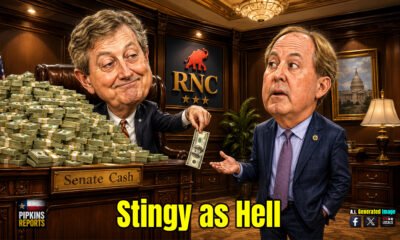
The Lone Star Freedom Project: Rick Perry’s Dark Money Machine Boosting John Cornyn
Washington DC – In the heat of Texas politics, as the 2026 Senate primary looms, voters across the state have been bombarded with a barrage of television and digital ads portraying U.S. Senator John Cornyn as a steadfast ally of President Donald Trump. These spots, flooding airwaves in key markets like Dallas-Fort Worth and Houston, aren’t the work of Cornyn’s official campaign. Instead, they originate from a shadowy newcomer: the Lone Star Freedom Project, a freshly minted 501(c)(4) nonprofit chaired by former Texas Governor Rick Perry.
Launched just weeks ago, this group has already funneled and estimated $260,000 into Dallas-Fort Worth media buys and $40,000 in Houston, all in a bid to shore up Cornyn’s image amid a brewing challenge from Texas Attorney General Ken Paxton. But beneath the glossy pro-Cornyn messaging lies a web of undisclosed funding and deep-rooted political alliances, raising questions about who—or what—is truly pulling the strings.
A Star-Studded Board, But Opaque Origins
The Lone Star Freedom Project burst onto the scene in early October 2025, positioning itself as a vehicle for “social welfare” in the Lone Star State. Its website, which went live around October 1, proudly lists Perry as chair, flanked by a roster of Texas heavyweights. Perry, the 47th Governor of Texas from 2000 to 2015 and briefly U.S. Secretary of Energy under Trump, brings political clout. His assentation from state House representative to agriculture commissioner, and ultimately to the governorship after succeeding George W. Bush.
Joining Perry are Susan Combs, a former Texas Comptroller and the state’s first female Agriculture Commissioner, who later served as Assistant Secretary for Policy, Management, and Budget at the U.S. Department of the Interior. Combs, now a fellow at the University of Texas Center for Identity and treasurer of the Women’s Suffrage National Monument Foundation, oversees a sprawling West Texas family ranch.
Claire Brickman, a University of Texas and Southern Methodist Law alum, rounds out the legal muscle with stints at the Department of Justice and as a state prosecutor. And then there’s Marcus Luttrell, the Houston-born Navy SEAL hero of Lone Survivor fame, a recipient of the Navy Cross and Purple Heart for his harrowing survival in Afghanistan’s Operation Red Wings.
On paper, it’s an all-star team of conservative credentials. Incorporated as a Delaware, not Texas, domestic corporation on June 25, 2025—just months before its ad blitz—the group claims 501(c)(4) status, allowing it to operate as a tax-exempt social welfare organization. Yet, for all its Texas pride, the project’s rapid formation and immediate dive into partisan advertising smack of strategic timing, especially as Perry has publicly lumped his endorsement of Cornyn with support for other GOP establishment figures like former Texas House Speaker Dade Phelan.
The Dark Money Veil: Unlimited Funds, Zero Transparency
What truly sets the Lone Star Freedom Project apart—and fuels its suspicious aura—is its 501(c)(4) designation. Under IRS rules, these “social welfare” nonprofits can engage in political activities, including unlimited independent expenditures on ads, as long as such efforts aren’t their “primary” purpose. The catch? They aren’t required to disclose donors, earning them the moniker “dark money” groups. Unlike super PACs or 527 organizations, 501(c)(4)s like this one can hoover up unlimited cash from individuals, corporations, unions, or even foreign nationals (if carefully crafted)—without ever revealing the sources.
This loophole is particularly alarming for foreign influence. Current federal law imposes no outright ban on contributions from non-U.S. citizens, green card holders, or overseas entities to 501(c)(4)s, provided the funds aren’t explicitly directed toward banned election activities. But there’s the rub. The organization’s stated purpose is “social walfare”, not “electioneering”.
Furthermore, there’s no cap on donation amounts, and since donors remain anonymous, a Russian oligarch, a Chinese state-linked firm, or a Saudi sheikh could funnel millions through domestic proxies, indirectly shaping U.S. elections. The group could then pass those funds to super PACs or launch its own ad salvos, all while cloaked in secrecy.
For a group as nascent as Lone Star Freedom Project —too new for IRS filings or an OpenSecrets profile—its absence from public databases isn’t surprising. Self-declared 501(c)(4)s don’t need pre-approval, and their first Form 990 returns won’t surface until mid-2026 at earliest. But that delay only amplifies the opacity: Who bankrolled that $300,000 ad buy? Domestic oil barons hedging against Paxton’s populist fire? Foreign interests eyeing Texas energy policy through Cornyn’s Senate perch? Or shadowy super PACs laundering cash? Without disclosure, it’s anyone’s guess, all we know for sure is that Rick Perry has his fingers all over it.
Perry and Cornyn: A Brotherhood Forged in Texas Power
The Lone Star Freedom Project isn’t operating in a vacuum—it’s the latest chapter in a decades-long bromance between Perry and Cornyn, two architects of the Texas Republican machine. Their paths first crossed in the late 1990s, when Cornyn served as Texas Attorney General (1999–2002), overlapping with Perry’s early days as governor starting in December 2000. The bond solidified in November 2002, when Perry appointed the newly elected Cornyn to a brief interim U.S. Senate term vacated by Phil Gramm, giving Cornyn a head start in Washington and cementing their mutual loyalty.
This alliance extends through a constellation of shared operatives, many of whom have shuttled between their orbits:
| Person | Role with Rick Perry | Role with John Cornyn | Notes |
|---|---|---|---|
| Chip Roy | Senior Advisor & Director of State-Federal Relations (2011); Ghostwriter for Fed Up! (2010) | Campaign aide (2002); Staff Director & Senior Counsel, Senate Judiciary Committee (2003–2009) | Advised Cornyn on immigration; later Texas AG under Paxton. |
| Brooke Rollins | Policy Director & Deputy General Counsel (early 2000s); TPPF President/CEO | Introduced & confirmed by Cornyn as Ag Secretary (2025) | Texas Public Policy Foundation ties; Cornyn praised her leadership. |
| Ted Delisi | Campaign consultant (2002, 2006 gubernatorial) | Press Secretary/Communications Director (1999–2002); 2002 Senate consultant | Co-founder of Delisi Communications, GOP strategy firm. |
| Deirdre Delisi | Chief of Staff (2004–2007); 2012 presidential advisor | Indirect via husband Ted | Texas Transportation Commission Chair (2008–2011). |
| Tony Fabrizio | Chief Pollster & Senior Strategist (2012 presidential) | Worked for NRSC campaigns under Cornyn’s chairmanship (2009–2012) | Frequent pollster for Cornyn-aligned establishment candidates. |
| Joe Allbaugh | Senior Campaign Advisor (2012 presidential) | Bush-era Texas GOP network ties | Former FEMA Director; propelled both men’s rises. |
| Ray Sullivan | Communications Director (2012 presidential); Chief of Staff (2009–2011) | Statewide GOP message coordination | Handled Perry re-elections. |
| Rob Johnson | Campaign Manager (2010 gubernatorial); Senior Strategist (2012 presidential) | Texas GOP fundraising networks | Active in both circles. |
These overlaps aren’t coincidental; they trace back to shared bastions like the Texas Public Policy Foundation, a Perry-favored think tank pushing government agendas that Cornyn has long championed. Perry’s endorsement of Cornyn in the 2026 primary—framed as a bulwark against Paxton’s insurgent bid—feels like a full-circle moment for two men who have traded appointments, advice, and influence for over two decades.
A Shadow Over Texas Conservatism?
As the Lone Star Freedom Project ramps up its pro-Cornyn offensive, its dark money structure invites scrutiny in an era of heightened concerns over election integrity. For Texas voters, the real question isn’t just whether Cornyn is a “Trump ally,” but whose money is scripting the narrative. In a primary pitting establishment grit against populist fervor, this group’s unchecked flow of hidden funds could tip the scales—and deepen America’s divide over who gets to buy influence in the shadows. As filings trickle in next year, the truth may finally emerge. Until then, the Lone Star’s freedom comes with a hefty veil of secrecy.
Election
New Poll Shows Crockett, Paxton Leading Texas Senate Primary Contests
Texas Senate Primaries Show Early Leads for Crockett and Paxton
AUSTIN, Texas – A new poll released by The Texas Tribune indicates that Jasmine Crockett and Ken Paxton are leading their respective primary races for the U.S. Senate seat in Texas. The survey, published on February 9, 2026, highlights the early momentum for both candidates as they vie for their party nominations in a closely watched election cycle. The results point to strong voter recognition and support for Crockett in the Democratic primary and Paxton in the Republican primary.
The poll, conducted among likely primary voters across the state, shows Crockett holding a significant lead over her Democratic challenger James Talarico, while Paxton maintains a commanding position among Republican contenders John Cornyn & Wesley Hunt.
According to the poll, Ken Paxton leads with 38 percent of likely GOP primary voters, pulling ahead of incumbent John Cornyn, who trails at 31 percent, while Wesley Hunt remains a distant third at 17 percent. The survey indicates Paxton would hold a commanding advantage in a runoff scenario and currently outperforms Cornyn across nearly every key Republican demographic group, with Latino voters the lone exception, where Cornyn maintains a seven-point edge.
Among Democrats, the poll shows Jasmine Crockett opening a notable lead, capturing 47 percent of likely primary voters compared to 39 percent for James Talarico—a meaningful shift from earlier polling that had Talarico in the lead. While still early, the numbers suggest momentum is consolidating ahead of primaries that will determine the general election matchups.
Jasmine Crockett, a sitting U.S. Representative whose district lines were redrawn out from under her, has responded to political extinction with a desperate lurch toward the U.S. Senate. Her campaign, widely criticized as race-baiting and grievance-driven, has leaned heavily on inflaming urban Democratic turnout while cloaking thin policy substance in fashionable slogans about healthcare and “equity.”
By contrast, Ken Paxton enters the race with a long, battle-tested record as Texas Attorney General, earning fierce loyalty from conservatives for his aggressive defense of state sovereignty, constitutional limits, and successful legal challenges to federal overreach. Though relentlessly targeted by opponents, Paxton’s tenure reflects durability, clarity of purpose, and an unapologetic alignment with the voters he represents—qualities that define his standing in the contest.
The Texas U.S. Senate race draws national attention, as the state remains a critical battleground in determining the balance of power in Congress. With incumbent dynamics and shifting voter demographics at play, the primary outcomes will set the stage for a potentially contentious general election. The Texas Tribune poll serves as an initial benchmark, though voter sentiment could evolve as campaigns intensify and debates unfold in the coming weeks.
Council
Fate City Council Votes to Release Secret Recordings
Councilman Mark Harper walks out of meeting before adjournment.
FATE, TX – The Fate City Council voted late Monday night to waive deliberative privilege, opening the door to the public release of secret audio recordings that may have driven a recall election against Councilwoman Codi Chinn. The decision came after hours of public criticism, procedural friction, and a lengthy executive session with legal counsel.
The meeting, held Monday, February 2, was streamed live by the city and is available on YouTube at: https://www.youtube.com/live/zQVN0i-d8C0 (Embedded Below)
(Source: City of Fate, official meeting broadcast)
Timeline for Readers
- 00:33:52 – Public comments begin, largely focused on the recall election of Councilwoman Codi Chinn.
- 00:56:10 – Councilman Harper interrupts public Comment.
- 00:57:00 – Councilman Harper interrupts public Comment.
- 00:58:00 – Councilman Harper interrupts public Comment.
- 02:21:00 – Executive Session – Council enters closed session to consult with legal counsel.
- 03:22:52 – Council reconvenes in open session.
- Primary motion – Council votes to “waive deliberative privilege”, allowing release of disputed audio recordings.
Public Comment and Visible Strain
Public comments began just after the 33 minute mark and quickly centered on the recall election. Speaker after speaker questioned the conduct of city officials and demanded transparency regarding audio recordings that have circulated privately but remained unavailable to the public.
During one speaker’s remarks, critical of Councilwoman Chinn, procedural tension became visible. Three separate times, Councilman Mark Harper interrupted to remind Mayor Andrew Greenberg that the speaker had exceeded the three-minute time limit. Each time, Mayor Greenberg thanked Harper for the reminder, then directed the speaker to continue.
The exchange stood out. While council rules clearly limit speakers to three minutes, the mayor’s repeated decision to allow the speaker to proceed suggested an effort to avoid the appearance of silencing criticism during a highly charged meeting.
Clarifying the Recordings
Contrary to some early assumptions, the audio recordings at issue were not recordings of executive sessions. Instead, they are one-party consent recordings, the existence of which has been previously reported and alluded to on Pipkins Reports. Their precise origin has not been publicly detailed, but their contents have been referenced repeatedly by both supporters and critics of the recall effort.
Behind Closed Doors
Following the public meeting, the council entered executive session to consult with legal counsel. After about an hour, members returned to open session at approximately 3:22:52 .
The primary motion coming out of that session was to “waive deliberative privilege“. The effect of the vote was to remove a legal obstacle to releasing the secret audio recordings that have been at the center of the controversy.
No excerpts were played, and no conclusions were announced. The council did not rule on the legality of the recordings, nor did it weigh in on the merits of the recall election itself.
Why the Vote Matters
The decision does not resolve the recall of Councilwoman Chinn. It does not validate or refute claims made by either side. What it does is shift the debate away from rumor and secondhand accounts.
According to guidance from the Texas Municipal League, governing bodies may waive certain privileges when transparency is deemed to serve the public interest, particularly when litigation risk is balanced against public trust (Texas Municipal League, Open Meetings Act resources).
Opinion and Perspective
The council’s action was a necessary step. Secret recordings, selectively referenced and strategically leaked, undermine confidence in local government. So does a refusal to confront them directly.
Transparency is not about protecting officials from embarrassment. It is NOT the job of the council to assist the city in concealing information that may be used against it in legal proceedings when the City Manager, or Councilmen, may have done bad things. It is about protecting citizens from manipulation. If the recordings exonerate those involved, their release will restore credibility. If they raise concerns, voters deserve to hear them unfiltered before making decisions in a recall election.
Monday night in Fate did not end the controversy. It ended the excuse for keeping the public in the dark.
Election
Bob Hall Faces Old Allegations as Supporters of His Opponent Stir Controversy in Rockwall
ROCKWALL, TX — Texas State Sen. Bob Hall appeared before voters at Rockwall County’s Final Friday Night Forum, on Friday. The appearance renewed online criticism from supporters of his primary challenger which brought attention back to a decades-old allegation from a former marriage and also to social-media comments allegidily attributed to Hall’s wife.
The renewed discussion did not stem from new legal filings, court actions, or investigative reporting. Instead, it followed social-media posts by individuals publicly supporting Hall’s opponent, Jason Eddington, including Fate City Councilwoman Codi Chinn, whose sharply worded statements have drawn attention for both their substance and tone.
The Forum and the Race
The forum was hosted by Blue Ribbon News in partnership with the Rockwall County Republican Party, and held at the Rockwall County Courthouse. It marked the final event in a series intended to give Republican voters an opportunity to hear directly from candidates ahead of the March primary.
Other candidates in attendance included:
- Rockwall County Judge
- Frank New
- Scott Muckensturm
- County Commissioner, Precinct 4
- John Stacy
- James Branch
- Lorne Megyesi
- Justice of the Peace, Precinct 2
- Victor Carrillo
- Chris Florance
Pipkins Reports could find no official transcript or video of the forum. According to available coverage, the event proceeded without public discussion of personal controversies, and no candidate addressed the matter from the stage.
Background on the Allegations
The most damaging allegations currently being recirculated date back to divorce proceedings in Florida in the early 1990s, during which Hall’s former wife, Jane Hall, made claims in court filings alleging physical, verbal, and sexual abuse during their marriage.
The allegations, raised during a contested divorce, as they often do. Bob Hall has denied the allegations. No criminal charges were filed. No court ruled against Hall or issued a finding of abuse. The filings did not result in convictions, injunctions, or adverse judgments.
The allegations became publicly discussed during Hall’s first Senate campaign in 2014 and have resurfaced intermittently during contested elections. Their latest reappearance coincides with the current Republican primary and has been driven by individuals openly advocating for Hall’s opponent.
Explicit Attribution and Political Context
Following the January 30 forum, Fate City Councilwoman Codi Chinn, who has publicly endorsed Jason Eddington, posted a statement on social media criticizing Hall and urging Republican voters to support Eddington.
In her post, Chinn wrote:
“Senator Bob Hall I expect you will be making a statement issuing an apology on behalf of your wife for body shaming a woman simply because you don’t ideologically agree with her. These comments are shameful and your silence is deafening. Being Republican shouldn’t mean being small minded. I hope Republican Primary voters will pick the true Conservative Jason Eddington, Candidate for Texas Senate, District 2!”
Critics of Chinn, including some local Republican activists, say the post reflects what they describe as a pattern of caustic and confrontational rhetoric directed at individuals she opposes politically. It’s ironic that Chinn requests accountability for language of others, while she herself asks for forgiveness of her digressions in her bid to not be recalled. Supporters of Chinn, by contrast, characterize her comments as blunt advocacy and a willingness to publicly challenge those with whom she disagrees.
Amplification by a Political Social Media Page
On January 31 at 10:57 p.m., the Facebook page Rockwall County News First published a post calling on the Rockwall County Republican Party to condemn comments attributed to Hall’s wife. The page credited Codi Crimson Chinn as the source of screenshots included in the post.
The post stated:
“We hope that Rockwall County Republican Party will join us in condemning Senator Bob Hall’s wife in her comments.”
The screenshots included in the post purport to show comments written by Kay Hall, Senator Hall’s wife. The screenshots have not been independently authenticated by this publication. According to the screenshots, the comments attributed to Kay Hall read:
“Oh, yes, so disgusting to see Jill get up an speak. She and all of the TFRW little people are in their element. Wish I had recorded her speech, or even more wish I had stood up in the room to tell everyone how she got the Democrats to vote for her in the election. The pictures are very flattering to her because she has gained weight and really looked aged. I am sitting across from Bob near the podium. too, close!!!”
As of publication, neither Senator Hall nor his wife has publicly confirmed the authenticity of the screenshots or issued a statement regarding the comments.
Hall’s Position and Current Status
Hall has not publicly addressed the social-media posts and did not respond to our request for comment. He has previously stated, during earlier campaigns, that efforts to revive allegations from his former marriage are politically motivated and unrelated to any legal findings or his conduct in office.
Hall is currently married to Sarah Kay Smith Hall, with whom he has three children. There are no legal actions or criminal allegations involving his current marriage. The current controversy centers on online posts circulated by political opponents and their supporters.
Conclusion
The Final Friday Night Forum was intended to focus voter attention on policy differences among Republican candidates. In the days following the event, however, the race shifted toward personal disputes fueled by online posts from supporters of Hall’s challenger, including commentary that some observers describe as emblematic of an increasingly sharp-edged political style.
As the March primary approaches, voters in Senate District 2 must weigh not only policy and legislative records, but also the motivations and methods used by campaigns and their advocates. Whether the renewed criticism is viewed as relevant scrutiny or as opposition-driven escalation remains a question for the electorate to decide.
You must be logged in to post a comment Login