

OMG! You just checked your lottery ticket for Mega Millions and you won! You check it again, maybe again and again. You feel a strange sensation of falling inward with joy as well as anxiety & panic. You just won all or part of $1.1 Billion dollars! Now what?
According to the Texas Lottery Commission, the very first thing you should do is sign the back of that ticket. Lottery tickets are a “bearer instrument”. Whoever “bears” (holds) the ticket is considered the owner unless the back of the ticket has been signed. So do that first… do it now!
Next, remain calm and most importantly, shut your mouth. Zip it. Avoid all temptation to shout from the rooftops that you have won the lottery. Go totally dark on social media … NEVER announce that you have won the lottery.
At this point the only person who should know is your spouse, that’s it. Don’t even tell your kids. Don’t even call your mother.
Unfortunately, for the current draw (at publication) the $1.1 billion dollar jackpot is being drawn on Friday evening… which means that you can’t do anything until Monday morning. That’s going to be three excruciating days of waiting. Just remember … keep your mouth shut while you formulate a plan.
You will have 180 days to claim the prize, so there is plenty of time to get your ducks in a row. Over the weekend you will likely play around with making endless lists of how to spend your money but think of that as just a game because monday morning the next thing you should do is start looking for an attorney.
Believe it or not, there are attorneys that specialize in lottery winnings. Make some calls & set up two or three interviews. Don’t tell them that you just won the big one, just that you need to discuss your options for a jackpot. When you get to their office, the first thing that you do is make THEM sign a non-disclosure agreement before you discuss anything. If they don’t sign … walk out. YOU are calling the shots now.
When you settle on an attorney, they will also be able to provide you with a financial adviser that will go over the taxes you will owe as well as advise you about the difference between the cash and annuity. They will also advise you on how to invest it … but even with this expert advice, you should seek a second or even a third opinion. Remember, there will always be people who want a piece of the action.
According to the National Endowment for Financial Education, 70% of those who receive large cash windfalls lose them within just a few years. So be smart and get financial advice.
Now you need to make a plan to claim your prize. It starts by calling the Texas Lottery Commission at: 800-375-6886 to complete an initial inquiry on your ticket and to schedule an appointment to complete the processing of your claim.
For this, you will need to travel to Austin. Prizes greater than $5,000,000, all Lotto Texas®, Powerball®, and Mega Millions® jackpot prizes, and prizes paid by annuities must be processed at Texas Lottery headquarters in Austin.
If you are married and have kids, we suggest that you get a babysitter and you and your spouse take separate modes of transportation. One of you would have the original ticket with you and the other a copy. You want to avoid a complete tragedy, right?
BTW, you still haven’t told anyone, right?
Bad things can happen if you spill the beans. Friends, family, and new people will suddenly appear in your life. Abraham Shakespeare was murdered in 2009 after winning a $30 million jackpot. The suspect, a woman who befriended Shakespeare after he won the lottery, shot him twice in the chest and then buried him under a slab of concrete.
Sandra Hayes of Missouri split a $224 million Powerball prize with 11 people, but she soon found that certain acquaintances were more interested in her assets than her friendship. She said that when she dined out with her friends, they would belatedly announce that they didn’t have enough money to foot the bill. “These are people who you’ve loved deep down, and they’re turning into vampires trying to suck the life out of me,” Hayes told The Associated Press.
In the State of Texas, you do NOT have to reveal your identity publicly to claim your prize. Texas, along with Delaware, Georgia, Kansas, Maryland, North Dakota, Ohio and South Carolina allow anonymity to Mega Millions winners. The 85th Texas Legislature’s regular session in 2017 enacted HB 59 authorizing certain prize winners who win lottery prizes in the amount of $1 million or more to choose to remain anonymous. So chose wisely.
By now you have probably decided whom you are going to tell about your good fortune. But remember, once you let that cat out of the bag you will not be able to get it back. Don’t think that your Mother is not going to blab to her sister… then the sister to the boyfriend… then the boyfriend to the guys at work… then just like the 6 degrees of Kevin Bacon the next thing you know CNN is knocking on your door … whether you chose to “remain anonymous” or not.
That kind of money can get people killed. So we suggest that you don’t tell anyone until after you have claimed the prize. Then, before you let that cat out of the bag, grab your closest family and tell them that you are sending a car for them and to pack their bags for a weekend trip. Get them off to a hotel (in the United States) and don’t let them know what’s going on until you get there.
So now it’s time to brainstorm about the future and your security and put your financial plans into action. And start enjoying the good life.
The good people at State Farm have this to say about your windfall.
“Maintain your perspective and sense of self
Don’t quit your day job. Certainly not until you have your lottery money in hand, but even then consider sticking with some sort of part-time work or at least a passionate hobby. Depending on how important work is to your sense of self, you may want to try a new career or go back to school to study something you’ve always been interested in.
Keep a healthy mind and body. We all know money can’t buy happiness — in fact, some folks say winning the lottery and dealing with the money and requests for help and loans ruined their lives with stress. Eat right, exercise, talk to close family and friends, and seek professional counseling if handling your new wealth is causing too much emotional strain.”
Good advice in our opinion. And now for our disclaimer:
These tips are merely suggestions and should not be considered financial or legal advice. Please consult professionals for specific advice.



Kentucky, USA – Mitch McConnell has been out of public view for 71 days. No speech. No interview. No video. No public appearance. Not even a short phone recording of the 84-year-old senator telling Kentucky voters, in his own voice, that he’s doing OK.
For a man who spent nearly two decades at the center of American political power, that is an extraordinary silence. And it has created a vacuum, as every vacuum eventually does, that the internet has been more than happy to fill.
McConnell’s last confirmed in-person Senate vote came June 11, when he voted on a cloture motion involving judicial nominee Justin D. Smith. He had also been present during the Senate’s marathon June 4 vote-a-rama, which ran into the early morning hours, and Senate records show him presiding over a Defense Appropriations subcommittee hearing June 9.
Three days after that last confirmed Senate appearance, McConnell was hospitalized following a fall at his Washington residence that left him “briefly unconscious”. His office later said he suffered a mild case of pneumonia and was undergoing rehabilitation.
On July 12, McConnell allegedly addressed Kentuckians in a written statement, saying he was recovering from the fall and pneumonia. His office released a photograph showing him sitting beside his wife, Elaine Chao, holding that day’s Washington Post.
That photo did not end the questions. It multiplied them.
A second photograph, released July 27 and reportedly dated July 26, showed McConnell again with Chao. Neither image included video or audio of McConnell speaking.
McConnell was discharged from a rehabilitation facility Aug. 6 and said he would continue intensive physical therapy at home while remaining engaged with Senate business remotely. His office has not announced when, or whether, he will return to the Capitol.
Republican colleagues have said they have spoken privately with him. Former McConnell adviser Scott Jennings described a lengthy conversation in which he said McConnell sounded alert and discussed politics and world affairs. But those conversations remain private.
And that is the heart of the problem.
Kentucky Gov. Andy Beshear, a Democrat, has repeatedly called for McConnell to provide a direct public update. Beshear recently said he had received “absolutely nothing” back from McConnell despite reaching out.
Meanwhile, social media has gone full Texas-sized conspiracy mill.
Benny Johnson on X wrote July 7 that McConnell’s family should answer demands for “proof of life,” while raising questions about Chao’s China connections and travel. Laura Loomer on X went considerably further, claiming without publicly established evidence that McConnell was “brain dead” and being kept alive by machines.
There is no actual evidence establishing those claims.
But dismissing every question as a conspiracy theory is equally lazy. The public record really is unusual: an elderly senator suffers a serious fall, spends weeks hospitalized and in rehabilitation, releases two questionable photographs and written statements, and remains completely absent from public view.
If he were truly coherent, a 30-second video would solve the issue … speculation grows that this is simply not possible and that is the reason they haven’t provided one.
There is now a natural deadline looming over this strange saga: September 14, 2026. That is the date the Senate is scheduled to return to regular business after its August recess, meaning McConnell will have been absent from public view for 95 days since his last confirmed appearance on June 11.
By then, a photograph and another written statement attributed to McConnell simply won’t cut it. If he is healthy enough to continue serving, his constituents should be able to see and hear him. If he isn’t, Kentucky voters deserve to know that, too.
September 14 shouldn’t necessarily be a literal deadline for his medical recovery, but it is a reasonable public accountability deadline: when the Senate comes back to work, the senator whose name appears on the roll should be able to demonstrate, in his own voice and on camera, that he is alive, aware and capable of carrying out the job for which Kentucky elected him.
If the nation doesn’t hear from him by September 14th, a criminal investigation should take place.

Montgomery, AL – The woman who spent years telling America which organizations were dangerous has now been arrested by the federal government in a fraud case involving secret payments, extremist informants, alleged shell companies and donor money.
Heidi Beirich, former director of the Southern Poverty Law Center’s Intelligence Project and former chief financial officer, was arrested Wednesday in California as the Justice Department’s criminal investigation into the SPLC widened. Beirich faces charges of wire fraud conspiracy, conspiracy to make false statements to a federally insured bank and conspiracy to conceal money laundering.
That’s quite a turn for someone whose professional career was built around exposing other people’s alleged extremism.
According to federal prosecutors, the case involves an SPLC informant identified in court documents as “F-9,” who operated inside the National Alliance, a white supremacist organization. The Justice Department alleges the SPLC secretly funneled approximately $1.2 million to F-9 over more than two decades as part of its intelligence-gathering operation.
The indictment does not name Beirich. Instead, it identifies a former senior SPLC employee as “Employee-2,” describing that person as someone who would later become director of the organization’s Intelligence Project. Multiple news organizations, including The Associated Press, have identified Employee-2 as Beirich. Her attorney, Michael Proctor, confirmed Wednesday that she had been charged in the federal case.
And the allegations get considerably stranger from there.
Prosecutors allege Beirich and F-9 were romantically involved and shared a residence and two bank accounts. Between 2015 and 2021, roughly $140,000 in SPLC donor money allegedly flowed into those joint accounts. The indictment says that money accounted for about 66 percent of the deposits into the accounts and was used to pay the couple’s personal living expenses.
Federal prosecutors also allege that SPLC officials helped establish bank accounts using fictitious company names to disguise the source and purpose of payments to informants.
This wasn’t simply a matter of paying someone for information. According to the indictment, the government believes the financial arrangements were deliberately structured to conceal what was happening from banks and donors. The original federal indictment against the SPLC alleges that, between 2014 and 2023, the organization secretly funneled more than $3 million to people associated with violent extremist groups, including the Ku Klux Klan, Aryan Nations and the National Socialist Party of America.
The SPLC itself was indicted in April on 11 counts involving wire fraud, false statements to a federally insured bank and conspiracy to commit concealment money laundering. The FBI investigated with assistance from IRS Criminal Investigation.
Beirich’s attorney has rejected the prosecution as politically motivated, saying that the justice system should not be used against political opponents. The SPLC has also maintained that its informant program was legitimate intelligence work designed to gather information about extremist organizations.
Beirich left the SPLC after leading its Intelligence Project from 2012 through 2019. She later co-founded the Global Project Against Hate and Extremism and continued to appear publicly as an expert on political extremism.
Business
Big Brother Just Leveled Up: If You Thought Flock Cameras Tracked Your Car, SignalTrace Tracks You
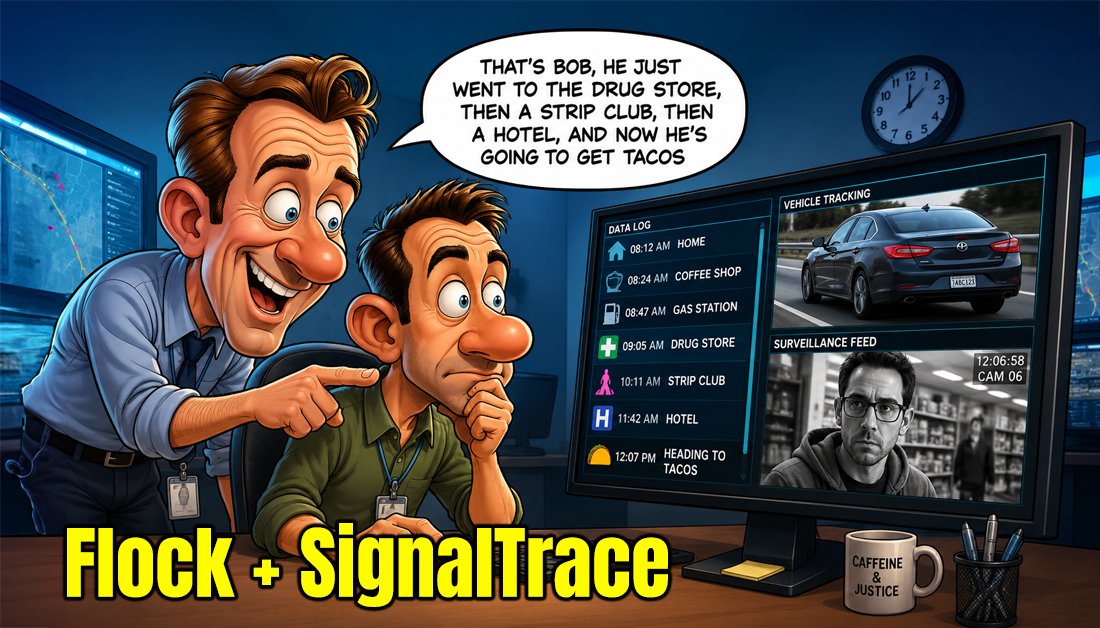
Your Town, USA – For years, Americans have debated the rapid expansion of automatic license plate reader (ALPR) systems like Flock Safety. Supporters argued the cameras simply photographed license plates visible from public roads. Critics warned they were quietly building a nationwide database of vehicle movements and violating the rights of every single American.
Now comes the next evolution.
Instead of merely tracking the vehicle, a new technology called SignalTrace™ is designed to identify and follow the person inside it by creating what its manufacturer calls a unique electronic fingerprint assembled from the wireless devices they carry and the electronic systems built into their vehicle.
If Flock Cameras know where your car has been, SignalTrace is designed to know where you have been—even if you change vehicles, remove your license plate, attempt to conceal your identity or just walk down the street.
Developed by Leonardo US Cyber and Security Solutions, LLC under its ELSAG brand, SignalTrace represents a significant expansion in surveillance technology. The system can combine traditional license plate recognition with passive radio-frequency collection to correlate dozens of electronic signals into a single profile that investigators can search historically or monitor in real time.
Beyond the License Plate
Traditional ALPR systems capture a photograph of a license plate along with the date, time, and location. SignalTrace expands that concept dramatically.
According to Leonardo’s product literature, the system installs sensors alongside existing ELSAG ALPR cameras (or it can operate independently) that continuously listen for publicly broadcast wireless signals emitted by nearby electronic devices.
Those signals are then correlated with nearby license plates.
Over time, the software learns which devices consistently travel together.
Instead of simply identifying a Toyota Camry with Texas plate ABC-1234, SignalTrace may recognize something far more specific:
- iPhone
- Apple Watch
- AirPods
- Vehicle tire pressure sensors
- Vehicle infotainment system
- Wi-Fi hotspot
- Bluetooth-enabled dashboard components
Collectively, those devices become what Leonardo calls an “electronic fingerprint.”
That fingerprint becomes associated with a particular vehicle, license plate, date, time, and location. Once established, investigators can potentially locate that same electronic fingerprint again—even if the vehicle’s plate changes or disappears.
How SignalTrace Works
Unlike wiretaps or cell-phone intercept devices, SignalTrace does not claim to capture communications. Instead, it passively listens for the electronic “handshakes” devices routinely broadcast into the air. According to Leonardo, the sensors detect publicly available radio-frequency identifiers from technologies.
The software then applies algorithms to identify groups of devices that repeatedly appear together across multiple locations and times. Leonardo describes this process as recognizing “convoys” of electronic devices. Those recurring combinations are linked to ALPR camera detections whenever a license plate is available.
All of the resulting information is stored within Leonardo’s ELSAG Enterprise Operations Center (EOC), allowing investigators to perform historical searches or monitor activity as new detections occur.
The sensors are not limited to highways. Leonardo says they can also be deployed in:
- Shopping centers
- Malls
- Stadiums
- Event venues
- Rail stations
- Parking facilities
- Virtually anywhere people gather
That greatly expands surveillance beyond traditional roadway cameras.
What Devices Can It Detect?
Perhaps the most striking aspect of SignalTrace is the sheer number of electronic devices that may contribute to a person’s digital fingerprint. Leonardo’s documentation lists several categories.
Bluetooth Devices
Nearly everyone carries Bluetooth-enabled electronics. These include:
- Smartphones
- Smartwatches
- Fitness trackers
- Wireless earbuds
- Wireless headphones
Wi-Fi Devices
The system can also detect Wi-Fi sources such as:
- Smartphones
- Tablets
- Laptops
- Vehicle Wi-Fi hotspots
Vehicle Electronics
Modern vehicles constantly broadcast signals from numerous onboard systems. SignalTrace can associate identifiers from:
- Tire Pressure Monitoring System (TPMS) sensors
- Vehicle safety systems
- Security sensors
- Infotainment systems
RFID Devices
Radio-frequency identification tags also become part of the picture. Examples include:
- Employee key cards
- Asset tracking tags
- Warehouse pallet transmitters
- Pet microchips
- Toll Tags
Individually, many of these identifiers may not uniquely identify someone. Together, however, they become remarkably distinctive. A phone alone may be common.
A phone plus a smartwatch, wireless earbuds, vehicle TPMS sensors, infotainment system, and Wi-Fi hotspot traveling together every morning creates an electronic signature that is far more difficult to confuse with someone else’s.
An Electronic Fingerprint
Leonardo openly markets this capability. Rather than relying upon one device, SignalTrace builds a composite identity. Imagine two identical pickup trucks.
Their license plates differ. Their owners both carry iPhones. Traditional ALPR systems distinguish them only by plate. But SignalTrace instead recognizes that one truck consistently travels with:
- Phone A
- Apple Watch A
- AirPods A
- TPMS Set A
- Infotainment System A
The other truck carries:
- Phone B
- Samsung Galaxy Watch
- Bose headphones
- TPMS Set B
- Vehicle hotspot B
Those collections become unique fingerprints. Even if one owner changes license plates—or drives another vehicle while carrying the same electronics—the fingerprint may remain recognizable.
In effect, investigators are no longer simply tracking a vehicle. They’re tracking the collection of electronic devices that travels with a person.
Law Enforcement Benefits
Leonardo promotes SignalTrace as an investigative force multiplier. Among its advertised capabilities:
- Integrates directly with existing ELSAG ALPR infrastructure.
- Identifies suspects through recurring electronic signatures.
- Recognizes vehicles using electronic fingerprints.
- Detects movement patterns and recurring travel.
- Identifies convoys.
- Assists investigations involving gangs.
- Supports human trafficking investigations.
- Expands surveillance beyond fixed ALPR locations.
- Enables both real-time monitoring and historical searches.
The company says sensors can be added to existing deployments, reducing implementation costs for agencies already operating ELSAG license plate readers.
Leonardo Says It’s Privacy Respecting
Leonardo argues SignalTrace remains privacy conscious because it captures only publicly broadcast signals. According to the company, the system:
- Does not decrypt communications.
- Does not intercept phone calls.
- Does not read text messages.
- Does not capture email contents.
- Does not access files stored on devices.
Instead, it collects only identifiers that devices voluntarily transmit over public radio frequencies. Leonardo compares the process to photographing a visible license plate on a public road.
From the company’s perspective, it is simply observing information already being broadcast into public space.
Privacy Advocates See Something Different
Privacy organizations and technology researchers have expressed far greater concern.
Critics argue SignalTrace fundamentally changes what ALPR systems are capable of doing. Instead of merely documenting where a vehicle traveled, they contend the technology enables persistent tracking of individuals through the electronic devices they carry every day.
Several researchers note that while modern smartphones increasingly randomize Bluetooth and Wi-Fi MAC addresses to reduce tracking, not every broadcast identifier is randomized.
Vehicle tire pressure monitoring systems, for example, often transmit fixed identifiers.
Likewise, combining multiple partially stable identifiers into one composite fingerprint may overcome many of the privacy protections built into individual devices. In other words, even if one identifier changes periodically, the surrounding collection of devices may remain recognizable.
Privacy advocates argue that this transforms anonymous radio emissions into something much closer to a persistent personal identifier.
Current Deployment
As of mid-2026, Leonardo is actively marketing SignalTrace and promoting it as an enhancement for existing ELSAG ALPR customers.
Public documentation indicates the sensors are intended to integrate with existing deployments, although no specific police department or municipality has publicly confirmed an operational deployment.
The underlying technology received a U.S. patent in March 2024 and was previously marketed in related forms under the name EOC Plus.
The Bigger Question
Supporters will argue SignalTrace is simply another investigative tool—one that relies only upon publicly available radio signals rather than private communications.
Critics see something far more consequential.
For decades, the debate centered on whether government should be able to track where your vehicle travels. SignalTrace moves beyond the automobile. It creates a persistent electronic identity assembled from the devices most Americans carry every day.
For decades, this author has maintained that there is no technology that exists, that the government will not eventually use against its own citizens.
You must be logged in to post a comment Login