Connect with us

Published

on

Fate, TX – Fate Tribune

In a swift decision, the Fate City Council has approved a controversial modification to the Lafayette Crossing development agreement—now rebranded as “Project Cactus”—that authorizes up to $15 million in reimbursements to a private developer for public infrastructure. The move, framed by city officials as an urgent economic opportunity, was rushed through the council without adequate public notice, discussion, or debate.

Coincidentally, the council’s vote to give away up to $15 million of taxpayer-controlled funds came just weeks after the city issued a $20 million bond, $15 million of which will be used to construct a new police station. The Fate Tribune has submitted an Open Records Request (ORR) to discover if the city knew of this potential request by the developer before the bond proposal was issued to the voters.

Buried in the Agenda, Rushed Through Council

The Project Cactus agreement appeared on a recent council agenda under the vague language of “economic development negotiations; and to deliberate the offer of a financial or other incentive to the business prospect with no clear explanation of the project’s scope, cost, or long-term financial obligations.” The Agreement was presented to the Council in a closed, executive session, and the public was never able to review it. Only a summary, which does not indicate how many incentive credits were under consideration, was posted for the public. Therefore, the people of Fate were left without access to the details and had no meaningful opportunity to review, question, or weigh in on the proposal before the council cast its vote.

Council members were reportedly told that time was of the essence and that an immediate vote was necessary to secure the project. The pressure tactic left no room for thorough analysis or citizen engagement. The rushed timeline ensured that residents would not have a chance to digest the financial implications or voice either support or opposition.

This is not the first time Fate residents have expressed frustration with the city’s lack of transparency in major spending decisions, but the size and scope of this developer giveaway have taken concerns to a new level.

A Familiar Development, Rebranded with Bigger Costs

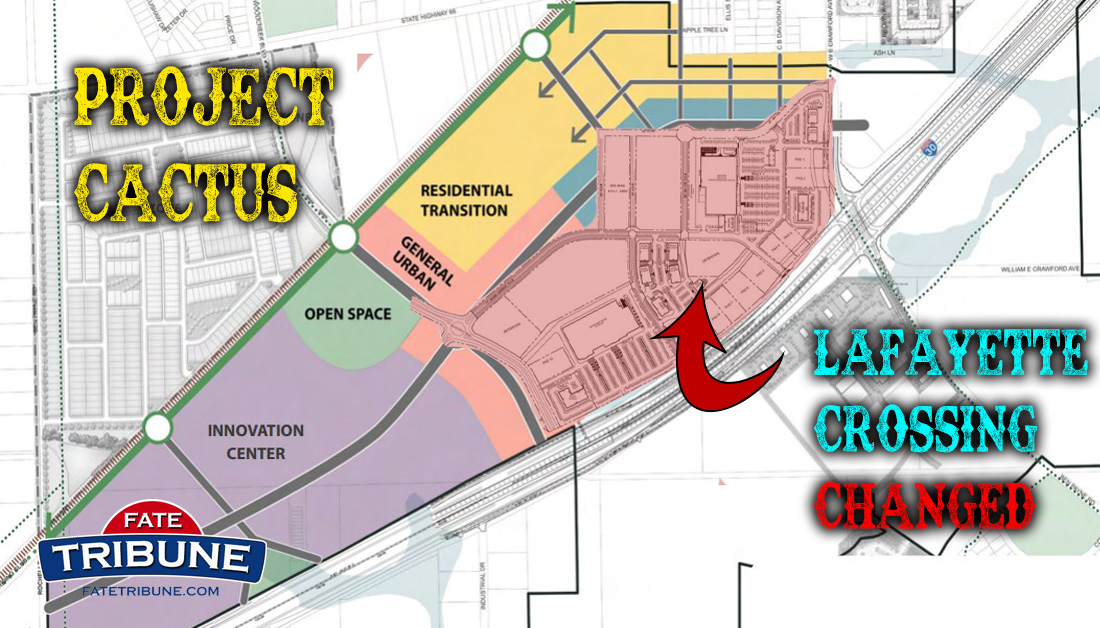
Project Cactus will span approximately 80 acres at the northwest corner of Interstate 30, between Woodcreek Blvd. and FM-551. Plans include 400,000 square feet of retail and restaurant space, anchored by two Fortune 100 retailers, we are told: one a grocery store, the other a department store. Both of which are undisclosed to the public.

In order to serve the development, approximately $15 million worth of public infrastructure—roads, sewer, water, and utilities—must be constructed. Under the newly amended agreement, the city will reimburse the developer for those costs using a blend of revenue streams:

  • $9 million in developer-paid impact fees collected from the eastern portion of the project
  • $1 million in utility capital replacement funds, earmarked for maintaining the city’s existing infrastructure
  • $1.7 million from the Fate Economic Development Corporation’s sales tax revenues
  • $3.3 million from the City’s general fund, supported by residential property taxes and citywide sales taxes

Although the agreement is framed as “performance-based,” reimbursement begins in 2028 and continues through 2037, with payments tied to 50% of the city’s potential sales tax generated from retailers in the development. The money comes as “tax credits”, a type of transferrable commodity that can be sold or traded in private markets. What we are referring to as the “developer”, is actually a slew of companies: D-F FUND 18, LTD., D-F FUND VI, LTD., D-F SOUTHWEST FUND 19, LTD., and LA-DF INVESTMENT FUND 8. These Tax Credits can be used by anyone on the development team, or sold off to some future entity. They can also just be cashed in, giving the developers a nice bonus.

$15 Million for Retail, $15 Million for Police—But Only One Got Voter Input

What makes this maneuver troubling to residents is the striking contrast between how the city handled its $15 million police station project versus how it handed over $15 million to a developer.

The police station project was part of a broader $20 million public safety bond package presented to voters and approved in November 2024. It went through a process of public discussions, public meetings, and was ultimately subject to democratic approval by a vote of the people, where it was passed by 60% of the voters.

In contrast, the Project Cactus reimbursement—also worth $15 million—received no such scrutiny. There were no town halls, no financial impact analysis made public, and no citizen advisory input. It was quietly placed on the agenda and passed under the rationale of urgency. Other than what was presented seconds before the vote, the public had no idea what, “Project Cactus” was.

A Taxpayer Gamble on Retail Hopes

Supporters of the deal argue the project will eventually generate over $140 million in taxable property value and $2.8 million in annual sales tax revenue for the city. But those gains are 10 years from now and are far from guaranteed. The commercial retail sector has been highly volatile in recent years, and the success of any development on the outskirts of Dallas-Fort Worth depends heavily on consumer patterns, traffic flow, and macroeconomic factors outside the city’s control.

With infrastructure costs scheduled to be completed by mid-2027 and anchor stores set to open by that year’s end, the sales tax reimbursement clock begins in 2028 and runs through 2037. The agreement replaces the original Lafayette Crossing deal, which capped developer credits at $9 million and limited city exposure. However, as we stated previously, the Tax Credits can be used or transferred at the whim of the Developers.

Citizens Left Wondering: Who Does City Hall Work For?

For many residents, the larger concern isn’t the project itself—it’s the process.

A massive, multimillion-dollar commitment was pushed through with minimal transparency, no time for public input, and under pressure to act quickly. In doing so, the city council placed the interests of a private developer ahead of the taxpayers who fund the very infrastructure being gifted away.

While the council insists that Project Cactus will broaden the tax base and relieve residential property owners in the long term, it’s the short-term sleight-of-hand that’s raising alarm bells. When the public is kept in the dark until it’s too late to act, it’s not economic development—it’s taxation without representation.

The people of Fate approved a bond to build a police station. They were never given a chance to weigh in on giving away the same amount to a retail developer. Perhaps it’s time to revise the Town Charter so that future councils can’t give away more than $100,000 to a developer at a time, without voter approval. It’s clear that the Fate Municipal Development District doesn’t view city obligations in the same way that citizens do. Furthermore, City Manager Michael Kovacs was derelict in his duty to the citizens of Fate, choosing to prioritize a developer’s timeline over the public’s right to transparency, oversight, and meaningful participation in the decision-making process.

Now the money is committed, the votes are cast, and the deal is done. What remains to be seen is whether the gamble pays off—or whether Fate’s taxpayers will be left holding the bag.


Michael Pipkins focuses on public integrity, governance, constitutional issues, and political developments affecting Texans. His investigative reporting covers public-record disputes, city-government controversies, campaign finance matters, and the use of public authority. Pipkins is a member of the Society of Professional Journalists (SPJ). As an SPJ member, Pipkins adheres to established principles of ethical reporting, including accuracy, fairness, source protection, and independent journalism.

Continue Reading
Click to comment

You must be logged in to post a comment Login

Leave a Reply

Council

Ethics Probe Into Former Fate Council Members Moves Forward

Published

on

Darcy Wack a Mole

Fate, TX – The political aftershocks from Fate’s bruising recall election are still rattling City Hall, even after two council members were shown the door. A formal ethics complaint was filed on the very last day former council members Codi Chinn and Mark Harper held office, and has escalated into an official city investigation.

During the May 18, 2026 executive session, the Fate City Council met behind closed doors to discuss two ethics complaints filed by Darcy Gildon, the Rockwall County Precinct 4 Chair and a known participant in the recall effort against Chinn. According to the posted agenda, the complaints involved Chinn and Harper, and were discussed in Executive Session with legal counsel.

After returning to open session, council members voted on two matters tied to the complaints. First, the council voted to establish jurisdiction over both ethics complaints, effectively allowing the process to move forward. Second, the council approved an extension of the original June 1 deadline for an initial determination, directing that a final report be received by July 6, 2026. The outside law firm Messer & Fort was identified as the investigating party.

On May 14, four days before the executive session, Chinn publicly posted portions of the complaint against her on Facebook. In the post, she wrote:

“I was transparent while in office and I don’t plan to change anything now that I’m not in office any longer.”

The complaint itself alleges Chinn violated the Fate City Charter and Code of Ethics by directly engaging with city employees, directing them to document complaints, organizing those complaints, and preparing to present them to council outside the authority of the city manager or a formal council vote. This is presumably all in association with the complaints and dismissal of DPS Chief Lyle Lombard.

[Codi Chinn Post on Facebook]

According to the complaint posted by Chinn, she allegedly instructed employees to “write it all down, put it on a timeline,” later describing [her] plans to organize statements in a chronological way. Stating, “I’m going to have organized everything… put it together like in a chronological way… what everybody has said… kind of like mixed together, not just one person’s statement.” She went on to say, “I don’t want to just show y’all what the statements are… I need to have it presented in a way that protects their identity.” Shortly thereafter, an “anonymous” letter was sent to Chinn, she claims, that made accusations against Lombard.

The ethics complaint argues that those actions may have crossed the line from legislative oversight into unauthorized administrative or investigatory conduct.

The complaint cites Charter Section 3.09(5), which states council members shall interact with city staff solely through the city manager and shall not give orders to employees privately or publicly. It also references Charter Section 3.05(11), concerning council authority to investigate official conduct only after a formal council vote, and Code of Ethics Section 2-309(10), which bars officials from appearing to exercise administrative authority.

Chinn’s public release of the complaint has created another layer of controversy.

Although she had technically already been removed from office at the time of her Facebook post, there remains a serious legal and ethical question over whether confidential executive session-related materials or discussions remain protected after a member leaves office. Texas law generally imposes confidentiality obligations regarding certain executive session matters, but the boundaries become less clear when an official is no longer serving.

The city has not publicly accused Chinn of violating confidentiality laws, nor has any formal allegation regarding disclosure been announced.

The complaint against former Councilman Mark Harper was also discussed in executive session Monday night, though details surrounding that filing have not yet been publicly released in full. However, sources familiar with the matter say the complaint against him may also relate to his involvement in the dismissal of Lombard. Harper was accused by City Manager Michael Kovacs, of threatening to fire him, if he didn’t fire the Chief.

Former Councilman Mark Harper could not be reached for comment prior to publication. Darcy Gildon also could not be reached for comment.

The investigation now moves into the hands of Messer & Fort, an outside legal firm retained to conduct the review. The firm is expected to provide findings to the city council by July 6.

For many residents, the dispute has become less about technical charter language and more about the increasingly bitter political divide that has overtaken local government in Fate. Supporters of the recall effort argue ethics enforcement is necessary to restore trust and proper governance. They seek to remind citizens that the root of all this controversy lies with Chinn, and her actions regarding the dismissal of Chief Lombard. Critics, meanwhile, view the complaints as the latest phase in a long-running political purge aimed at silencing dissenting voices.

Continue Reading

Council

Ethics Fight Ends in Censure of Councilman Mark Hatley

Published

on

Ethics Censure Hatley

FATE, TX — The Fate City Council voted last night to censure Councilman Mark Hatley following a contentious ethics hearing that exposed deep divisions among elected officials.

The censure stems from two ethics complaints alleging Hatley improperly disclosed confidential information tied to internal discussions about the potential firing of former Department of Public Safety Chief Lyle Lombard. According to testimony, Hatley shared details with local journalist Michael Pipkins of PipkinsReports.com, including references to recorded conversations with City Manager Michael Kovacs.

The complaint was filed by outgoing councilman Scott Kelley, who played a central role throughout the proceedings and ultimately did not recuse himself and voted in favor of censure.

Monday’s meeting included a formal evidentiary hearing where Hatley, represented by attorney David Dodd, presented a defense and attempted to question fellow council members. The process, however, was repeatedly constrained by legal warnings from City Attorney Jennifer Richie, who advised council members not to answer questions related to Lombard’s termination due to ongoing litigation. That guidance, issued numerous times during the hearing, limited testimony and narrowed the scope of cross-examination.

The council ultimately split along familiar lines. Kelley was joined by outgoing councilman Mark Harper and recalled councilwoman Codi Chinn in supporting the censure. Mayor Andrew Greenberg and Councilman Rick Maneval opposed it, creating a 3–2 divide before the deciding vote was cast. Councilwoman Martha Huffman ultimately sided with the majority, breaking what would have otherwise been a tie, and would have quashed the censure.

Under Texas municipal norms, a censure is a formal statement of disapproval by a governing body against one of its own members. It carries no direct legal penalty, meaning Hatley retains his elected position and voting authority. However, such a reprimand can damage political standing, limit influence within the council, and shape future electoral prospects…if the electorate so decides.

The underlying controversy traces back to the dismissal of Lombard, which has since evolved into a broader legal dispute involving claims of wrongful termination. During Monday’s hearing, repeated references to that litigation underscored the complexity of the case and the limits placed on public disclosure. Richie’s guidance, aimed at protecting the city’s legal position, effectively curtailed testimony that might have clarified key details. Critics argue this dynamic left Hatley unable to fully defend himself against the allegations.

The political context surrounding the vote is difficult to ignore. This was Chinn’s last meeting, as she was recalled from office by the voters, in part due to her involvement in the Lombard matter. Kelley, who initiated the ethics complaint, participated fully in the decision-making process knowing that this was his last meeting. Harper has also been linked in prior discussions about leadership conflicts within city administration, and for he as well, this was his last meeting. Meanwhile, all three have supported recall efforts targeting Hatley, Greenberg, Maneval, and Huffman, for additional recall, along with two new councilmen who will take their seats at the next meeting.

From a procedural standpoint, the meeting reflected a council operating under significant strain. Testimony was fragmented, legal cautions were frequent, and the final vote appeared to follow established political alliances rather than shifting based on evidence presented during the hearing. Even Hatley’s legal representation struggled to gain traction within the constraints imposed by the city’s legal posture.

Opinion

The battle for power in Fate is very real. What unfolded Monday night was not merely an ethics hearing; it was the visible culmination of an ongoing political battle inside Fate’s leadership. When a complainant votes on his own accusation; when key witnesses are effectively shielded from cross examination; when you have councilmen under recall by the very people bringing charges against their opponents; the process begins to look less like a search for truth and more like a managed outcome. It’s cut-throat politics at its worst.

What’s changed due to this Hearing? Essentially, nothing. Hatley gets a political black eye, but that’s about it. The sides were already defined, and the votes exactly as expected. Councilmen whose terms were ending anyway are now gone after delivering one last poke in the eye to their opponents. And the City Manager, who is at the heart of this debacle because of his employee decisions, and his inability to stand up to influence from Council Members… is still employed.

For residents of Fate, the final result is an up-close view into how dirty local politics can get. It diminishes the desirability of the city to new residents, hurts economic growth, and the entire process gives citizens the perspective that their city government is completely dysfunctional.

Disclosure

The author of this article was referenced during the hearing as a recipient of information discussed in the ethics complaints. The reporting above is based on observations of the public meeting and review of the proceedings.

Continue Reading

Election

Fate Voters Go Familiar: Robbins Edges McCarthy in Tight Place 3 Race

Published

on

Robbins wins race against McCarthy

FATE, TX — Allen Robbins defeated newcomer Melinda McCarthy for Place 3 on the Fate City Council in the May 2, 2026 election, signaling that a slim majority of voters preferred experience over change.

The seat, previously held by Scott Kelley, was open after Kelley declined to seek reelection, setting up a direct contest between Robbins’ prior service and McCarthy’s outsider campaign.

Unofficial results show Robbins winning with 52.22% of the vote, 883 votes, to McCarthy’s 47.78%, 808 votes, out of 1,691 ballots cast. The margin reflects a divided electorate, with nearly half backing a first-time candidate.

Robbins campaigned on experience, but his record on the council became a central issue. Public records show he supported a roughly 5.96 percent property tax rate increase, higher solid waste fees, and a $3 monthly road fee applied broadly to residents.

He also backed zoning changes and approved a 179-unit townhome development, decisions that critics argue contributed to rapid growth and increased density. Some residents have tied those policies to worsening traffic and a perceived decline in quality of life in Fate.

McCarthy’s campaign focused on transparency, responsiveness, and reevaluating growth decisions. Her message resonated with a significant share of voters but fell short against Robbins’ name recognition and governing background.

The results remain subject to canvassing, but Robbins is expected to return to the council as debates over growth, taxation, and infrastructure continue.

Analysis and Commentary

This race underscores a familiar tension in local politics. Voters often voice frustration with growth and rising costs, yet still choose candidates they believe understand the system.

Robbins’ win suggests that, for now, experience outweighs dissatisfaction. But the narrow margin tells a different story beneath the surface.

Nearly half the electorate signaled a desire for change, and those concerns are unlikely to fade. If anything, they will follow Robbins back into office, where the consequences of past decisions, and future ones, will be closely watched.

Continue Reading