4 ways to master the 2020 kitchen from Chef Curtis Stone
Chef Curtis Stone believes in cooking smarter, not harder. Having tested, mastered and embraced many of 2020’s kitchen advancements, Stone shares four ways to master the kitchen this year with maximum flavor and minimum effort.


(BPT) – From connectivity to cooktops and the latest gadgets, the ever-progressing kitchen of 2020 provides endless opportunities to simplify life in the home.
Whether cooking for his family, hosting a dinner party or serving up Michelin-starred dishes, Chef Curtis Stone believes in cooking smarter, not harder. Having tested, mastered and embraced many of 2020’s kitchen advancements, Stone shares four ways to master the kitchen this year with maximum flavor and minimum effort.
1. What’s your favorite tool of 2020?
“For quite some time, the thought of bringing technology into the kitchen felt a little out of place for me. However, as someone who is always on the go, connected appliances have really become a time-saving luxury that help me find more time to dedicate to the most important things in life, like my family.
“What I really love about Bosch home appliances is they believe in technology that is simple to use, which is why their Home Connect appliances are at the top of my list of 2020 kitchen necessities. It’s so convenient — I can preheat my wall oven remotely so make-ahead meals are ready for the oven as soon as I get home. I also manage household chores from my smartphone, so I never have to worry about little things like reordering dishwasher detergent tabs or whether I shut off the hood lights — automations like this are kind of a dream.”
2. There are so many different types of cooktops — electric, induction, gas. Which do you recommend?
“At my restaurant, Gwen, we cook all of our meat over a traditional open flame for a straight-from-the-fire essence and perfect char. However, it’s no secret I’m a big fan of newer methodologies like induction cooktops for faster boiling and easy cleanup. From a chef’s perspective, precision, power and efficiency are key to creating flavorful dishes that will keep your guests coming back for more. This is one of the reasons why I love the new Bosch FlameSelect gas cooktop.
“FlameSelect brings the accuracy of induction to the gas cooktop through nine very precise flame levels — from simmering delicate sauces to achieving the perfect sear over high heat — so you never need to guess the intensity of the flame. You just select the flame level needed for your favorite recipe and prepare for great results.”
3. Cooking for a crowd can be overwhelming. What’s your ultimate entertaining secret?
“One of my biggest tips when preparing a meal for a crowd is to keep your station (or kitchen) clean throughout the cooking process — this is a chef standard. Whether it’s a big dinner party or an intimate gathering, cleaning as you go prevents clutter that may get in your way and simplifies post-meal cleanup, which is crucial when you have guests waiting for you and your food.
“I love that I can place my dirty utensils, mixing bowls, and even large pots and pans right into my connected Bosch dishwasher and just carry on cooking while it does the hard work. I’m also able to start or monitor a load remotely and its quiet performance won’t disrupt the party — dishes can be out of sight and out of mind. Winner!”
4. You recently earned a Michelin star for the seasonal dishes you’re serving up at LA-based Maude. What’s your go-to dish for springtime hosting?
“When hosting, I like to cook within the season and keep it simple. Seasonal fruits and vegetables always taste best at their peak and can easily turn a simple dish into something that wows. I always look forward to cooking with asparagus every spring, and after mastering the kitchen, this mouthwatering, herbed steak dinner will be ready to serve before you know it. Enjoy!”
Pan-Seared Ribeye Steaks with Roasted Asparagus
- Serves: 4
- Prep Time: 10 minutes
- Cook Time: 10-15 minutes
Ingredients: Roasted Parmesan Asparagus
- 1 bunch asparagus, ends trimmed
- 1 tablespoon olive oil
- 2 ounces Parmesan cheese, finely grated
- Lemon wedges
Ingredients: Butter-Basted, Pan-Seared Ribeye Steaks
- 2 boneless ribeye steaks (1 inch thick; 12 ounces)
- Kosher salt, freshly ground black pepper
- 2 tablespoons olive oil
- 4-6 tablespoons unsalted butter, room temperature
- 4 garlic cloves, bruised
- 6 large sprigs fresh thyme or 2 small sprigs fresh rosemary
Method
- Using Convection Bake, preheat oven to 450 degrees F. Place rack in center of oven.
- Toss asparagus in oil on a large baking sheet. Line asparagus in one even row lengthwise over sheet pan. Sprinkle Parmesan evenly.
- Preheat 2 large skillets on cooktop over high heat. Meanwhile, place asparagus in oven, roasting for 8-10 minutes, or until crisp-tender.
- Just before cooking, pat steak dry with paper towel and sprinkle with salt and pepper. Add oil to hot skillets, then add steaks. Cook steaks for 4 minutes, or until dark brown and caramelized on bottom.
- Turn steaks over and cook for 2 minutes. Reduce heat to medium-high. Add butter, garlic, and thyme to skillets. Use spoon to baste melted butter over steaks as they cook, for about 2 more minutes for medium-rare doneness.
- Transfer steaks to rack set on a sheet pan and let rest for about 4 minutes (half the cooking time).
- Slice each steak against grain using sharp knife. Divide steak slices and roasted asparagus among 4 plates. Serve with lemon wedges.


Austin
Texas GOP Wants Closed Primaries. New Secretary of State Robert Howden Is Preparing to Fight Them.

Austin, TX – Texas Republicans spent years demanding control of their own primary. Now they have a new Secretary of State, Robert S. Howden, appointed by Republican Governor Greg Abbott, and the man taking over the state’s election machinery is inheriting a lawsuit in which his office is expected to defend the very open primary system the GOP wants to dismantle.
The Republican Party of Texas filed the federal lawsuit in September 2025, arguing that Texas’ open primary system violates the party’s First Amendment right of association. Under the current system, Texas voters do not register by party and may choose which party’s primary to vote in during an election cycle. The GOP wants only registered Republicans participating in Republican primaries.
The case is pending in federal court in Amarillo before U.S. District Judge Matthew Kacsmaryk.
And Robert S. Howden has now inherited it.
Howden Steps Into the Fight
Gov. Abbott appointed Howden as Texas’ 116th secretary of state on July 17, effective July 18. Howden previously served as Abbott’s senior adviser and director of legislative affairs and has worked in the administrations of four Republican governors. As secretary of state, he is Texas’ chief elections officer.
Abbott has been quite clear about where he stands.
At the 2026 Republican Party convention, he said Texas would eventually make clear that “only Republicans vote in Republican primaries.” Abbott has also said lawmakers “can and should be more responsive to Republicans than a judge may be,” indicating that he expects the Legislature to address the issue during the 2027 session.
But that doesn’t mean the Secretary of State’s office is supposed to simply surrender in court.
That was the position taken by Howden’s predecessor, Jane Nelson.
Nelson argued that changing Texas’ primary system was a job for the Legislature, not a federal judge. In an October 2025 statement, she said it was her responsibility to defend existing election laws and that she would implement whatever changes the Legislature lawfully enacted.
The Attorney General’s office took the opposite position.
Attorney General Ken Paxton sided with the Texas GOP, asking the federal court to strike down portions of the Texas Election Code governing open primaries. According to reporting by The Texas Tribune, Nelson’s lawyers said Paxton’s office gave them less than an hour’s notice before taking the opposing position.
So the Republican Party sued the Republican-controlled state government. The Republican Attorney General joined the plaintiffs. And the Republican Secretary of State fought the lawsuit.
That’s not exactly the tidy party unity politicians like to advertise.
The Real Fight Is Over Who Controls the Nomination
The GOP argues that crossover voting allows Democrats and independents to influence Republican nominations, potentially helping candidates who are less conservative than the party base.
The lawsuit specifically pointed to the 2024 Republican primaries involving former House Speaker Dade Phelan and Rep. Gary VanDeaver. Both won their races by fewer than 800 votes, and the party argued that crossover voters helped determine the outcomes.
The party has already made closing primaries an official priority. Republicans adopted rules supporting closed primaries in 2024 and renewed that push at their 2026 convention.
But changing the system is not as simple as flipping a switch.
Texas has more than 18 million registered voters, and the state’s registration system was never designed around party registration. Moving to closed primaries could require new registration procedures, computer-system changes and a method for existing voters to establish party affiliation.
The GOP wants the courts to clear the way, preferably in time for 2028.

San Angelo, TX – San Angelo’s battle over massive data centers has moved from City Hall chambers to the ballot box, and two council members could soon have to defend their seats before voters angry about how the city has handled the projects. What began as a fight over water, power, development and transparency is now a full-blown political revolt, with recall efforts targeting Council Members Harry Thomas and Joe Self.
And the controversy comes at an interesting moment for Texas. Gov. Greg Abbott has ordered state regulators to conduct a comprehensive audit of data centers moving through the state’s electric grid interconnection process, saying the review must be completed before any data center project moves forward. ERCOT subsequently told Fox News Digital that Abbott’s directive “effectively pauses all data center projects” while the state reviews their demands on the grid.
That means the questions being shouted at San Angelo City Hall are no longer merely local complaints from residents opposed to a particular development. Texas officials are now asking some of the same questions.
Abbott directed the Public Utility Commission of Texas and ERCOT to examine pending data center projects and gather information, including projected annual and peak electricity demand, water consumption, water sources, and whether facilities intend to generate some of their own electricity. ERCOT reported that roughly 90 percent of the 474 gigawatts of large-load interconnection requests currently under review are associated with data centers, more than five times Texas’ record peak electricity demand.
Back in San Angelo, the San Angelo Data Center Citizen Coalition has been pushing its own accountability campaign.
A petition seeking the recall of Council Member Harry Thomas, who represents Single Member District 3, was submitted July 15 with more than the required signatures. The city clerk later certified the petition after determining 53 signatures were sufficient, clearing the way for a recall election.
Following public comment, the City Council voted 6-1 to call the recall election.
Thomas has maintained that he has no intention of resigning.
“I weigh every decision I’ve ever made on behalf of the 100,000 citizens in San Angelo,” Thomas said after the petition was submitted. “Every time I vote, I vote for all the citizens. I have no plans to resign from my position.”
Self is now facing his own recall effort.
The coalition submitted an affidavit seeking Self’s recall and subsequently collected the signatures necessary to move forward. On Aug. 6, Self issued a statement saying he supports residents’ right to seek a recall but rejected what he described as misinformation about his involvement with data centers.
“I have not signed any non-disclosure agreements,” Self said. “I have not benefited financially. I have not voted in favor of a data center.”
Self said the council has instead voted on regulations that would apply if a data center is established in San Angelo.
That distinction between approving a specific project and approving regulations governing potential projects has become one of the central arguments in the political fight. San Angelo officials have considered rules addressing land use, water and wastewater issues as the city confronts proposals for large-scale data center development.
The proposed Skybox project has become particularly contentious. City officials have described it as a potential $7.2 billion investment, while opponents have raised concerns about water consumption, electricity demand, infrastructure, noise and transparency surrounding the development process.
The political consequences are spreading beyond San Angelo.
Residents in Temple and Granbury have also launched recall or charter efforts amid disputes over data center development. In Temple, opponents have cited concerns about land, water consumption and heat generated by facilities. In Granbury, activists gathered signatures seeking recalls involving the mayor and most members of the City Council.
Election
Texas Senate Hopeful James Talarico Shared Pride Event Stage With 11-Year-Old Child Drag Performer

Federal Court Upholds State Limits on Minors at Adult Drag Shows
Taylor, TX – A federal appeals court has just upheld a Florida law restricting minors from attending certain adult live performances, including some drag shows. Within hours of that ruling, renewed attention was focused on Texas Democratic U.S. Senate candidate James Talarico after reports resurfaced showing he headlined a 2021 Pride fundraiser featuring an 11-year-old child drag performer promoted as one of the event’s main attractions.
On Tuesday, the U.S. Court of Appeals for the 11th Circuit ruled in HM Florida-ORL, LLC v. Secretary of the Florida Department of Business and Professional Regulation, allowing Florida to enforce its law restricting minors from attending certain adult live performances. Florida Attorney General James Uthmeier announced the decision, calling it a victory for protecting children. The ruling does not prohibit drag performances for adults, but it recognizes that states may impose limits when minors are involved.
The timing has drawn renewed scrutiny to Talarico’s record as he campaigns for the U.S. Senate against Texas Attorney General Ken Paxton.
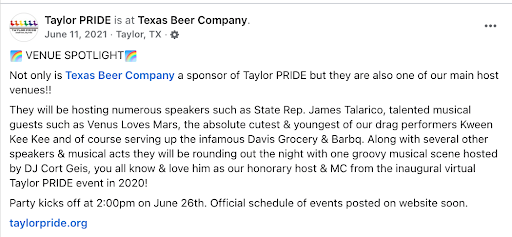
According to promotional materials first highlighted by the Washington Free Beacon, Talarico was a featured speaker during Taylor PRIDE’s June 26, 2021 fundraiser in Taylor, Texas. The event was organized to raise money for “rural LGBTQ communities” and included live music, Drag Story Hour, adult drag performers, and an 11-year-old performer using the stage name “Kween Kee Kee.”
Taylor PRIDE advertised the child as “the absolute cutest & youngest of our drag performers.” Promotional posts stated the child would perform a drag routine and host “Kee Kee Storytime,” where children would participate in Pride-themed craft activities. The event was held at Texas Beer Company.
Photographs published from the event show Talarico addressing attendees from the stage and posing with participants. Additional photographs and video posted publicly show Kween Kee Kee, a local preteen named Keegan, performing in a shimmering blue dress, platinum blonde wig, and theatrical makeup during what organizers described as a Youth Drag Show. One attendee shared video of the child performing the splits before the audience.
The fundraiser also featured several adult drag performers, including Brianna Brinxx, Belladonna Dior, Felecia Enspire, and a performer using the stage name Sedonya Face.
Following criticism from conservative activists who protested the event, Taylor PRIDE defended the festival on social media. The organization rejected claims that the event was sexually explicit or exploitative and encouraged the public to review photographs from the event and decide for themselves.
Talarico’s campaign did not respond to requests for comment from the Washington Free Beacon regarding his participation.
The resurfaced event adds to a broader record that Republicans have highlighted throughout Talarico’s political career. While serving in the Texas House, Talarico opposed legislation restricting drag performances in the presence of children and argued lawmakers should avoid harming what he described as Texas’ drag performers. He has also opposed Republican-backed legislation restricting certain transgender medical treatments for minors and has frequently spoken in support of LGBTQ causes.
More recently, however, Talarico has attempted to present himself as a more moderate statewide candidate. He has described previous remarks, including referring to God as “nonbinary,” as “cringey” and has removed some progressive messaging from campaign materials as he seeks to broaden his appeal beyond Democratic primary voters.
The renewed attention comes as cultural debates surrounding children and drag performances continue playing out both politically and legally. Florida’s appellate court victory represents one of the most significant recent rulings supporting a state’s authority to restrict minors from attending certain adult-oriented live performances, even as litigation over similar laws continues elsewhere.