


OPINION
The United States of America – The framers of our Constitution weren’t building a pure democracy; they were building a balancing act. And they knew exactly what they were doing.
The original Constitution divided political power among different interests. The People elected the House of Representatives. State legislatures selected Senators. The Executive branch was headed by a President chosen through the Electoral College. Everybody had skin in the game. Everybody had a seat at the table. And nobody got all the power.
That arrangement wasn’t some accident buried in old parchment. It was deliberate.
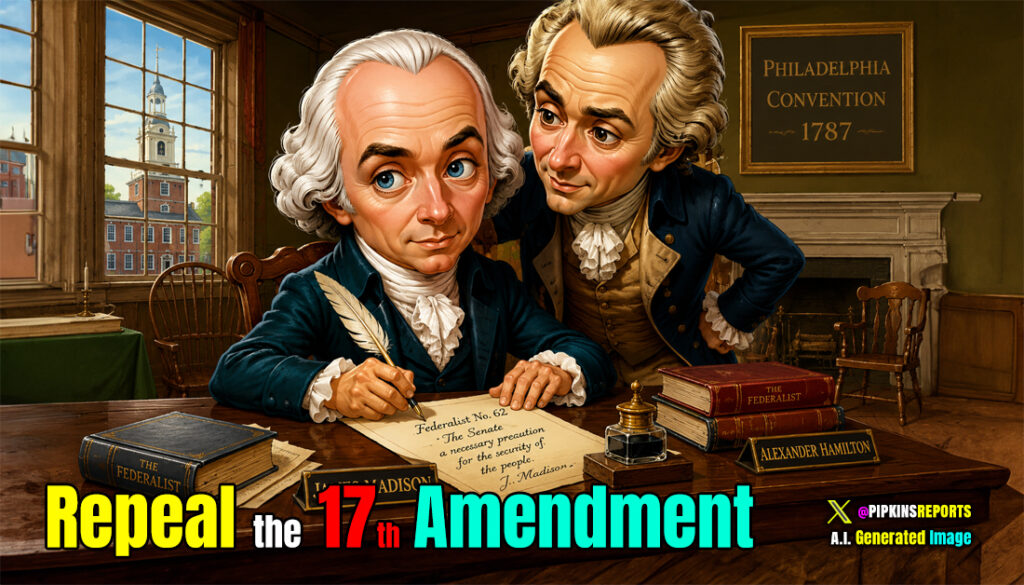
Article I, Section 3 of the Constitution plainly stated that senators would be “chosen by the Legislature” of each state. According to James Madison in Federalist No. 62, appointment by state legislatures was designed to create a direct connection between the states and the federal government. He wrote that this method would “form a convenient link between the two systems.” The Senate was never intended to represent the passions of the public. The House already did that. The Senate represented the states themselves.
And that’s because the United States was formed by sovereign states entering into a union, not by Washington handing power down from on high.
During the Constitutional Convention of 1787, delegates spent weeks fighting over representation. Large states wanted population-based representation. Smaller states feared being steamrolled. The eventual Connecticut Compromise created two chambers, one representing the People and one representing the States. It was a compromise that helped save the convention from collapse. Benjamin Franklin himself urged concessions to preserve the union.
Madison argued repeatedly that the Senate’s structure would act as a stabilizing force. The upper chamber would provide experience and continuity while insulating the country from sudden swings in public opinion. The U.S. Senate’s own historical records note that senators were intentionally made older and selected by state legislatures to provide stability and restraint.
Then came 1913.
The Seventeenth Amendment fundamentally changed the arrangement by transferring the election of senators from state legislatures to popular vote. Supporters argued it would reduce corruption and legislative deadlocks. It certainly changed things, but it also removed the states themselves from direct representation in Washington. The National Constitution Center describes the amendment as the only major constitutional change affecting the structure of Congress since the Bill of Rights.
Since then, senators have become national politicians rather than ambassadors of their state governments. Their incentives changed. Governors and legislatures may protest federal mandates, but their senators often answer first to national donors, party leadership and television cameras.
That’s a very different system than the one the founders designed.
State governments today have no institutional voice inside Congress. They sue Washington. They lobby Washington. They beg Washington. But they no longer possess representation within Washington itself, which is exactly what the original Senate provided.
Supporters of the Seventeenth Amendment point to corruption scandals that occurred before 1913. Those problems were real. But replacing one flaw with another doesn’t necessarily count as progress, history is full of reforms that created new problems while solving old ones.
The Constitution was built on competing interests checking one another. The House represented the people. The Senate represented the states. The president represented the nation as a whole. It wasn’t complicated.
We’ve drifted far from that arrangement.
Today Washington treats states less like partners and more like administrative districts. Federal agencies dictate policy, Congress spends borrowed money with abandon, and senators spend more time chasing campaign cash than defending state sovereignty.
Maybe the old system wasn’t perfect. Nothing designed by human beings ever is. But the framers understood something modern politicians often forget… Power needs rivals.
Repealing the Seventeenth Amendment wouldn’t weaken democracy. It would restore federalism. It would give state governments a genuine stake in the game again and force Washington to remember that the states created the federal government, not the other way around.
We shouldn’t expect the people who benefit from the current arrangement to voluntarily surrender power. Congress is not likely to repeal the Seventeenth Amendment, and senators certainly aren’t inclined to vote themselves out of their present status. The framers anticipated moments like this.
That’s why Article V of the Constitution gives the states another path, a convention for proposing amendments called by two-thirds of the state legislatures. If Americans truly want to restore federalism and return the states to their rightful place in the constitutional order, the answer probably won’t come from Washington. It’ll have to come from the states themselves, from the People. The people created the states, the states created the federal government, and sometimes it’s necessary to remind Washington who’s really supposed to be in charge.
For those who believe the time has come to restore the constitutional balance our founders envisioned, organizations like Convention of States Action are already leading the fight. Visit https://conventionofstates.com/, get informed, and get involved, because Washington isn’t going to limit itself unless the states and the people demand it.
Sources: Article I of the Constitution, James Madison’s Federalist No. 62, Madison’s notes from the Constitutional Convention, and historical material from the U.S. Senate and Library of Congress.