


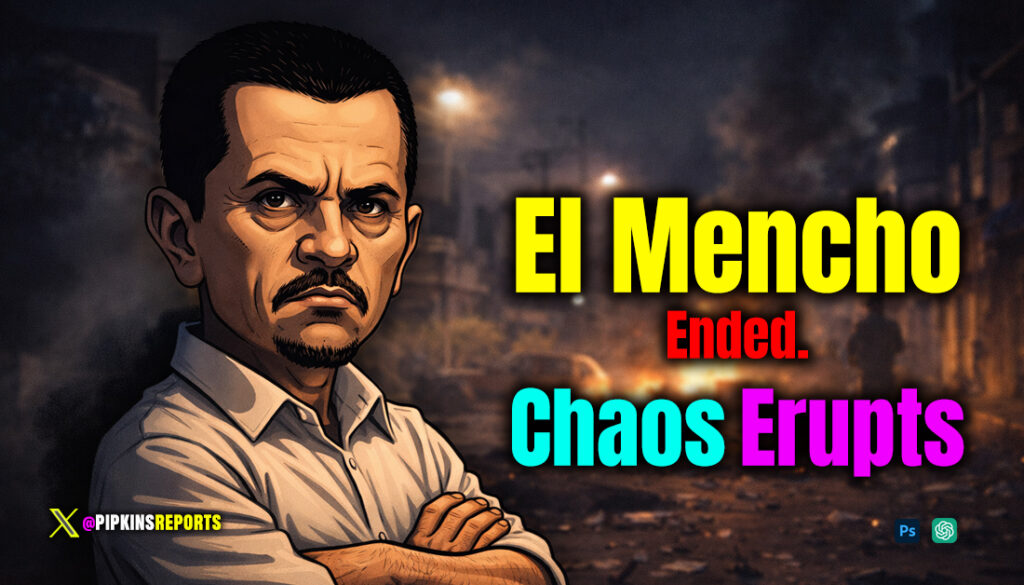
MEXICO CITY, Mexico — Nemesio Oseguera Cervantes, the elusive and brutal cartel boss known as “El Mencho,” was killed Sunday in a targeted security operation in the mountains of Jalisco, an operation Mexican officials say was supported by U.S. intelligence assets. Within hours of confirmation of his death, widespread violence erupted across western Mexico, prompting U.S. authorities to issue urgent shelter-in-place warnings for American citizens.
El Mencho led the powerful Jalisco New Generation Cartel (CJNG), one of the most violent and sophisticated drug trafficking organizations operating in North America. His killing marks one of the most significant blows to organized crime in Mexico in more than a decade. But it has also triggered immediate instability in key strongholds, including Guadalajara and Puerto Vallarta, where roadblocks, arson, and armed clashes have disrupted daily life and air travel.
U.S. Intelligence Role Confirmed
According to statements released by the White House press office, the United States provided intelligence support to the Mexican government in advance of the operation carried out in Talpa de Allende, Jalisco. The targeted strike resulted not only in El Mencho’s death, but also in the killing of three additional cartel members. Three others were wounded and two were taken into custody.
Administration officials described El Mencho as one of the top traffickers of fentanyl into the United States and a priority target for both governments. Last year, President Donald Trump formally designated the CJNG as a Foreign Terrorist Organization, a move intended to expand prosecutorial and financial tools available to U.S. authorities combating transnational criminal networks.
In a public statement, the administration emphasized that the United States would continue working with Mexican counterparts to dismantle narcotics trafficking organizations responsible for the flow of fentanyl and other synthetic opioids into American communities. Officials also commended the Mexican military for what they described as a coordinated and successful operation.
While U.S. personnel were not reported to have directly participated in ground combat, the confirmation of intelligence-sharing underscores the deepening operational collaboration between Washington and Mexico City in confronting cartel leadership.
Immediate Fallout: Roadblocks, Arson, Flight Cancellations
Within hours of reports that El Mencho had been killed, armed groups erected roadblocks using burning vehicles along highways in Jalisco. Social media footage verified by local outlets showed heavy gunfire in several municipalities long associated with CJNG dominance.
Commercial aviation was disrupted across the region. Although no airports were formally closed, road access to terminals was cut off in multiple locations. U.S. officials reported that most domestic and international flights in Guadalajara and Puerto Vallarta were canceled due to security concerns. Ride-sharing services in Puerto Vallarta were suspended entirely.
Local residents described a night punctuated by explosions and sustained gunfire. One resident in Guadalajara, who requested anonymity for safety reasons, said, “We heard shooting for hours. Nobody knew if it was the military or cartel members. People stayed inside.”
Mexican federal authorities have deployed additional troops to stabilize affected zones. As of Monday evening, casualty figures from the unrest remained unclear.
State Department Issues Shelter-in-Place Alert
The U.S. State Department issued an updated security alert warning American citizens in several parts of Mexico to shelter in place due to “ongoing security operations and related road blockages and criminal activity.”
The advisory stated that U.S. government personnel in impacted areas were also sheltering in place and would continue doing so while conditions remained volatile. Americans were urged to minimize unnecessary movement, monitor local media, and check federal highway authorities for road closures, as toll roads in multiple areas were temporarily suspended.
In addition, the department advised citizens to maintain communication with family members regarding their location and well-being.
Assistant Secretary of State for Consular Affairs Mora Namdar emphasized that the safety and security of U.S. citizens remains the administration’s highest priority. She encouraged Americans in Mexico to enroll in the Smart Traveler Enrollment Program (STEP) to receive real-time security updates and follow official travel advisories.
The U.S. Embassy in Mexico City published a detailed list of impacted areas and operational changes affecting transportation infrastructure.
Risk of Power Vacuum
Historical precedent offers cautionary lessons.
When Joaquín Guzmán, known as “El Chapo,” was captured and later extradited to the United States, factions within the Sinaloa Cartel fractured, leading to internal conflict and regional instability. Experts note that CJNG, while heavily centralized around Oseguera Cervantes’ leadership, maintains regional commanders who may compete for dominance.
“The immediate question is succession,” said a Mexico-based security consultant who requested anonymity due to the sensitivity of the situation. “If a clear heir emerges quickly, violence may subside. If not, fragmentation could produce months of instability.”
The Jalisco region occupies a strategic nexus for drug transit routes, port access, and financial operations. Prolonged instability there could reverberate nationally.
Broader Strategic Implications
The confirmed intelligence cooperation between the United States and Mexico may signal a new phase in bilateral security coordination. For years, the two governments have navigated a delicate balance between sovereignty concerns and shared security objectives.
The Foreign Terrorist Organization designation for CJNG carries significant legal implications. It enables enhanced financial sanctions, material support prosecutions, and expanded investigative authorities under U.S. law. Critics of the designation have warned it could complicate diplomatic engagement, while supporters argue it reflects the scale and brutality of cartel operations.
For American citizens currently in Mexico, the immediate concern remains personal safety. The State Department has reiterated longstanding travel advisories for several Mexican states, particularly those with sustained cartel presence.
As of this writing, Mexican federal officials have not released comprehensive operational details surrounding the strike that killed Oseguera Cervantes, citing ongoing investigations.