



Fate, Texas — A routine procedural vote to advance a recall election against Fate City Councilwoman Codi Chinn has escalated into a sharp political confrontation, as Chinn and her supporters accuse Mayor Andrew Greenberg of disregarding safety concerns and acting out of what they describe as personal animus.
The meeting, scheduled for Monday, January 26th, 2026, includes consideration of a Certificate of Sufficiency necessary to formally set the recall election, which has become the latest flashpoint in an increasingly bitter feud between Chinn and the mayor. Her supporters now argue the recall effort is driven by personal grievances rather than civic concerns, and some have begun openly discussing the possibility of filing a counter-recall against the mayor himself.
At issue is a recall petition that gathered more than 400 signatures from Fate residents seeking to remove Chinn from office. According to city verification records, 396 of those signatures were deemed valid—more than enough to meet the statutory threshold required to place the recall on the ballot.
Chinn and her allies do not dispute the number of verified signatures. Instead, they argue that the process, and the timing of the meeting to advance it, reflects political hostility rather than concern for good governance.
“He’s Willing to Put Ppl in Danger”
COUNCILWOMAN CODY CHINN REGARDING MAYOR GREENBERG.
In a Facebook post, Chinn accused the mayor of recklessly jeopardizing public safety in order to ensure the recall vote moved forward before key election deadlines expired. Chinn created a poll on Facebook, asking social media whether the meeting should be canceled due to weather. However, critics note that Chinn did not reference the recall timeline when raising concerns about the weather.
When Pipkins Reports asked her, “You should be honest with people and tell them why you want this.” Chinn responded:
“No the MAYOR should be honest with why he’s jeopardizing the safety of city staff, the ppl who want to comment, and city officials,” Chinn wrote. “This is the last meeting he can have me recalled because HE waited until it’s too late to put me on the May ballot.”
She continued by asserting that the mayor’s motivations were personal rather than procedural.
“He’s willing to put ppl in danger for his petty little grudge!” she wrote.
Chinn further argued that any leader genuinely concerned about residents would have postponed the meeting if road conditions deteriorated.
“Anyone with an ounce of integrity and care for his citizens would cancel the meeting if there’s ice on the roads,” she wrote. “But he wants me recalled MORE than he cares about ppls lives!”

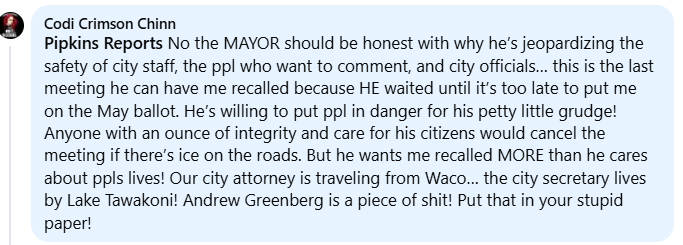
Her post also highlighted the travel required of city staff and officials, underscoring her claim that the meeting posed unnecessary risk. In doing so, she exposed the hometown of the City Secretary. Her message concluded with profanity directed at the mayor and a disparaging remark about this publication.
A Recall Driven by Conduct, Not Weather
While Chinn and her supporters frame her as a victim and the recall as retaliation for her political positions, the general basis for the recall effort centers largely on her conduct and language while serving on the council. Critics of Chinn cite what they describe as a confrontational style and the use of sharp language during her tenure, which is incompatible with the decorum expected of an elected official. Supporters of the recall argue that her latest post reinforces their concerns.
Supporters of the recall argue that the very Facebook post Chinn used to denounce the mayor illustrates the problem voters are seeking to address. They contend the recall is not about silencing dissent, but about restoring professionalism and civility to city government.
Chinn, however, rejects that characterization, maintaining that her blunt language is being weaponized against her by political opponents unwilling to tolerate her criticism.
The Procedural Flashpoint
The City Council meeting at the center of the controversy was not the recall election itself, but a legally required step to advance it. Under Texas law, once a recall petition is certified as sufficient, the governing body must issue a certificate of sufficiency, triggering the scheduling of the election. It’s a process that must go forward … by law.
Chinn is correct about the timing. With the May election approaching, failure to act now would likely have pushed the recall into the November election, or potentially a standalone Special Election, increasing costs to the taxpayers.
Mayor Greenberg has issued the following statement on Facebook:

Supporters Escalate the Fight
As the recall process moves forward, Chinn’s supporters are signaling they are not content to play defense. Several have openly discussed the possibility of initiating a counter-recall against Mayor Greenberg, arguing that his decision to proceed with the meeting demonstrates poor judgment and disregard for public safety.
While no counter-recall petition has yet been filed, the threat alone marks a significant escalation in Fate’s already volatile political climate. What began as a recall of one council member now risks expanding into a broader referendum on the city’s leadership.
What Comes Next
If the Certificate of Sufficiency is finalized Monday night, voters will ultimately decide whether Chinn’s conduct warrants removal from office. The recall election would give residents the opportunity to weigh her style, language, and performance against her claims of political persecution.
Should her supporters follow through on threats of a counter-recall, Fate could soon find itself mired in overlapping recall efforts.
Even as weather conditions improve, tensions surrounding the recall remain unresolved. As the recall advances, the question before Fate voters is no longer simply whether Councilwoman Chinn should remain on the council, but whether the standards of conduct at City Hall have reached a breaking point.
Editor’s Note:
This article includes direct quotations from social media posts and statements made by public officials regarding an ongoing recall process. Allegations, interpretations, and characterizations attributed to elected officials or their supporters are presented as claims and opinions, not findings of fact. Pipkins Reports relies on public records, verified statements, and publicly available posts in its reporting. Readers are encouraged to review source materials and attend public meetings to form their own conclusions.