


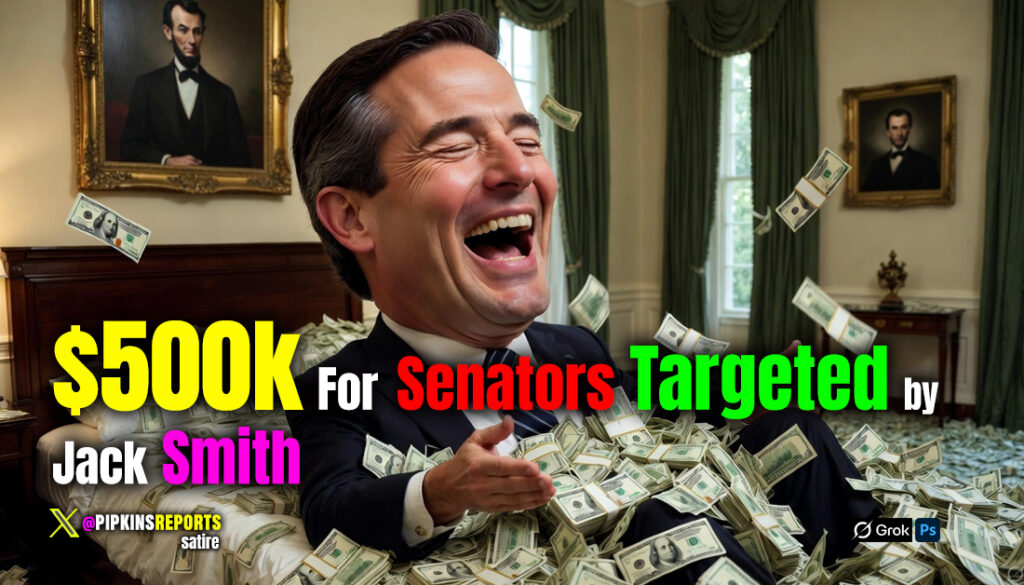
In a stunning act of self-preservation, Senate Republicans quietly inserted a provision that allows each senator to sue the federal government for up to $500,000, if their private data or communications are seized by law enforcement without notice. The clause, designed to shield senators from the same FBI and Special Counsel Jack Smith investigations that swept up Trump allies and staff, gives them a pathway to free cash, but not ordinary Americans.
It’s obscene. Senators managed to create a taxpayer-funded mechanism to protect themselves from unlawful government surveillance, while the same body has done virtually nothing to protect the American people. Particularly those who were spied upon, prosecuted, and imprisoned after January 6 for what amounted to pretend political crimes.
Evidently, Senate Republicans can move mountains when the boot of government lands on their necks … but not yours.
A Hidden Clause with a Heavy Price Tag
According to Fox News and Politico, the Senate’s new protection scheme was tucked into the legislative branch appropriations section of the 1200 page resolution. The original CR was just 25 pages. So another question is, who came up with the 1175 new pages? Regardless, the new text empowers any Senator to sue the United States if any federal agency accesses or subpoenas their records without prior notice. Each senator can recover a minimum of $500,000 per violation, plus attorney fees, paid directly from taxpayer funds. Wouldn’t it be nice if an American Taxpayer could sue the Government when they are wrongfully targeted?
The provision, reportedly crafted under the direction of Sen. John Thune (R-S.D.), requires federal agencies and communication providers to notify the senator’s office when a warrant or subpoena is issued. If the senator is under active criminal investigation, the notice may be delayed up to 60 days, otherwise, the agency must inform them immediately. Again, why is there no law that requires citizens to be notified when the Government snoops into their phone records?
The measure stems from revelations that Jack Smith’s office had secretly obtained communications records of several Republican senators during the post–January 6 investigations, including Sen. Ted Cruz (R-TX) and Sen. Mike Lee (R-UT). Both men were outraged when they discovered that their private data had been accessed without their knowledge.
The Speed of Self-Protection
The speed with which Congress acted to protect its own members is breathtaking. When senators felt the sting of unlawful surveillance, they mobilized almost overnight. A complex funding bill became the vehicle for a self-defense clause, guaranteeing cash settlements for those who dwell in the marble halls of the Capitol.
Meanwhile, ordinary Americans targeted by the government all the time. The January 6 defendants, parents labeled “domestic extremists” by the FBI, pro-life activists raided at dawn by armed agents, all remain without any recourse. Their bank accounts have been frozen, their communications monitored, their reputations destroyed, and their livelihoods ruined.
No senator has slipped in a provision to reimburse them for wrongful seizures, lost wages, or reputational harm. There is no taxpayer-funded clause for Americans falsely accused of “insurrection” for walking through open Capitol doors.
When the government spies on the powerful, Congress writes a law.
When it spies on the powerless, Congress writes a press release.
The Hypocrisy Exposed
This “spy clause,” as some insiders are calling it, exposes an old truth about Washington: accountability is only a crisis when the wrong people are targeted. Senators who had their communications quietly accessed were outraged at what they called “weaponization of law enforcement.” Yet those same senators have watched in silence as ordinary citizens—some elderly veterans, others young mothers—were prosecuted and imprisoned for little more than political expression.
The hypocrisy is galling.
Sen. Cruz, for instance, was reportedly incensed that Smith’s team might have viewed his phone records. Yet where was the outrage when the same Department of Justice placed January 6 protesters in solitary confinement for months before trial? Where was the clause protecting them from prosecutorial overreach, data seizures, and surveillance without notice?
If lawmakers can slip in a half-million-dollar self-compensation fund in a 1,200-page spending bill, why can’t they slip in something meaningful for the American people—like, a permanent codification of President Trump’s executive orders that defended free speech, restrained federal power, and protected law enforcement officers from political purges?
January 6 patriots, most of whom were peaceful protesters caught in an entrapment scheme, have been stripped of due process, spied upon through geofencing and mass-data dragnets, and punished under laws written for foreign terrorists. When senators were spied upon, they get compensated.
The lesson is unmistakable. Washington will protect itself … and doesn’t give a damn about you.
A Final Thought
The Senate’s “spy clause” is more than a budget gimmick; it’s a kickback. It reflects a Congress that moves swiftly to guard its own interests but drags its feet when Americans cry out for justice. It proves, once again, that in Washington, the rules change depending on who’s being targeted. Senators get settlements; citizens get sentences.
If Republicans can carve out a taxpayer-funded legal remedy for themselves, they can also carve out one for the people who sent them there.
Or will Washington keep proving that the swamp always looks after its own?
Sources:
- Politico, “Thune Secures Provision Allowing Senators to Sue Over Jack Smith Subpoenas” (Nov. 10, 2025)
- MSN, “Shutdown deal lets senators sue for $500K over data seizures in Jan. 6 probe” (Nov. 11, 2025)
- The Daily Beast, “House Republicans Claim They Were Blindsided by MAGA Senators’ Cash Grab” (Nov. 11, 2025)