



FATE, TX – Just two months after Councilwoman Codi Chinn publicly posted an unredacted recall affidavit that included citizens’ names and home addresses, she now refuses to release a similar document that would reveal her supporters. Her explanation for the change, however, appears to conflict with information provided by city officials.
The dispute centers on an “Affidavit of Petitioners’ Committee,” the formal document required to begin a recall process under Texas law. The affidavit lists the members of the committee seeking the recall, including their names and home addresses.
Earlier this year, such an affidavit was filed to initiate a recall election against Chinn. According to records obtained by Pipkins Reports, Chinn received the document through her city-issued email account and later posted the affidavit publicly on Facebook without authorization or redacting the listed addresses.
The disclosure drew widespread criticism from residents and local observers who argued that publishing citizens’ home addresses could expose them to harassment or intimidation. A police report later named Chinn as a suspect in a possible unlawful disclosure investigation, a matter previously reported by Pipkins Reports.
Among the individuals listed on that recall affidavit were Andrew Greenberg and several members of the Fate City Council.
At the time, Chinn denied wrongdoing and defended her decision to publish the document.
The political situation in Fate has since flipped.
Supporters aligned with Chinn recently filed their own recall affidavit targeting Greenberg along with council members Mark Hatley, Rick Maneval, and Martha Huffman.
When residents asked on social media whether Chinn would again release the affidavit publicly, she declined and suggested there was a key distinction between the two situations.

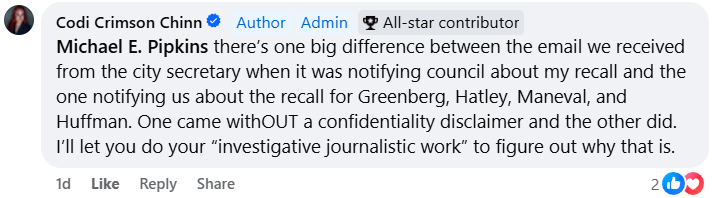
“… there’s one big difference between the email we received from the city secretary when it was notifying council about my recall and the one notifying us about the recall for Greenberg, Hatley, Maneval, and Huffman,” Chinn wrote online. “One came without a confidentiality disclaimer and the other did. I’ll let you do your ‘investigative journalist work’ to figure out why that is.”
So, we did. To verify the claim, Pipkins Reports contacted Fate City Manager Michael W. Kovacs to ask whether the city had changed the language used in emails sent to council members regarding recall documents.

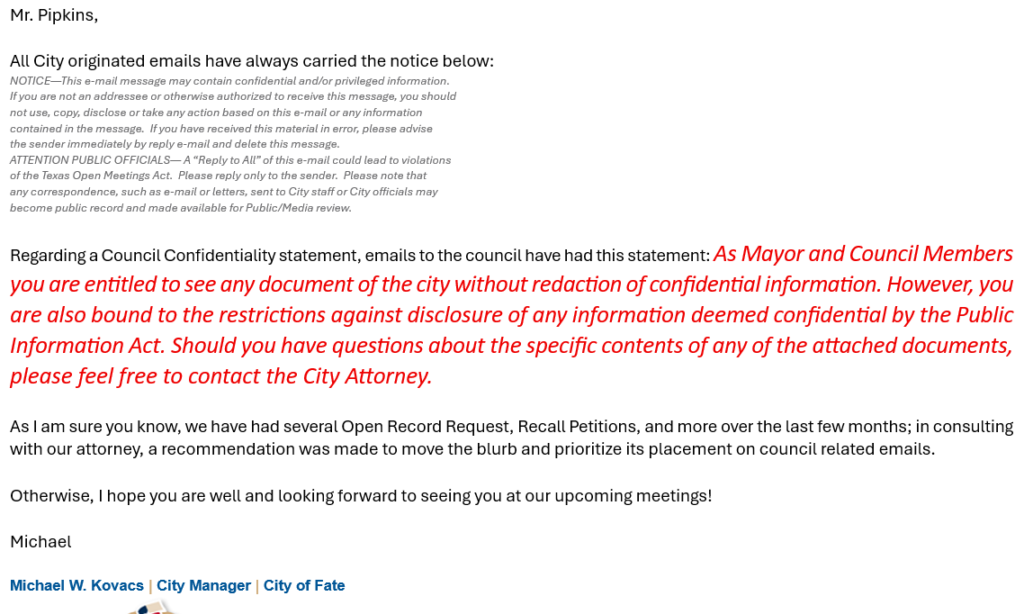
Kovacs said it had not. “All City originated emails have always carried the notice below,” Kovacs wrote in an email response.
The notice warns recipient that the message “may contain confidential and/or privileged information” and it cautions against copying or disclosing the contents if the recipient is not authorized.
In addition to the standard email disclaimer, Kovacs also noted that council members have long received additional guidance reminding them that although elected officials may view unredacted documents in their official capacity, they remain subject to restrictions on disclosing confidential information. The additional disclaimer says, “As Mayor and Council Members you are entitled to see any document of the city without redaction of confidential information,” Kovacs wrote. “However, you are also bound to the restrictions against disclosure of any information deemed confidential by the Public Information Act.”
Kovacs added that the city recently moved the confidentiality language higher in the email to emphasize the notice, following consultations with the city attorney during a period that included several recall petitions and open records requests. (ie: after Chinn disclosed the document)
Public records law and city policy
Under the Texas Public Information Act, most government records are presumed public unless they fall under specific statutory exceptions. The law requires government bodies to withhold certain categories of sensitive personal information, such as Social Security numbers, driver’s license numbers, financial account data, and some contact information. While a citizen’s name and address may appear in some public filings, many municipalities (including Fate) adopt internal practices designed to limit the disclosure of personal identifying information when documents are shared publicly. This includes the redaction of addresses of the public.
Opinion and analysis
The facts of the situation are relatively straightforward.
When the recall affidavit targeted Chinn, she had no problem releasing the document publicly on social media with citizens’ addresses intact. When a similar affidavit surfaced targeting her political opponents, the same kind of disclosure suddenly became off limits.
Chinn has attributed that difference to changes in the email disclaimer language. The city manager’s explanation suggests the warning language was not new, but rather long-standing. Only the prominent location of the language changed.
So it would appear that Chinn’s response is a case of political convenience.
Ultimately, voters in Fate will decide how they view the episode. But the unfolding recall battle has already delivered one clear lesson. In politics, the standard you apply to others often returns to test you.
### Pipkins Reports has requested a copy of the Affidavit of Petitioners’ Committee from the City of Fate. When received, we will provide that information to the public … redacted of course, as we did previously.