


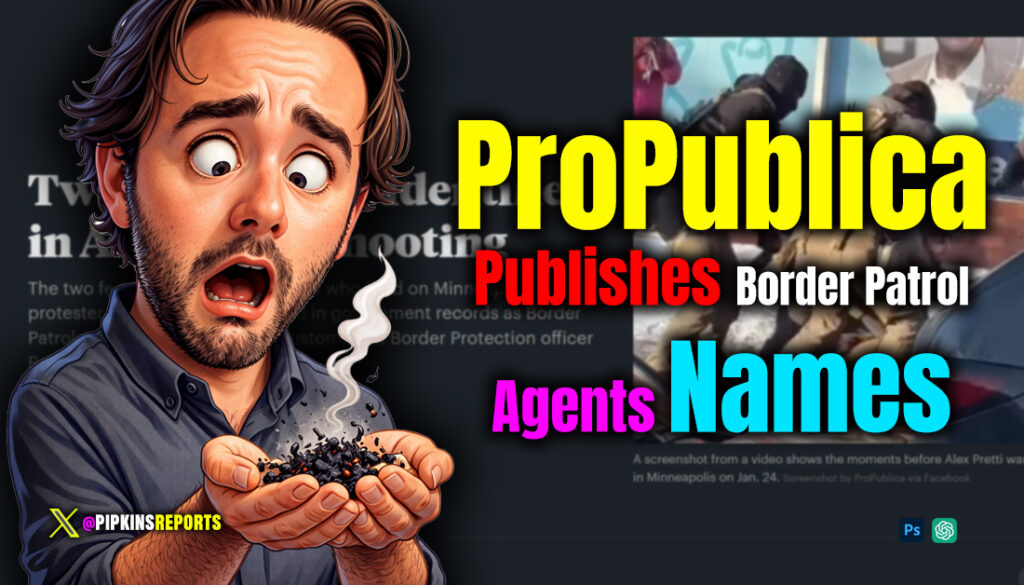
New York, NY – It was a decision guaranteed to ignite outrage, and ProPublica knew it. In the middle of a volatile national debate over immigration enforcement and federal authority, the nonprofit newsroom chose to publicly identify the federal agents involved in a fatal shooting, pouring gasoline on an already raging fire.
On January 24, 2026, Alex Pretti was shot and killed during an anti immigration enforcement protest in Minneapolis. Ten shots were fired in less than five seconds. The shooting occurred amid Operation Metro Surge, a federal deployment of immigration agents to urban areas that has drawn intense public opposition and repeated demonstrations. Days later, ProPublica published a story naming the Border Patrol and Customs and Border Protection agents who fired the shots.
We will not repeat those names here. We will not contribute to a situation that places federal agents and their families at heightened risk of harassment, threats, or violence.


The ProPublica story was authored by reporter J. David McSwane (202-556-3836), who, unlike the agents he identified, voluntarily used his own name. He also voluntarily publishes his contact information. ProPublica defended the decision in a public note from its editors, arguing that disclosing the agents’ identities served the public interest and promoted accountability. According to the outlet, officials had not released key information quickly enough, and anonymity, they argued, shielded those involved from scrutiny.
That justification has not satisfied critics across the country, particularly given the timing and political climate surrounding the case. The agents involved were placed on administrative leave, and the Department of Justice Civil Rights Division opened an investigation into the shooting. Those processes were already underway when ProPublica chose to publish the names.
The shooting itself unfolded in the early morning hours on Nicollet Avenue. Pretti, a 37 year old nurse and military veteran, arrived at the protest site as federal agents were conducting immigration related arrests. Video footage shows Pretti holding a phone and recording officers as they interacted with civilians. A confrontation followed.
According to publicly available video timelines, Pretti was pepper sprayed, pulled into the street, and restrained by multiple federal agents. During the struggle, a firearm was present. Moments later, shots were fired. Pretti was struck multiple times and pronounced dead at the scene.
Federal officials stated that Pretti was armed and that agents fired their weapons during a struggle while carrying out their duties. Forensic audio analysis later confirmed that ten shots were discharged in under five seconds. The precise sequence of actions and decisions leading to the shooting remains under investigation by federal authorities.
What is not under investigation is ProPublica’s editorial choice. By naming the agents while emotions were raw and protests ongoing, the outlet ensured that the focus would shift away from institutional review and toward individual targeting. That shift was immediate.
Social media reaction to the story was fierce. Some praised ProPublica for what they described as courageous transparency. Others warned that the publication had effectively doxxed law enforcement officers in the middle of a national political firestorm. One widely shared post accused the reporter of placing “a target” on the agents and their families. The debate quickly devolved into ideological trench warfare.
This is not an abstract concern. In recent years, law enforcement officers across the country have faced harassment, threats, and attacks following the release of personal information online. Families, spouses, and children often bear the brunt of that exposure, despite having no connection to the incidents in question.
ProPublica maintains that accountability requires identification. But accountability in the American system is not crowdsourced outrage. It is established through investigations, evidence, and due process. Those mechanisms were already in motion. Publishing names did nothing to advance the investigations themselves. It did, however, amplify public pressure and personal risk.
This moment underscores a troubling trend in modern journalism. Activist outlets increasingly blur the line between reporting and advocacy, treating exposure as an end in itself. In doing so, they often dismiss the real-world consequences of their choices, particularly when those consequences fall on people deemed politically acceptable targets.
The death of Alex Pretti is serious and tragic. It deserves a full accounting, grounded in facts and resolved through lawful processes. Federal agents, like any other government actors, must be held to the same legal standards. But they are also entitled to due process and basic personal safety.
By choosing to name the agents before investigations are complete, ProPublica did not simply report on the story. It became part of it. And in doing so, the outlet raised a question that now hangs over its own newsroom: when journalism knowingly endangers lives, who holds the journalists accountable?