


OPINION – Recently, the City of Fate gave us another example of how government is reaching too far into the control of our lives through a public transportation system called STAR Transit. But thanks to an open records request, we now know the issue runs much deeper than a single budget item. According to city records, Fate has spent $80,385.94 on STAR Transit services between April 16, 2021 and April 16, 2026. [Document Here] (Note: we didn’t ask for records beyond that date. The total spent is most assuredly more.)
This not a one-time decision. It’s a pattern of abuse that may span perhaps a decade. With every council approving the funding in every city budget.
And it appears the spending may not stop there. In internal communications obtained through the same request, City Manager Michael Kovacs discussed expanding transit options, including interest in more “robust” micro-transit systems and ideas aimed at reducing traffic congestion, proposals he indicated would be presented to the City Council. He seeks to have more “fixed routes” (ie: a full-scale bus system).
There is no documented evidence that he ever completed that task.

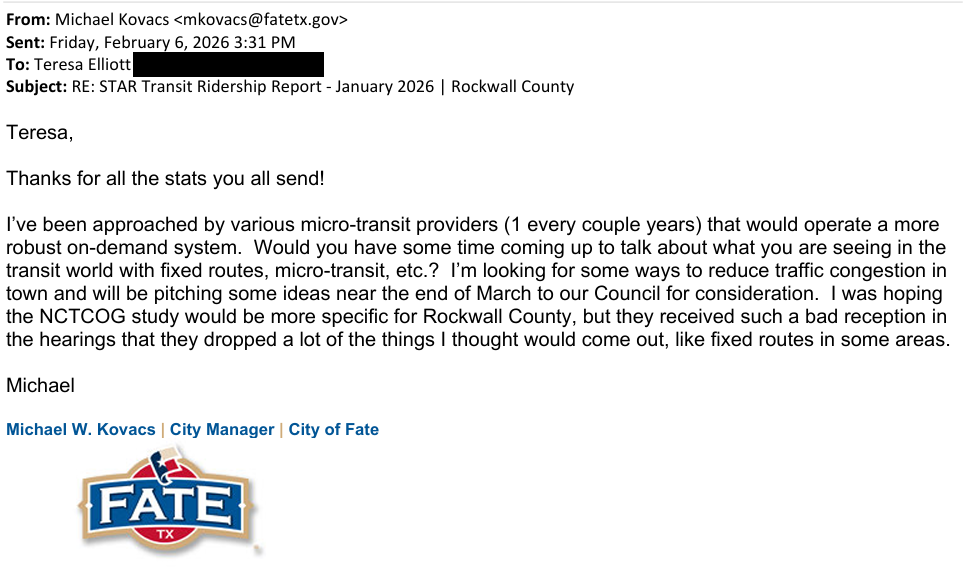
I made the claim that STAR Transit would be a precursor to DART, and I was criticized heavily. One outgoing council member accused me of misleading the public. But I was right, and the evidence proves it. This isn’t just about maintaining a small, call-a-ride service. It’s about growing a transit system. A posture that fits right in with Kovacs’ vision of a Strong Town.
STAR Transit is not a narrowly tailored service for the elderly or disabled either, as some mistakenly believe. By its own description, it is open to anyone in its service area, offering rides for jobs, errands, doctor visits, and more. In plain terms, it is already a full-fledged public transit system. It is a regional one that covers not only Fate & Rockwall County, but Kaufman County, Mesquite, Balch Springs, Seagoville, DeSoto, Cedar Hill, Duncanville, Hutchins, Lancaster, and Wilmer.
So let’s ask the obvious question. Why are Fate taxpayers subsidizing a system that serves a broad population, many of whom don’t live here and don’t pay into our city’s general fund? They operate with a $7.2 Million dollar budget. Of that, they receive $6.4 million in grants and taxpayers’ money from State and Federal sources. Mind you, riding the bus is not free. Users still pay a fee to ride.
But even that question misses the larger point.
Before we argue about buses in general, we need to get back to basics. What is the purpose of government?
At its core, government exists to ensure fairness among the people, to enforce the law, and to provide for safe communities. It exists to fund essential services such as: police, fire protection, emergency response, utilities, roads, and to manage appropriate land use through zoning. That is the lane the government belongs in. That is its job. Its purpose.
Its purpose is not to become a social welfare system. It is not to operate as a charitable clearinghouse. It is not to morph into a publicly funded support network for every perceived need. Those responsibilities belong first to individuals and their families, and then to churches and private charitable organizations operating voluntarily.
Nothing is stopping anyone in Fate from donating their own money to STAR Transit. Nothing. They can choose to use the service just as they would for Uber or Lyft. That is what charity looks like in a free society.
What I oppose, and what I believe should concern every taxpayer, is the government taking money from citizens and giving it to outside organizations and NGOs. Doing so is not charity, it is compulsion. It is coerced government redistribution.
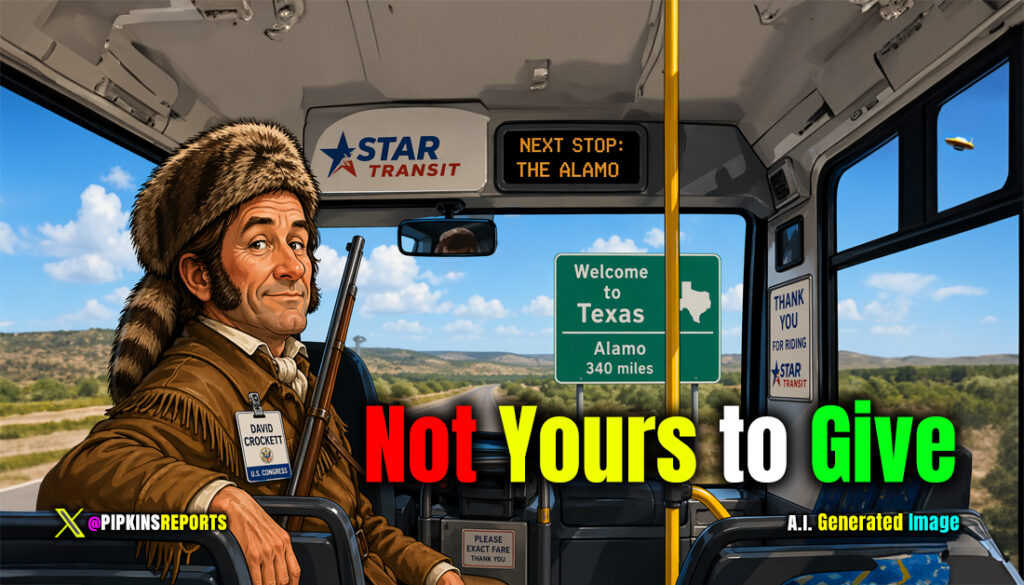
There’s a reason the story of David Crockett still resonates. In “Not Yours to Give,” Crockett refused to support a federal appropriation for a widow of a soldier, not because he lacked compassion, but because he understood a simple truth, it wasn’t his money to give.
That principle has been lost in the City of Fate. And once it’s lost, the door opens to something bigger.
Because programs like STAR Transit rarely remain what they start as. Today, it’s a limited, on-demand service. Tomorrow, it becomes something else. It will, because the leaders are already in discussion to make it so.
We’ve seen this progression before with systems like Dallas Area Rapid Transit (DART). It begins with a reasonable pitch, help people reach essential services. Then comes the next step, just one fixed route. Then, expansion along major corridors. Then, broader coverage, more infrastructure, more funding.
Each step sounds reasonable. Each one is sold as necessary. And each one costs more.
That trajectory is not hypothetical. It is already being discussed. The city manager’s own communication makes clear that expansion, modernization, and increased service levels are under consideration.
And with expansion comes the familiar promises: reduced traffic, improved accessibility, solutions for those who can’t afford cars. Care for disabled and elderly. But those promises always come with a price tag. A growing one.
I’ve already heard the pushback. “It’s only $17k.” “It helps people.” “Some people need transportation.” “Don’t be heartless“. “You hate old and disabled people.” “You’re a monster“.
But name-calling is irrelevant. The size of the number is irrelevant. Principles don’t scale. If it’s wrong at $800,000, it’s wrong at $80,000.
And let’s address this directly. It is not heartless to say the government should not seize money from its citizens to fund NGOs. In fact, I would argue the opposite. You probably did too. Remember DOGE? How about the “Learing Center” in Minneapolis? The healthcare fraud in California? It is far more respectful of both taxpayers and those in need to keep charity where it belongs, with individuals, families, and communities … acting voluntarily.
What is dangerous is a system where government decides which causes are worthy and funds them with money that was never theirs to begin with. The same documents we received in our Open Records Request also reveal that while the city was paying STAR Transit, the company was returning some of that money to sponsor the Tree Lighting and Celebrate Fate events. This is how corruption starts. You scratch our back, we’ll scratch yours.
Of course, I’m not making any claims that anything thus far is illegal. But the potential for corruption is there. Tomorrow it could be anything. There is no shortage of NGOs that have worthy causes that are willing to accept our tax money.
This is how government grows, not in sweeping changes, but in incremental steps. A few thousand dollars here; a program there. Each one justified. Each one defensible. Until the boundary disappears entirely.
So no, this isn’t really about buses, old or disabled people.
It’s about whether we still believe government has a defined purpose, and whether we are willing to defend it as David Crockett did, right before he died at the Alamo. Because if we don’t, then the warning in Crockett’s story wasn’t just a story. It was a prediction.