


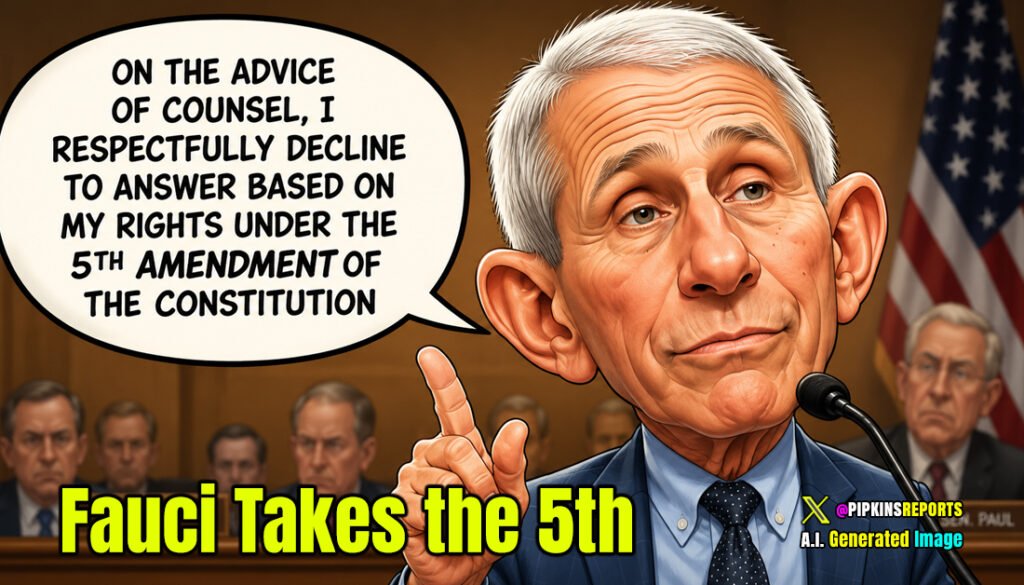
Washington, D.C. — One of the most recognizable faces of the COVID-19 pandemic sat before a U.S. Senate committee Wednesday, raised no dramatic objections, launched no fiery defense of his decisions, and then declined to answer lawmakers’ questions by invoking the Fifth Amendment. It was a moment that instantly became one of the defining political images of the post-pandemic era.
Dr. Anthony Fauci, the former director of the National Institute of Allergy and Infectious Diseases, appeared under subpoena before the Republican-led Senate Homeland Security and Governmental Affairs Committee after being called by Sen. Rand Paul, R-Ky. Rather than respond to questions about his role during the pandemic, Fauci told the committee he was following the advice of counsel and would invoke his constitutional right against self-incrimination.
The hearing quickly became a familiar partisan clash.
Paul argued that Fauci should answer questions surrounding government funding for research connected to the Wuhan Institute of Virology, shifting public statements regarding COVID-19’s origins, and decisions that shaped federal pandemic policy. Democrats, led by Ranking Member Sen. Gary Peters, D-Mich., countered that the hearing was little more than political theater designed to relitigate the pandemic instead of addressing current national security concerns.
But amid hours of defending Fauci’s reputation, Democratic members largely avoided discussing one subject that has increasingly drawn attention in recent days: Fauci’s own pandemic diary.
Before Wednesday’s hearing, Paul released more than 1,000 pages of Fauci’s government-maintained diary covering key periods of the pandemic. The senator argued that the private entries reveal inconsistencies between Fauci’s internal assessments and his public messaging during COVID-19.
[ Read and Download the Diary Here ]
Paul wrote on X that Fauci’s diary showed “what he wrote privately and what he told the country are two different stories.“
Some entries reportedly document uncertainty during the earliest weeks of the outbreak, uncertainty that many scientists shared as information rapidly evolved. Portions of those same observations had previously appeared in Fauci’s 2024 memoir and public interviews, according to the Associated Press. Other critics argue the diary raises additional questions deserving public examination.
Yet during Wednesday’s hearing, Democratic senators spent little time addressing the contents of the diary itself. Instead, much of their defense centered on Fauci’s decades of public service and repeated assertions that there is no credible evidence proving he committed criminal wrongdoing.
Scientists and public health officials likewise defended Fauci ahead of the hearing. More than 150 infectious disease experts signed a public letter rejecting accusations against him and urging Congress to end what they characterized as political attacks. Fauci has consistently denied misleading Congress and has maintained that the available scientific evidence favors a natural origin for COVID-19 rather than a laboratory leak.
Paul, however, has argued the hearing was necessary because Congress still has unanswered questions. He also noted that invoking the Fifth Amendment prevents lawmakers from obtaining sworn testimony that could either confirm or refute allegations surrounding Fauci’s public statements.
Fauci’s attorney, David Schertler, called Paul’s accusations “false and disgraceful” and said they would consider legal options in response.
The hearing also unfolded against an unusual legal backdrop. Former President Joe Biden previously granted Fauci a presidential pardon covering potential federal offenses tied to his government service, though legal scholars have noted that such pardons do not shield a witness from future perjury or contempt allegations arising from new testimony. That reality made Fauci’s decision to invoke the Fifth all the more politically significant, regardless of the legal reasons offered by his attorneys.
Whether Republicans ultimately pursue a contempt referral remains uncertain.
What is certain is that Wednesday’s hearing added another chapter to one of the most divisive political debates in modern American history.