


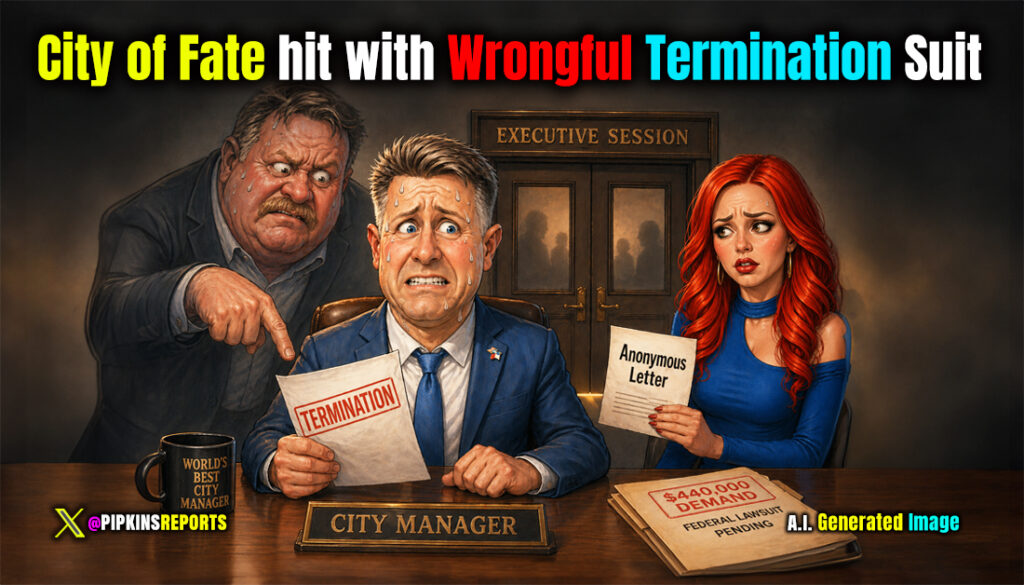
FATE, TX – Attorneys for former Department of Public Safety Chief Lyle Lombard have sent a demand letter to the City of Fate seeking preservation of evidence and offering a pre-suit compromise, while also pursuing a federal lawsuit against the City of Fate and Michael Kovacs alleging unlawful termination, violations of due process, and infringement of constitutional rights.
The lawsuit has not yet been filed. According to the demand letter and proposed complaint, Lombard intends to file in the U.S. District Court for the Eastern District of Texas if a settlement is not reached, alleging he was terminated in November 2025 in violation of Texas Government Code § 614.022 and his rights under the First and Fourteenth Amendments.
According to the complaint, Lombard began working for the City of Fate in April 2018 and received positive performance evaluations throughout his tenure. The filing states that after a series of social media posts by his spouse criticizing city leadership, Lombard received a negative performance review on October 30, 2025.
On November 12, 2025, Kovacs informed Lombard that he would be discussed in executive session and offered him a separation agreement that included two months’ severance.
The lawsuit further alleges that during a City Council executive session, Councilwoman Codi Chinn presented anonymous complaints regarding Lombard. The following day, Kovacs issued Lombard a written complaint summarizing those allegations, and Lombard was required to surrender his badge, identification, and service weapon. He was terminated on November 21, 2025.
Lombard claims the City improperly relied on anonymous, unsigned complaints in taking disciplinary action, which he argues violates Texas law requiring signed complaints against law enforcement officers.
The lawsuit also alleges that Lombard’s termination was motivated, at least in part, by his spouse’s protected speech, constituting retaliation in violation of the First Amendment.
Lombard is seeking reinstatement, damages, injunctive relief, and attorneys’ fees. A pre-suit demand letter sent to the City requested $440,000 to resolve the matter prior to litigation.
The case remains pending, and the allegations have not yet been adjudicated in court.
Opinion and Analysis
The legal filings outline the formal claims, but previously reported evidence raises additional questions about how the City of Fate arrived at its decision to terminate Lombard.
Pipkins Reports has previously published details of a recorded conversation made by Councilman Mark Hatley in which City Manager Michael Kovacs can be heard alleging that Councilman Mark Harper threatened to terminate him (Kovacs) if Lombard was not removed. If accurate, that statement suggests the termination decision may have been influenced by council-level pressure, despite the expectation that a city manager operates independently in personnel matters. Harper has refused to confirm or deny the allegations.
A second recorded conversation involving Codi Chinn adds another dimension. In that audio, Chinn discusses the need to compile complaints from Department of Public Safety personnel into a format suitable for executive session review. However, based on the documents referenced in the lawsuit, and our Open Records Requests, the only material ultimately presented was the now-central “anonymous letter” provided to Kovacs. No other complaints or documents were ever provided.
In the same recording, Chinn also references Lombard’s wife and her social media activity. Chinn stated: “…it’s unfortunate because it didn’t have to be that way, but I think if he [Lombard] wasn’t so involved politically. You can’t do the things that you’re doing on an operational level that suck. And then have a bad attitude and a bad wife on top of it.”
That statement is notable because it aligns directly with one of the core allegations in the lawsuit—that Lombard’s termination was influenced, at least in part, by the protected speech of his spouse. The filings argue that such consideration would implicate First Amendment protections, a claim that will ultimately be tested in court.
Taken together, the recordings and the legal filings raise questions about whether the termination process was influenced by political pressure, reliance on anonymous complaints, and factors outside standard disciplinary procedures.