


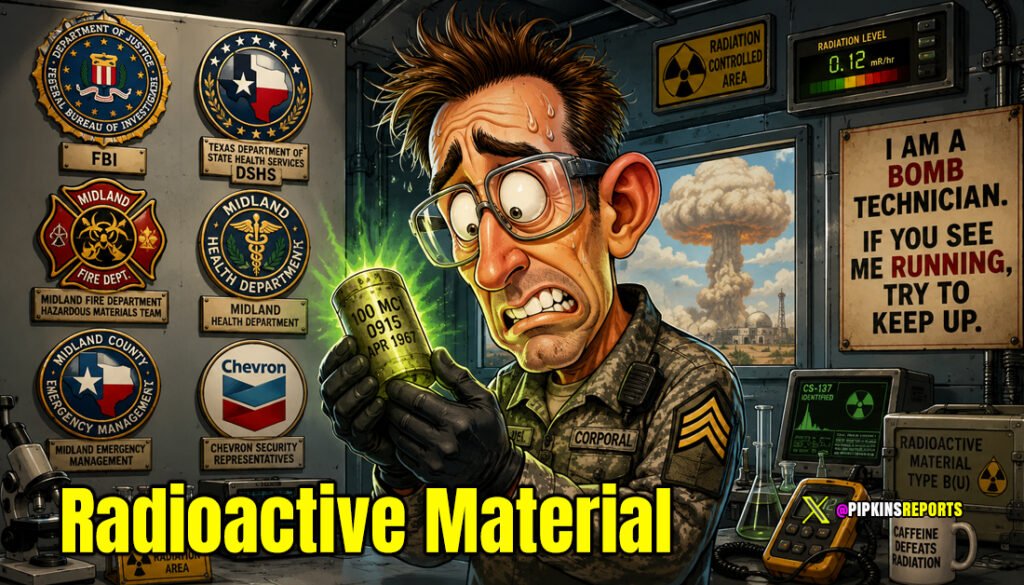
Midland County, TX – A routine patrol by a Texas Department of Public Safety trooper in Midland County turned into something far more unusual last weekend when specialized radiation detection equipment picked up an unexpected signal. What investigators eventually uncovered, just a few inches beneath the dirt, was a sealed radioactive Cesium-137 source manufactured nearly 60 years ago, a relic from another era that had somehow remained hidden underground until now.
The discovery sounds like something lifted from a Cold War thriller. But according to the Texas Department of Public Safety, the operation ended safely, with no injuries, no contamination of personnel, and no danger to the public.
The incident began Friday, July 24, when a DPS Corporal assigned to the agency’s Radiological and Nuclear Threat Detection Unit received an alarm from his vehicle mounted radiation detection system while patrolling near South County Road 1210 in Midland County. After conducting a systematic survey with additional detection equipment, the trooper confirmed radiation was coming from beneath the ground.
DPS then assembled an impressive list of partners, including the FBI, the Texas Department of State Health Services, the Midland Fire Department Hazardous Materials Team, Midland Health Department, Midland Emergency Management officials, and Chevron security personnel, to plan and execute a safe excavation. Authorities established controlled hot and cold zones while continuously monitoring radiation exposure throughout the recovery effort.
The source was ultimately located six to eight inches below the surface.
According to DPS, the object was identified as a sealed 100 millicurie Cesium,137 radioactive source manufactured in April 1967. Officials documented the device, confirmed radiation readings, and removed it without incident.
So what exactly is Cesium,137?
Cesium-137 is a radioactive isotope created as a byproduct of nuclear fission, most commonly during the operation of nuclear reactors and the production of nuclear weapons. It has a half life of approximately 30 years, meaning even a source manufactured in 1967 still retains a meaningful portion of its original radioactivity today.
Unlike naturally occurring radioactive materials, Cesium-137 does not occur in nature in significant quantities. It is man made and has long been used in industry, medicine, and scientific research because it emits strong gamma radiation.
For decades, sealed Cesium-137 sources were widely used in industrial density gauges that measured the thickness or density of materials during manufacturing and drilling operations. They also appeared in oil field logging equipment, cancer treatment machines, laboratory calibration devices, and moisture measuring instruments used in construction.
West Texas, with its decades of intensive oil and gas exploration, has historically been home to thousands of industrial radioactive sources. While today’s regulatory controls are considerably stricter, older equipment from the 1950s, 60s, and 70s was not always documented as thoroughly as modern standards require.
That raises an obvious question. How does a radioactive source wind up buried underground?
DPS has not released any findings suggesting criminal activity, nor has the agency identified how the source ended up beneath the surface.
Several possibilities exist. The device may have been accidentally lost during oil field operations decades ago, intentionally buried after equipment was dismantled under outdated disposal practices, or simply forgotten as ownership changed hands over the years. Historical records show that sealed radioactive sources occasionally became “orphan sources,” industry terminology for radioactive materials that fall outside regulatory control after companies close, equipment is abandoned, or documentation disappears.
While sealed sources like the one recovered are engineered to contain radioactive material safely, they can become dangerous if damaged, opened, or improperly handled. Incidents involving orphan sources have caused serious radiation injuries in other countries when unsuspecting individuals dismantled industrial equipment without realizing radioactive material was inside.
Fortunately, none of that occurred in Midland County.
DPS credits the success of the operation to its specialized Radiological and Nuclear Threat Detection Unit, which consists of one lieutenant, one sergeant, and six corporals stationed across Texas. The unit uses vehicle mounted detectors, backpack systems, personal radiation detectors, unmanned aircraft equipped with radiation sensors, and radioisotope identification devices to locate radiological materials that have fallen outside regulatory control. The agency is also expanding that capability by issuing personal radiation detectors to every DPS trooper statewide.