


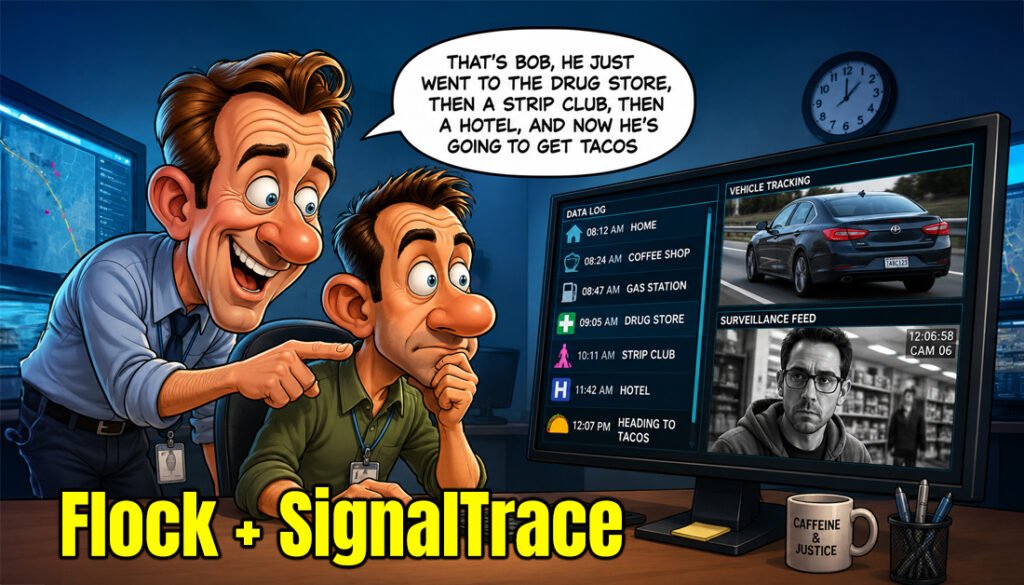
Your Town, USA – For years, Americans have debated the rapid expansion of automatic license plate reader (ALPR) systems like Flock Safety. Supporters argued the cameras simply photographed license plates visible from public roads. Critics warned they were quietly building a nationwide database of vehicle movements and violating the rights of every single American.
Now comes the next evolution.
Instead of merely tracking the vehicle, a new technology called SignalTrace™ is designed to identify and follow the person inside it by creating what its manufacturer calls a unique electronic fingerprint assembled from the wireless devices they carry and the electronic systems built into their vehicle.
If Flock Cameras know where your car has been, SignalTrace is designed to know where you have been—even if you change vehicles, remove your license plate, attempt to conceal your identity or just walk down the street.
Developed by Leonardo US Cyber and Security Solutions, LLC under its ELSAG brand, SignalTrace represents a significant expansion in surveillance technology. The system can combine traditional license plate recognition with passive radio-frequency collection to correlate dozens of electronic signals into a single profile that investigators can search historically or monitor in real time.
Beyond the License Plate
Traditional ALPR systems capture a photograph of a license plate along with the date, time, and location. SignalTrace expands that concept dramatically.
According to Leonardo’s product literature, the system installs sensors alongside existing ELSAG ALPR cameras (or it can operate independently) that continuously listen for publicly broadcast wireless signals emitted by nearby electronic devices.
Those signals are then correlated with nearby license plates.
Over time, the software learns which devices consistently travel together.
Instead of simply identifying a Toyota Camry with Texas plate ABC-1234, SignalTrace may recognize something far more specific:
- iPhone
- Apple Watch
- AirPods
- Vehicle tire pressure sensors
- Vehicle infotainment system
- Wi-Fi hotspot
- Bluetooth-enabled dashboard components
Collectively, those devices become what Leonardo calls an “electronic fingerprint.”
That fingerprint becomes associated with a particular vehicle, license plate, date, time, and location. Once established, investigators can potentially locate that same electronic fingerprint again—even if the vehicle’s plate changes or disappears.
How SignalTrace Works
Unlike wiretaps or cell-phone intercept devices, SignalTrace does not claim to capture communications. Instead, it passively listens for the electronic “handshakes” devices routinely broadcast into the air. According to Leonardo, the sensors detect publicly available radio-frequency identifiers from technologies.
The software then applies algorithms to identify groups of devices that repeatedly appear together across multiple locations and times. Leonardo describes this process as recognizing “convoys” of electronic devices. Those recurring combinations are linked to ALPR camera detections whenever a license plate is available.
All of the resulting information is stored within Leonardo’s ELSAG Enterprise Operations Center (EOC), allowing investigators to perform historical searches or monitor activity as new detections occur.
The sensors are not limited to highways. Leonardo says they can also be deployed in:
- Shopping centers
- Malls
- Stadiums
- Event venues
- Rail stations
- Parking facilities
- Virtually anywhere people gather
That greatly expands surveillance beyond traditional roadway cameras.
What Devices Can It Detect?
Perhaps the most striking aspect of SignalTrace is the sheer number of electronic devices that may contribute to a person’s digital fingerprint. Leonardo’s documentation lists several categories.
Bluetooth Devices
Nearly everyone carries Bluetooth-enabled electronics. These include:
- Smartphones
- Smartwatches
- Fitness trackers
- Wireless earbuds
- Wireless headphones
Wi-Fi Devices
The system can also detect Wi-Fi sources such as:
- Smartphones
- Tablets
- Laptops
- Vehicle Wi-Fi hotspots
Vehicle Electronics
Modern vehicles constantly broadcast signals from numerous onboard systems. SignalTrace can associate identifiers from:
- Tire Pressure Monitoring System (TPMS) sensors
- Vehicle safety systems
- Security sensors
- Infotainment systems
RFID Devices
Radio-frequency identification tags also become part of the picture. Examples include:
- Employee key cards
- Asset tracking tags
- Warehouse pallet transmitters
- Pet microchips
- Toll Tags
Individually, many of these identifiers may not uniquely identify someone. Together, however, they become remarkably distinctive. A phone alone may be common.
A phone plus a smartwatch, wireless earbuds, vehicle TPMS sensors, infotainment system, and Wi-Fi hotspot traveling together every morning creates an electronic signature that is far more difficult to confuse with someone else’s.
An Electronic Fingerprint
Leonardo openly markets this capability. Rather than relying upon one device, SignalTrace builds a composite identity. Imagine two identical pickup trucks.
Their license plates differ. Their owners both carry iPhones. Traditional ALPR systems distinguish them only by plate. But SignalTrace instead recognizes that one truck consistently travels with:
- Phone A
- Apple Watch A
- AirPods A
- TPMS Set A
- Infotainment System A
The other truck carries:
- Phone B
- Samsung Galaxy Watch
- Bose headphones
- TPMS Set B
- Vehicle hotspot B
Those collections become unique fingerprints. Even if one owner changes license plates—or drives another vehicle while carrying the same electronics—the fingerprint may remain recognizable.
In effect, investigators are no longer simply tracking a vehicle. They’re tracking the collection of electronic devices that travels with a person.
Law Enforcement Benefits
Leonardo promotes SignalTrace as an investigative force multiplier. Among its advertised capabilities:
- Integrates directly with existing ELSAG ALPR infrastructure.
- Identifies suspects through recurring electronic signatures.
- Recognizes vehicles using electronic fingerprints.
- Detects movement patterns and recurring travel.
- Identifies convoys.
- Assists investigations involving gangs.
- Supports human trafficking investigations.
- Expands surveillance beyond fixed ALPR locations.
- Enables both real-time monitoring and historical searches.
The company says sensors can be added to existing deployments, reducing implementation costs for agencies already operating ELSAG license plate readers.
Leonardo Says It’s Privacy Respecting
Leonardo argues SignalTrace remains privacy conscious because it captures only publicly broadcast signals. According to the company, the system:
- Does not decrypt communications.
- Does not intercept phone calls.
- Does not read text messages.
- Does not capture email contents.
- Does not access files stored on devices.
Instead, it collects only identifiers that devices voluntarily transmit over public radio frequencies. Leonardo compares the process to photographing a visible license plate on a public road.
From the company’s perspective, it is simply observing information already being broadcast into public space.
Privacy Advocates See Something Different
Privacy organizations and technology researchers have expressed far greater concern.
Critics argue SignalTrace fundamentally changes what ALPR systems are capable of doing. Instead of merely documenting where a vehicle traveled, they contend the technology enables persistent tracking of individuals through the electronic devices they carry every day.
Several researchers note that while modern smartphones increasingly randomize Bluetooth and Wi-Fi MAC addresses to reduce tracking, not every broadcast identifier is randomized.
Vehicle tire pressure monitoring systems, for example, often transmit fixed identifiers.
Likewise, combining multiple partially stable identifiers into one composite fingerprint may overcome many of the privacy protections built into individual devices. In other words, even if one identifier changes periodically, the surrounding collection of devices may remain recognizable.
Privacy advocates argue that this transforms anonymous radio emissions into something much closer to a persistent personal identifier.
Current Deployment
As of mid-2026, Leonardo is actively marketing SignalTrace and promoting it as an enhancement for existing ELSAG ALPR customers.
Public documentation indicates the sensors are intended to integrate with existing deployments, although no specific police department or municipality has publicly confirmed an operational deployment.
The underlying technology received a U.S. patent in March 2024 and was previously marketed in related forms under the name EOC Plus.
The Bigger Question
Supporters will argue SignalTrace is simply another investigative tool—one that relies only upon publicly available radio signals rather than private communications.
Critics see something far more consequential.
For decades, the debate centered on whether government should be able to track where your vehicle travels. SignalTrace moves beyond the automobile. It creates a persistent electronic identity assembled from the devices most Americans carry every day.
For decades, this author has maintained that there is no technology that exists, that the government will not eventually use against its own citizens.