


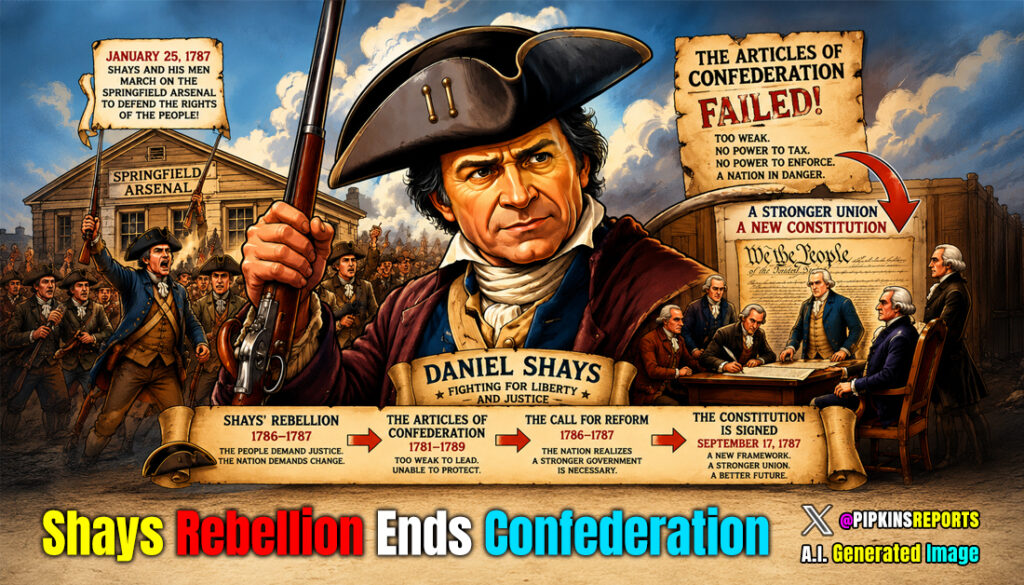
HISTORY – As Americans prepare to celebrate the 250th anniversary of the Declaration of Independence, it’s worth remembering something many school textbooks and social media historians tend to skip these days. The Constitution that hangs behind glass in the Rotunda for the Charters of Freedom, was not America’s first constitution.
It was the second.
Long before James Madison and the delegates gathered in Philadelphia in 1787, the young nation experimented with another system of government, one born amid war, shaped by distrust of centralized authority, and ultimately abandoned when its flaws became impossible to ignore.
On July 4, 1776, the Continental Congress adopted the Declaration of Independence, formally announcing that the Thirteen Colonies of Britain considered themselves free and independent states. Yet true independence would have to be won on the battlefield.
The Revolutionary War had already begun more than a year earlier with the battles of Lexington and Concord in April 1775. For eight years, General George Washington‘s Continental Army fought the British Empire through defeats, shortages, and brutal winters. Victory was never guaranteed. It would end with Britain’s surrender at Yorktown in October 1781, although the war was formally concluded with the Treaty of Paris in September 1783.
However, while the war was still raging, Congress recognized that the new nation, if it were to be successful in its rebellion, needed a framework for government.
Delegates drafted the Articles of Confederation in November 1777. After years of debate among the states, the Articles were finally ratified on March 1, 1781, becoming America’s first constitution.
The Articles established what was essentially a loose alliance of 13 sovereign states. Congress could conduct diplomacy, declare war, and manage western territories, but its powers were intentionally limited. There was no president. No national judiciary. Congress could request money from the states, but had no authority to compel payment or levy taxes.
At the time, the arrangement made sense.
Americans were still fighting for independence, and few had any appetite for creating a strong national government that might resemble the British system they were trying to escape. Nobody wanted to trade George III for another distant authority. So the states retained most of their power, and Congress remained intentionally weak.
But peace exposed weaknesses that war had masked.
States often ignored Congress. They imposed tariffs against one another, printed competing currencies, and frequently refused to contribute money to the national government. War debts mounted. Foreign powers questioned whether the United States could survive as a unified nation. There was no executive branch to enforce laws and no national courts to settle disputes.
Then came Shays’ Rebellion in 1786.
Shays’ Rebellion erupted in western Massachusetts in the fall of 1786, when farmers burdened by debt and heavy taxes faced foreclosures and possible imprisonment. Many were Revolutionary War veterans who believed they had sacrificed for independence only to find themselves losing their farms.
Led by former Continental Army captain Daniel Shays, groups of armed men shut down courts to prevent foreclosures and, in January 1787, attempted to seize the federal arsenal at Springfield. The uprising was ultimately suppressed by a privately funded state militia, but the episode sent shockwaves throughout the country. To many national leaders, the rebellion exposed the inability of the Confederation government to maintain order or provide for the common defense.
The uprising by Massachusetts farmers alarmed George Washington, James Madison, and Alexander Hamilton. Washington even wrote in a letter to Henry Lee that he was, “mortified beyond expression” and worried that Americans were proving incapable of self-government. James Madison viewed the rebellion as proof that excessive democracy and weak national authority endangered republican government, and Alexander Hamilton practically used the rebellion as Exhibit A to propose a stronger central government. It became painfully clear that merely tweaking the Articles would not solve the problem.
So delegates assembled in Philadelphia in May 1787 with the stated purpose of revising the Articles of Confederation. But instead, they scrapped them altogether.
Over the course of four months, the Constitutional Convention produced an entirely new framework. Completed in September 1787, the United States Constitution officially took effect on March 4, 1789. It created three branches of government, gave Congress the power to tax and regulate commerce, and established a system of checks and balances intended to preserve liberty while providing enough national authority to hold the republic together.
Most importantly, the States regained most of their independence. With the Federal Government becoming the arbitrator of conflict between them. Any power not specifically specified as belonging to the federal government is reserved for the States, or the People.
Over the years, many amendments have been made. Perhaps the most disastrous amendment that is still in effect today is the 17th amendment … which stripped away representation by the States, which were so important to our founding fathers.
Opinion
Modern political debates often treat the Constitution as though it sprang into existence fully formed in 1787, but those of us who follow history understand another side of the story.
With the Articles of Confederation, the Founders first tried a decentralized system that left most authority with the States. But they learned through experience that a weak national government could be nearly as dangerous as one that is too strong.
That doesn’t mean they intended to create the sprawling administrative state Americans know today. Far from it. Their goal was balance, national unity without sacrificing liberty, federal authority restrained by checks, balances, and state sovereignty.
As the nation approaches its semiquincentennial (250th anniversary), Americans should remember that the Constitution itself was born from a humble trial and error. The Founders recognized when their first attempt wasn’t working, and had the wisdom to take steps and fix it.
It’s a reminder that self-government requires both principle and the willingness to confront reality when facts demand it.